
Deck failure starts where many DIY decks fail: In the middle of the span. Years later you can be standing on that completed deck and notice that your feet bounces up and down. That’s because the beam sags. The footing looks good; the joists is just fine. But the beam was sized to hope, not physics.
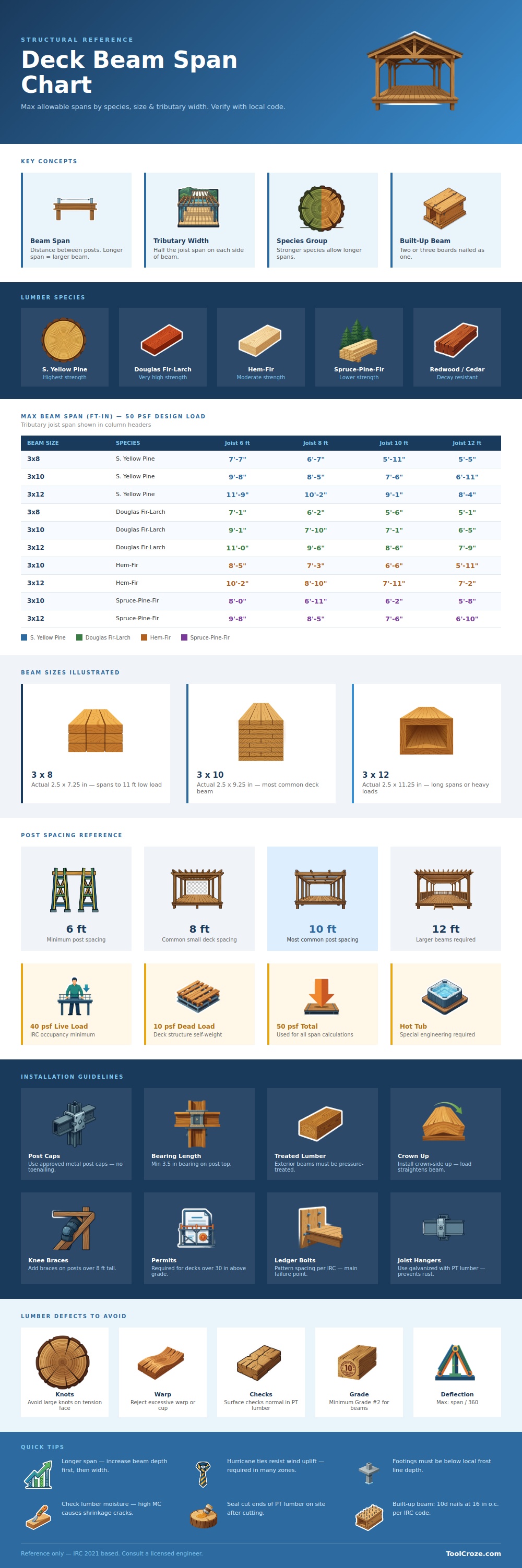
Deck beam spans is more important than choosing decking boards. The beam is the skeleton that holds everything up; the unseen part. Get this wrong and start again. This chart breaks everything down by tributary width, size, and even by species so you don’t have to guess.
How to Choose the Right Deck Beam
Tributary width sounds scary but it’s really just some simple math. Pretend you’re standing on your deck looking down from above. The beam support a load equal to half the span of the joists on one side and half the span on the other side. So if you’ve got 8-foot span joists everywhere, that means there are four feet of load on either side of the beam. An eight-foot tributary width. Look that up in the chart to determine how far apart your posts can be. The math makes sense because it matches how the load distribute.
The chart breaks down wood species into different strengths: Spruce-Pine-Fir and Hem-Fir versus Southern Yellow Pine. The latter is stronger then the former, meaning you can span greater distances with smaller beam size. This is one you’ll want to check on your lumber, but many people fail to realize that the source of lumber matters; just because something is a two-by-ten doesn’t mean it will support as much weight. Not all two-by-tens is created equal. By using stronger types of wood, you can space your posts farther away, saving money on materials and concrete footings.
“People often build their beams out of several boards because you don’t find very long boards.” To make a sturdy beam, you take three two-ten footers and nail them together. “You need to be sure to nail them good so that they aren’t sliding around, but just acting like one board.” This graphic details this process of building up boards for greater depth. And, that’s what really matters (depth to resist bending). Even though there might not be much more wood in the same space, the deeper beam will deflect less due to its depth.
And this is where plans go awry. The math all works out perfectly, except you put the beam up and rest it an inch on the post and expect it to hold. That’s not going to last long. To code, there has to be some minimum amount of bearing (typically about 3.5 inches) so the force is distributed correctly.
Also note: Never toenail wood into wood. Use metal post caps instead. They’re much stronger than wood-to-wood connections, which create weak points prone to splitting under stress. And don’t neglect orientation! Beams always need to be installed with their crown up. Wood wants to curve and when you install it that way, the deck weight will straighten it out in the years to come. If you install it crown down, then gravity will bend it even more until your deck resembles a smiley face.
Rot and humidity are ever-present enemies of durability. Use pressure-treated lumber for any exterior framing, but be careful about making cuts in place because this will expose new untreated wood fibers. Use a protective sealant or stain on these cut ends right away to prolong the lifespan of your frame.
Additionally, look out for big knots on the side of the beam that’s facing tension (typically the lower edge if the beam is being loaded). Knots mess up the grain and act as points of weakness, where snapping can occur at the worst possible moment, when someone or something is suspended above it by 100+ lbs. It is not a huge deal, but it is something to consider when you are dealing with several hundred pounds of humans and furnitures.
Do you need a permit? Before you break ground, check your local codes. Most jurisdictions requires a permit for any deck more than 30 inches off the ground. They will also check to make sure your beams is sized right. Knowing exactly what you’re doing, and having the span checked, will save you from expensive re-work down the road.
Likewise, footings should of extend below the frost line or risk moving in winter, shifting posts and cracking beams. This isn’t just about maintaining floor-levelness; this is about maintaining foundational integrity.
Cost is never the whole story when selecting a beam. You are balancing safety, species and span for a deck that will feel solid in decades to come. And you shouldn’t notice the first bounce. Done right, you won’t even feel it as you walk, leaving nothing but space to enjoy.
