⚡ DC Motor Torque Calculator
Calculate torque from power & speed, current & motor constant, or voltage & back-EMF
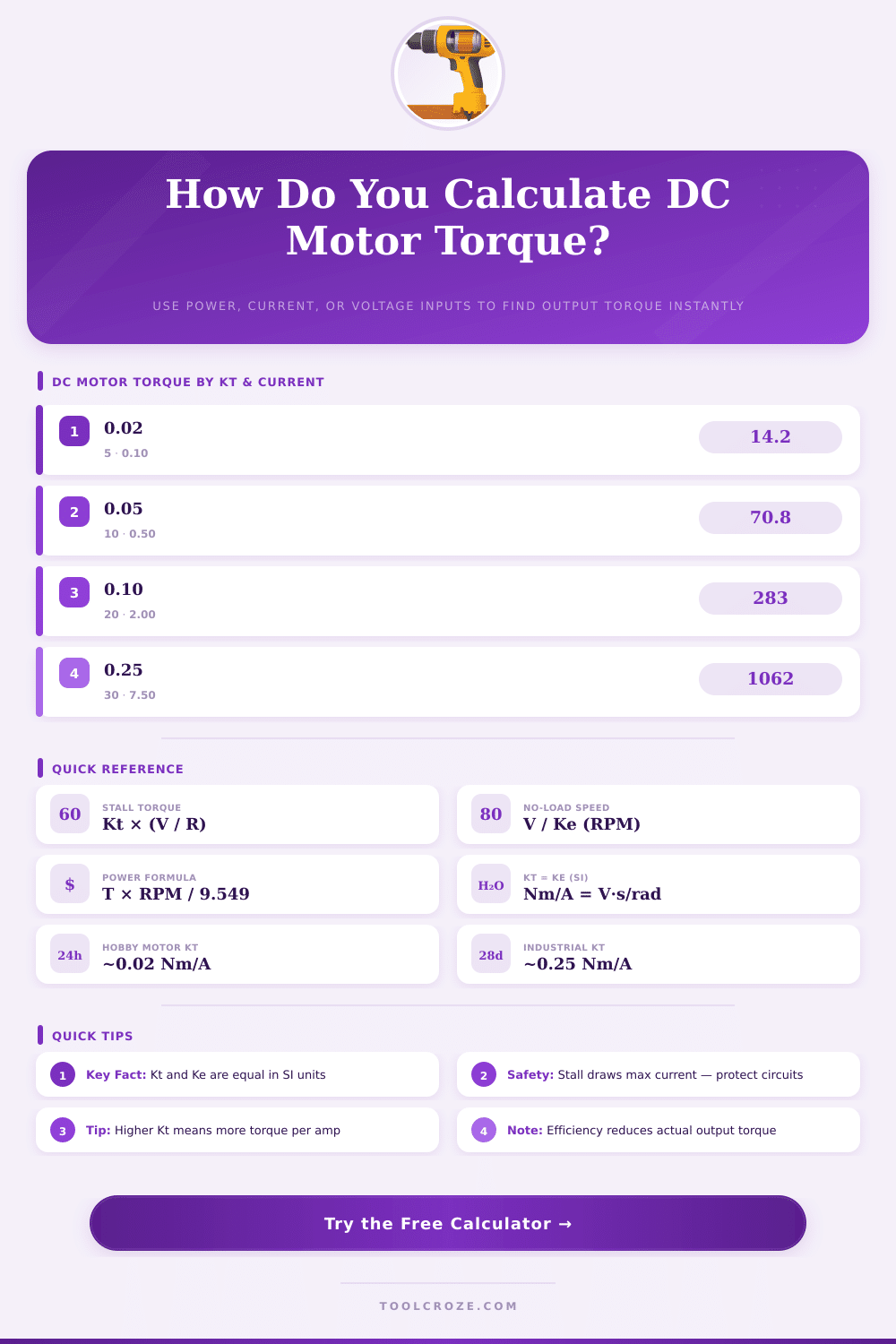
| Kt (Nm/A) | 5 A | 10 A | 20 A | 50 A | 100 A |
|---|---|---|---|---|---|
| 0.02 (Hobby) | 0.10 Nm | 0.20 Nm | 0.40 Nm | 1.00 Nm | 2.00 Nm |
| 0.05 (Starter) | 0.25 Nm | 0.50 Nm | 1.00 Nm | 2.50 Nm | 5.00 Nm |
| 0.10 (Servo) | 0.50 Nm | 1.00 Nm | 2.00 Nm | 5.00 Nm | 10.0 Nm |
| 0.25 (Industrial) | 1.25 Nm | 2.50 Nm | 5.00 Nm | 12.5 Nm | 25.0 Nm |
| 0.50 (EV/Heavy) | 2.50 Nm | 5.00 Nm | 10.0 Nm | 25.0 Nm | 50.0 Nm |
| Operating Point | Speed (% of No-Load) | Torque (% of Stall) | Current (% of Stall) | Efficiency Zone |
|---|---|---|---|---|
| Stall | 0% | 100% | 100% | 0% (overheating risk) |
| Low speed | 20% | 80% | 80% | Low |
| Peak efficiency | 50–70% | 30–50% | 30–50% | Highest |
| High speed | 80% | 20% | 20% | Moderate |
| No-load | 100% | ~0% | ~0% | ~0% (no work) |
| Voltage (V) | Stall Current (A) | Stall Torque (Nm) | Stall Torque (ft-lb) | No-Load RPM (Ke=0.001) |
|---|---|---|---|---|
| 6 V | 12.0 A | 0.60 Nm | 0.44 ft-lb | 6,000 RPM |
| 12 V | 24.0 A | 1.20 Nm | 0.88 ft-lb | 12,000 RPM |
| 18 V | 36.0 A | 1.80 Nm | 1.33 ft-lb | 18,000 RPM |
| 24 V | 48.0 A | 2.40 Nm | 1.77 ft-lb | 24,000 RPM |
| 36 V | 72.0 A | 3.60 Nm | 2.66 ft-lb | 36,000 RPM |
| 48 V | 96.0 A | 4.80 Nm | 3.54 ft-lb | 48,000 RPM |
At the core, a DC Motor converts electrical energy into rotary motion by means of electromagnetic induction. Here is how it works: when current flows through the armature in a magnetic field, the Lorentz force acts on those current-bearing leads. The commutator; that segmented copper ring that you can see inside, reverses the current direction during the rotor twist.
That fast switching ensures that the force that pushes the rotor stays in one permanent rotary direction, without leaving it hesitating.
How a DC Motor Works and Makes Torque
Torque is the basic turning force that pushes objects to rotate (or at least tries to). Think about it as a measure of how hard one can turn something. In a DC Motor it is the rotary force that moves the rotor, so the part that twists.
Every conductor feels a force around its edge, that is the distance from the central axis to the radius of the armature. That creates rotary impact. To count Torque one multiplies the applied force by the perpendicular distance from the line of that force to the rotary axis.
The result measures in newton-metres.
Various industrial fields use different units (kg·cm), lb·ft or Nm, but all they measure the same: how much burden the motor shaft can handle and beat. Look at any curve of DC Motor activity, and you will find Torque on the X-axis. Great is that those units stay same, whether you talk about an electrical motor, a steam turbine or any other energy source.
Here is something that is worth mentioning. In a typical permanent-magnet DC Motor the Torque grows in line with the current, bigger flow, stronger Torque. So the maximum current that the motor can safely receive sets its highest Torque skill.
The relation is simple: more current through the coils gives bigger turning force. The most basic motor drivers work by limiting the voltage that one sends too the motor. Because the coils have internal resistance, lower voltage causes lower current, which naturally limits the Torque that the motor can reach.
RPM usually follows almost the input voltage. During the armature twist, it acts as a generator that produces its own voltage that resists the supply voltage. Hence you will observe that DC Motors deliver bigger Torque during starting than at full speed.
Different motor builds are designed for various needs. Series-wound DC Motors give strong Torque at low speeds, so they are ideal for electrical vehicles and heavy factory work. Series motors start great, while shunt motors better hold speed.
Brushless DC Motors bring bigger efficiency, almost no issue about wear, because here nothing rubs and wears during changing speeds. Both kinds benefit a lot from high gear reduction. It allows the motor to work close to its best efficiency and means that a smaller motor reaches the same Torque output.
Brushless motors in robotic arms commonly use gear ratios well above 100:1. Brushed DC Motors normally need less extreme ratios, because they reach maximum more slowly, but give huge starting Torque.
Permanent-magnet DC Motors in common frame sizes deliver strong starting Torque together with linear traits of speed to Torque. That linear response ensures smooth activity, no dead zone, nosurprise during different input currents and speeds.