⚡ DC Motor HP Calculator
Calculate horsepower, watts, torque, and efficiency for any DC motor application
| Motor Type | Typical Efficiency | Speed Range (RPM) | Typical HP Range | Best Application |
|---|---|---|---|---|
| Permanent Magnet DC | 80–90% | 500–5,000 | 0.01–5 HP | Fans, pumps, small drives |
| Series Wound DC | 75–88% | 1,000–15,000 | 0.1–50 HP | Traction, winches, cranes |
| Shunt Wound DC | 82–92% | 500–3,600 | 0.5–200 HP | Machine tools, conveyors |
| Compound Wound DC | 80–90% | 600–3,000 | 1–100 HP | Elevators, compressors |
| Brushless DC (BLDC) | 85–95% | 1,000–10,000 | 0.01–200 HP | EVs, robotics, HVAC |
| Stepper Motor | 40–70% | 50–2,000 | 0.001–2 HP | CNC, 3D printers, precision |
| HP | Watts (W) | kW | Torque @ 1750 RPM (lb·ft) | Torque @ 3600 RPM (lb·ft) |
|---|---|---|---|---|
| 0.25 HP | 186.4 W | 0.186 kW | 0.75 lb·ft | 0.37 lb·ft |
| 0.5 HP | 373 W | 0.373 kW | 1.50 lb·ft | 0.73 lb·ft |
| 1 HP | 746 W | 0.746 kW | 3.00 lb·ft | 1.46 lb·ft |
| 1.5 HP | 1,119 W | 1.119 kW | 4.50 lb·ft | 2.19 lb·ft |
| 2 HP | 1,492 W | 1.492 kW | 6.00 lb·ft | 2.92 lb·ft |
| 3 HP | 2,238 W | 2.238 kW | 9.00 lb·ft | 4.38 lb·ft |
| 5 HP | 3,730 W | 3.730 kW | 15.01 lb·ft | 7.30 lb·ft |
| 7.5 HP | 5,595 W | 5.595 kW | 22.51 lb·ft | 10.94 lb·ft |
| 10 HP | 7,460 W | 7.460 kW | 30.01 lb·ft | 14.59 lb·ft |
| 20 HP | 14,920 W | 14.92 kW | 60.03 lb·ft | 29.17 lb·ft |
| Application | Voltage (V) | Current (A) | Efficiency | Approx. HP |
|---|---|---|---|---|
| Hobby Fan / Toy | 3–12 V | 0.1–2 A | 55–70% | 0.001–0.02 HP |
| Cordless Drill Motor | 18–20 V | 5–20 A | 70–80% | 0.1–0.3 HP |
| EV Wheel Motor | 48–96 V | 50–200 A | 85–93% | 3–25 HP |
| Treadmill Motor | 90–130 V | 8–20 A | 80–88% | 1–3 HP |
| Conveyor Belt | 24–48 V | 10–30 A | 82–88% | 0.3–2 HP |
| Industrial Machine Tool | 120–240 V | 20–100 A | 88–94% | 3–25 HP |
| CNC Spindle | 48–72 V | 20–60 A | 85–92% | 1.5–5 HP |
| Water Pump | 12–120 V | 5–25 A | 75–85% | 0.05–3 HP |
dc motors work everywhere around us. In drill presses, on treadmills, and also running industrial blenders. When one mentions the power of motors, horsepower (HP) always comes up.
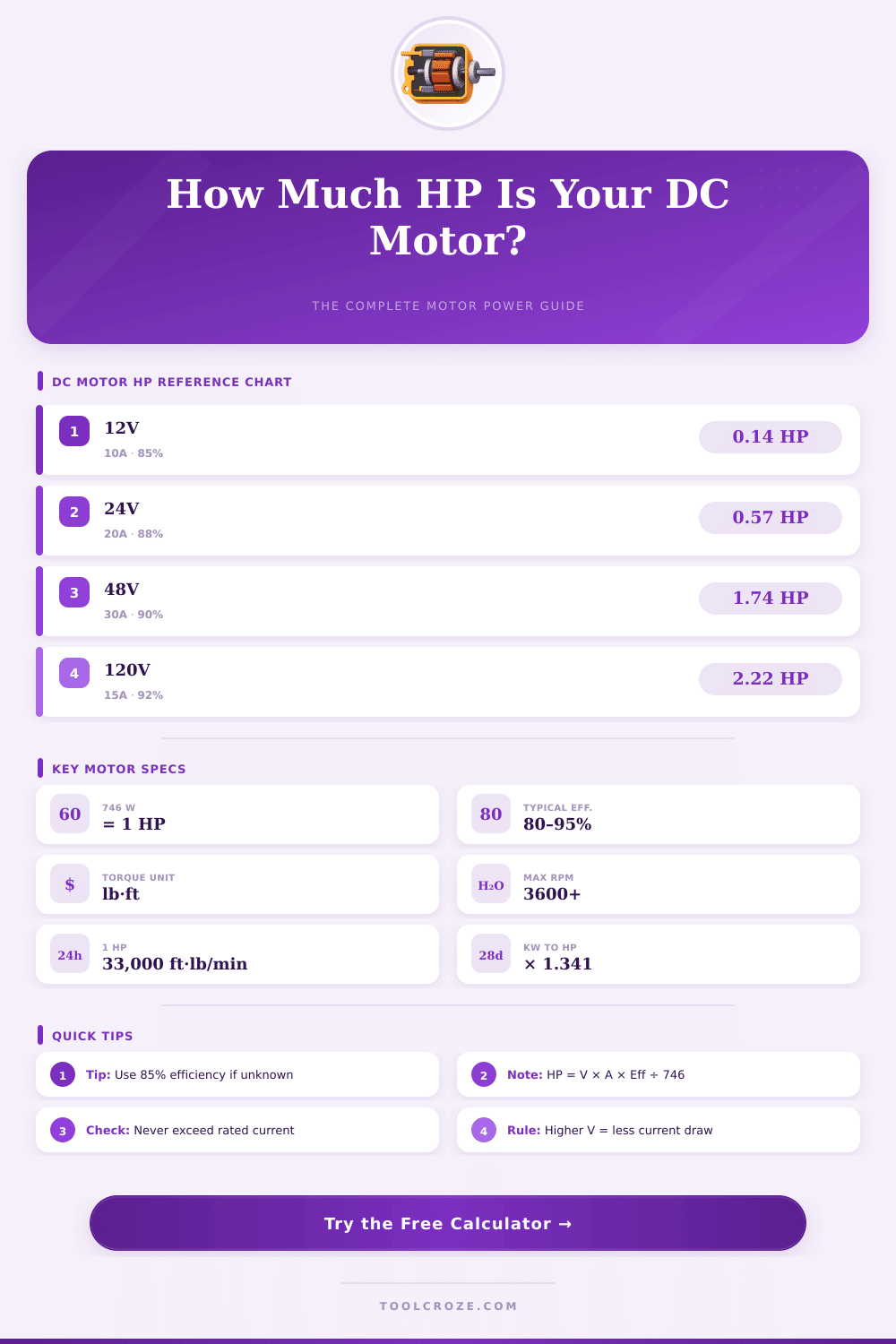
One HP equals 746 watts and that change matters when you try to estimate what motor can really last.
How to Find DC Motor Horsepower
To estimate the horsepower of a dc motor, you need three facts: the voltage, the current, and the efficiency of the motor. The core of the formula for basic power in kilowatts is to multiply the efficiency by the voltage and current, then divide the result by 1000. Well, there are free online calculators that do all that easily…
Simply enter your values, and you get the result in seconds.
The values on the nameplate of a motor show its rated power when it receives the listed supply voltage. But here everything starts getting tricky: losses always step in. As the losses change, the efficiency also changes.
For home use, a small motor commonly reaches between 60% and 80% efficiency. Picture a motor that would need just 932 watts if it were ideal. That would be 1.25 HP…
But in reality you must count about 1300 watts, because the drop in efficeincy pulls everything down.
Motors are rated in kilowatts or horsepower, because they convert electrical energy into mechanical. The load itself is mechanical, not electrical. Hence you sea HP or kW instead of kVA.
Some dc motors come with double ratings that overlap. It is possible to find a nameplate on an industrial motor with 15/20 HP at 1150/2600 RPM. For instance, a certain 7-inch motor, weighing 50 pounds, can produce 45 foot-pounds of torque.
At maximum, it reaches 14.4 HP, while its continuous rating stays at 6.1 HP in the range of 12 to 48 volt DC.
Here is something that commonly surprises folks. A 5 HP dc motor, designed for continuous use, could indeed reach around 50 HP, depending on the voltage and current that you deliver to it. That happens because continuous HP and peak HP are entirely different.
Treadmill motors work the same way. High-end treadmills for gyms are sold by the power that the motor can handle all day continuously, while home treadmills use only the usual DC-HP, because they run only some hours daily.
dc motor units in the range of 1 to 2.75 HP became very popular for home workshop tools. Lathes, drill presses, such devices. They give strong torque at low speeds and let you adjust the speed with proper control.
Permanent magnet dc motors offer a lot of torque, but they do not reach the highest speeds that you find otherwise. Larger dc motors costmore, so some folks choose a VFD with a three-phase AC motor when the budget is tight.