⚡ DC Motor Efficiency Calculator
Calculate efficiency, copper losses, back-EMF, and heat dissipation for brushed, BLDC, and PM DC motors
🔍 Detailed Loss Breakdown
| % Load | Brushed DC Efficiency | BLDC Efficiency | PM DC Efficiency |
|---|---|---|---|
| 25% | 60-70% | 72-82% | 65-75% |
| 50% | 70-78% | 80-88% | 74-82% |
| 75% | 76-83% | 85-93% | 80-88% |
| 100% | 75-85% | 85-95% | 80-90% |
| 125% (overload) | 65-75% | 78-88% | 72-82% |
| Loss Type | Brushed DC | BLDC | PM DC |
|---|---|---|---|
| Copper (I²R) | 50-60% | 30-45% | 45-55% |
| Iron (Core) | 15-25% | 20-35% | 18-28% |
| Mechanical (Friction/Windage) | 10-20% | 10-18% | 12-20% |
| Brush Contact (Brushed only) | 5-10% | N/A | N/A |
| Switching/Controller | N/A | 5-12% | N/A |
| Motor Ke (V/kRPM) | 1000 RPM | 3000 RPM | 6000 RPM | 10000 RPM |
|---|---|---|---|---|
| 1 V/kRPM | 1 V | 3 V | 6 V | 10 V |
| 5 V/kRPM | 5 V | 15 V | 30 V | 50 V |
| 10 V/kRPM | 10 V | 30 V | 60 V | 100 V |
| 20 V/kRPM | 20 V | 60 V | 120 V | 200 V |
| 48 V/kRPM | 48 V | 144 V | 288 V | 480 V |
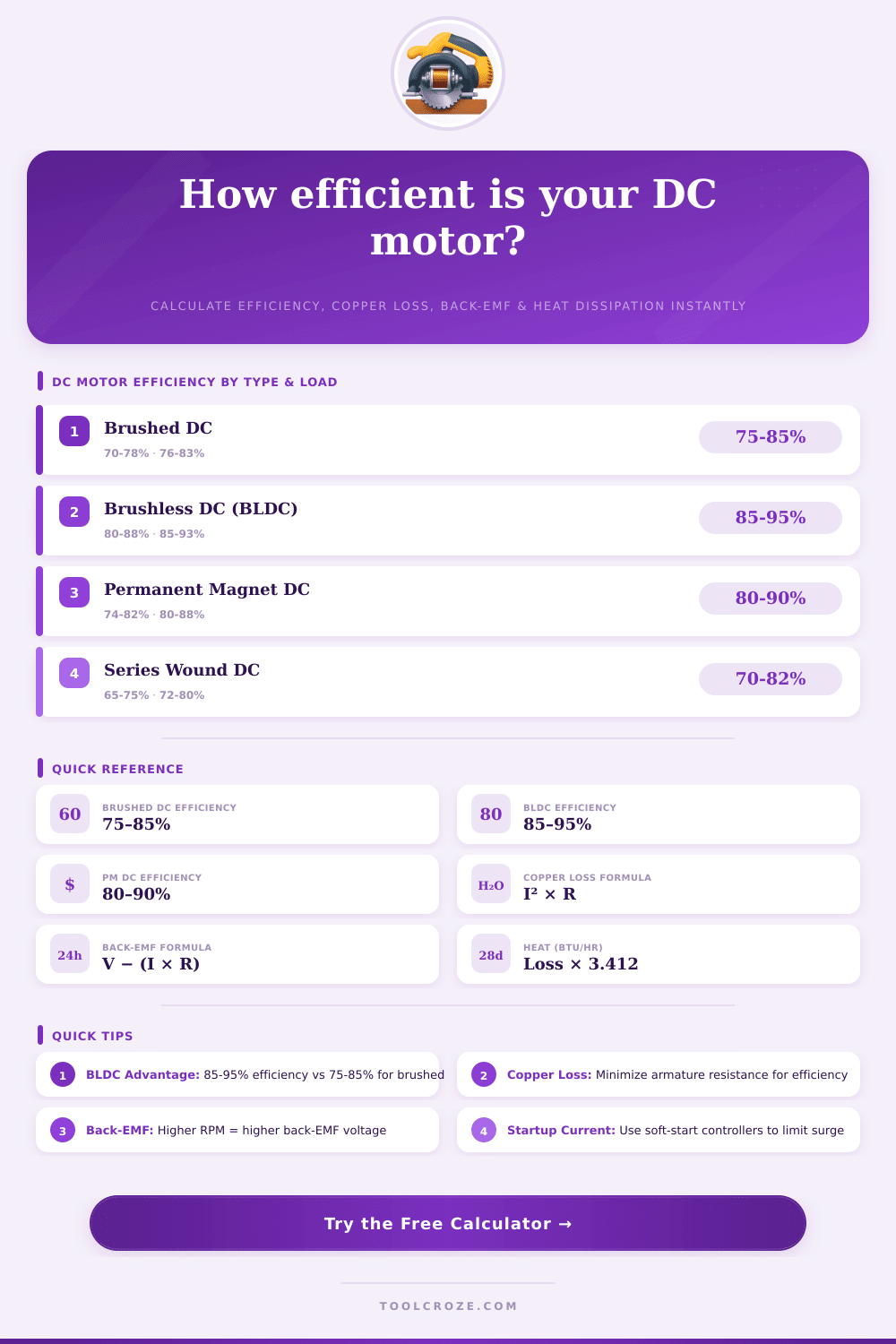
The efficiency of a dc motor is basically about how much entering electrical energy truly exits as usable mechanical force. One defines it as the ratio between output power and input power. For instance if a dc motor receives 100 watts of electricity, but only gives 80 watts of mechanical work, then it operates with 80 percent efficiency.
Typical ranges of efficiency for dc motor units range a lot. Some books point it between 70 and 85 percent, while others mention maybe values as low as 50 to 80 percent. Big machines usually perform more well than small ones.
DC Motor Efficiency: What It Is and What Affects It
A small dc motor in the one-horsepower category reaches around 80 percent. Also heavy service units in the 70-100 watt range can reach around 80 percnet.
However brushless dc motor units form another case. They can produce up to 90 percent of mechanical power from the whole input electrical energy. This beats the brushed dc motor units, that stays at 75 to 80 percent.
Because of their high efficiency, almost every modern device now carries a brushless dc motor. Those use electronic control to turn the current through magnetic field to the rotor, instead of using physical brushes.
Generally higher speeds of dc motor units give better efficiency. That counts for almost all kinds of electrical machines. Dc motor units keep high efficiency through a broad range of speed and torque, because there energy electronics provides the flow exactly where needed, without big extra parts.
A shunt dc motor has two spots, where the efficiency falls to zero. One happens when the speed reaches zero. The second is when the torque becomes zero.
The best efficiency for a dc motor comes at high speeds under lightweight load. It is interesting to think about that.
To reach maximum efficiency in any dc motor, the changing energy losses must match the fixed ones. Among fixed causes are wind drag, bearing drag, brush drag, and lost currents in the core. The whole efficiency is found by adding all those energy losses to the output power, then comparing that with the input.
During running, a dc motor creates opposite voltage called back EMF, that works against the given voltage. That indeed lowers the final voltage and the flow of current. When a dc motor stops and does not move, that back EMF is gone.
Only the resistance of the dc motor windings limits the flow in that situation. The PWM frequency truly does not affect the efficiency, which maybe surprises some. Converting AC power to DC power causes also loss between 5 and 20percent.