
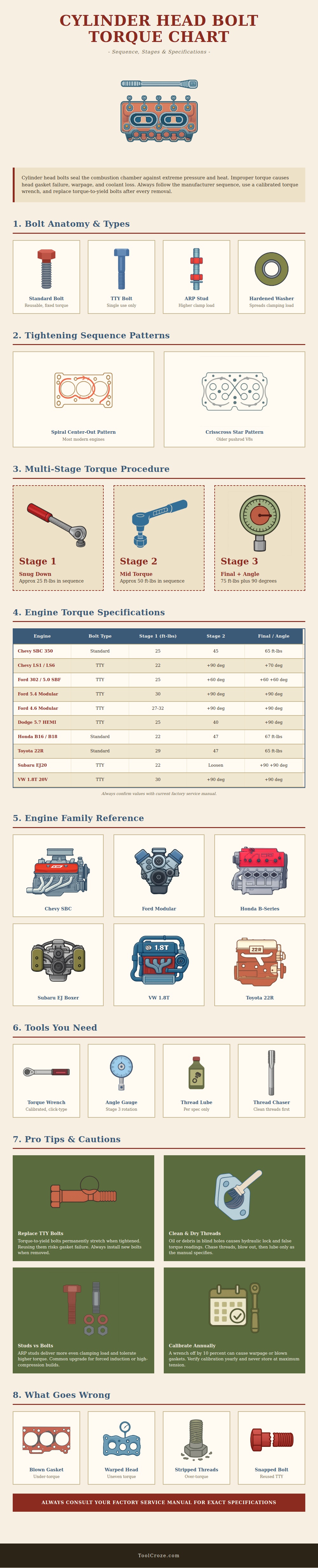
Cylinder head bolts is required to create a seal between the cylinder head, the head gasket, and the engine block. If you dont tighten the cylinder head bolts proper, the cylinder head may warp or the head gasket may fail. Because the cylinder head is exposed to high temperatures and high pressures within the engine, the head bolts must be tightened to specific torque value to ensure that the cylinder head will remain secure.
Different types of cylinder head bolt exist. Each engine have different types of cylinder head bolts that you must identify before the cylinder head bolts are installed. For instance, some engine cylinder heads use standard reusable bolts that the mechanic tighten to a specific number of foot-pounds.
How to Tighten Cylinder Head Bolts Correctly
However, other engine use torque-to-yield bolts that stretch permanent when they are tightened to the specified torque and angle. Since the torque-to-yield bolts has stretched to the proper tension, these bolts should not be reused as they may snap. Additionally, some engines use stud instead of cylinder head bolts.
Since studs tend to offer more even clamping force, they provide a more stable platform for the head bolts to be installed on. The sequence in which the cylinder head bolts is tightened is important to ensure that the cylinder head is even pressed against the engine block. If the bolts are not tightened in the correct sequence, the cylinder head may warp or the head gasket may not create a proper seal.
Many moddern engines has specifications that require the bolts to be tightened in a spiral pattern. Other engines may require the bolts to be tightened in a crisscross pattern. Regardless of which pattern the cylinder head manufacturer require, the bolts should not be tightened in a random order.
The step-by-step process that is used to tighten the cylinder head bolts should be followed. For instance, the bolts may be tightened in three step. In the first step, the bolts are tightened to a lower torque value.
In the second step, the bolts are tightened to a higher torque value. Finally, the engine manufacturer may specify the bolts to be tightened by a specific number of degree. This degree value is often measured by an angle gauge as this gauge will provide the proper measurement of the stretch of the torque-to-yield bolts.
The proper tools must be used to tighten the bolts to the proper torque values. For instance, a calibrated click-type torque wrench will ensure that the bolts are tightened to the proper torque values. A calibrated torque wrench is required to ensure that the torque specification are met because if you dont follow the specification with a non-calibrated wrench, the bolts may be too loose or too tight.
Additionally, an angle gauge may be used if the manufacturer specifies the number of degrees that the bolts should be tightened to. Finally, the bolt hole in the engine block should be clean and dry so that no oil is trapped within the holes. If oil becomes trapped within the bolt holes, it may cause hydraulic lock which can damage the engine block.
If the bolts are under-torqued they will not create proper seal between the cylinder head and the engine block and the head gasket will leak. If the bolts are over-torqued the thread in the engine block may be stripped or the bolts may snap. If the bolts are not tightened according to the proper sequence the cylinder head may warp which will prevent the proper seal of the head gasket.
Thus, to prevent these type of failures, the bolts should be cleaned, properly tightened to the proper sequence, and you should of used a calibrated torque wrench to install the bolts proper.
