⚙️ CVT Belt Length Calculator
Calculate the precise belt length for any CVT system — snowmobiles, ATVs, scooters, and more
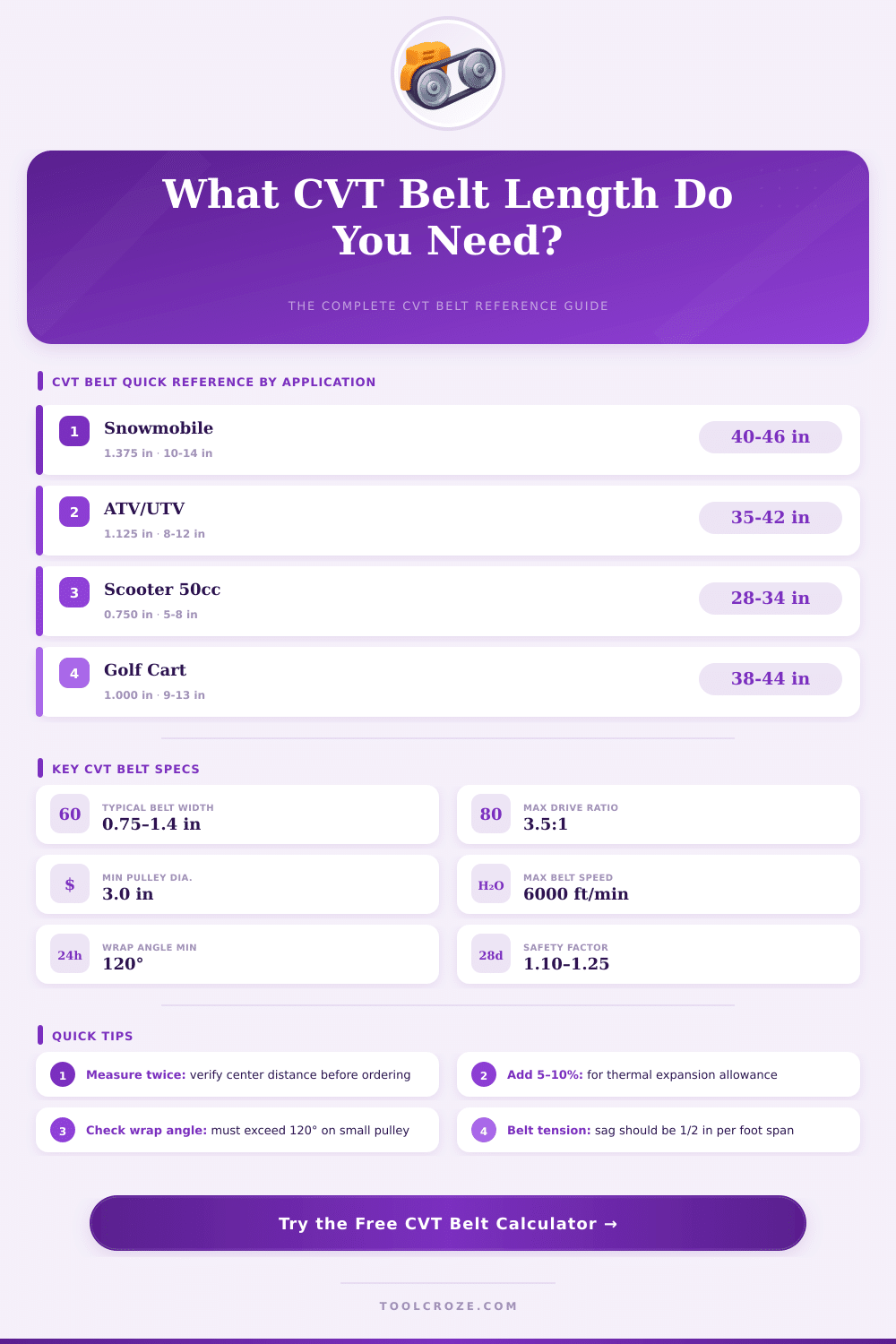
| Application | Drive Dia. | Driven Dia. | Center Dist. | Approx. Belt Length | Belt Width |
|---|---|---|---|---|---|
| Sport Snowmobile | 6.5 in | 13 in | 12 in | ~45.8 in | 1.375 in |
| Utility Snowmobile | 6.0 in | 12 in | 11 in | ~43.1 in | 1.375 in |
| ATV 450cc | 5.5 in | 11 in | 9.5 in | ~38.8 in | 1.125 in |
| UTV / Side-by-Side | 6.0 in | 12 in | 10.5 in | ~41.1 in | 1.375 in |
| Scooter 50cc | 3.5 in | 6.0 in | 6.5 in | ~24.9 in | 0.750 in |
| Scooter 150cc | 4.0 in | 7.5 in | 7.5 in | ~29.6 in | 0.875 in |
| Golf Cart | 5.0 in | 10.0 in | 10.0 in | ~39.3 in | 1.000 in |
| Go-Kart CVT | 3.0 in | 6.0 in | 7.0 in | ~24.1 in | 0.750 in |
| Material | Max Speed (ft/min) | Temp Range | Tension Ratio | Best For | Relative Life |
|---|---|---|---|---|---|
| Rubber V-Belt | 5000–6000 | -30°F to 185°F | 5:1 | General purpose | Baseline |
| Polyurethane | 4500–5500 | -40°F to 200°F | 4:1 | Low-noise, precision | 1.2x |
| Aramid/Kevlar | 7000–8000 | -50°F to 250°F | 3:1 | High-power CVT | 2.0x |
| Steel-Cord | 6000–7000 | -20°F to 220°F | 3.5:1 | Heavy industrial | 2.5x |
| Carbon Fiber | 8000–10000 | -40°F to 280°F | 2.5:1 | High-performance racing | 3.0x |
| Raw Edge Cogged | 5500–6500 | -30°F to 200°F | 4.5:1 | Small pulleys, ATV | 1.5x |
| Drive RPM | Drive Dia. (in) | Driven Dia. (in) | Ratio | Driven RPM | Belt Speed (ft/min) |
|---|---|---|---|---|---|
| 3600 | 4.0 | 8.0 | 2.0:1 | 1800 | 3770 |
| 3600 | 6.0 | 12.0 | 2.0:1 | 1800 | 5655 |
| 5000 | 4.0 | 8.0 | 2.0:1 | 2500 | 5236 |
| 5000 | 5.0 | 10.0 | 2.0:1 | 2500 | 6545 |
| 7000 | 4.0 | 12.0 | 3.0:1 | 2333 | 7330 |
| 8500 | 3.5 | 10.5 | 3.0:1 | 2833 | 7776 |
| 3000 | 6.0 | 18.0 | 3.0:1 | 1000 | 4712 |
For a two-pulley CVT, the ideal center distance is typically 1.5–2.5 times the diameter of the larger pulley. Too short a center distance reduces wrap angle and increases belt wear. Too long increases vibration and whip.
The wrap angle on the smaller pulley must exceed 120° to prevent slippage. If your calculated wrap angle is below 120°, increase the center distance or use an idler pulley. Each 10° of wrap angle below 150° reduces power transmission capacity by approximately 8–12%.
CVT-zones measure by means of three codes, that each points to a part of the zone. Consider sample as 669-18-30. The number 669 show the length of the zone along the course in millimeters.
18 point the width of it, also in millimeters. And 30 describe the angle of the teeth at the inner side. Understanding the meaning of those codes help a lot for choosing the right zone.
CVT Zone Codes and How to Choose the Right One
One commonly finds the sizes 729×17.7×30 at bigger 50cc scooters with long case cover. On the other hand, models with short cases, 10-inch wheels and 8-bolt CVT-covers usually require 669-18-30 zone. Like this the kind of motor case and the size of wheels is useful for estimtaing which zone to use.
During buying of replacement, stay near the original measures: some millimeters for the length, 0.5 mm or less for the width, and most 2 grades for the angle. Suppliers of zones commonly offer ones that look like but do not match exactly to the original. For instance, for original 729-18-30 one could suggest 729-17.7-30, because rubber zones have natural tolerance.
One spot to control is whether a prior owner installed the wrong zone. Make sure to control that the current zone seats well in the CVT, before you use it as base for knew purchase; that is a wise step.
Materials of zones differ between each other. Some use rubber with fiber for support. Basic zones lack fiber, while full EPDM-types with more fibers…
As kevlar mixed in the rubber (turn more rigid). There are also zones for engines up to 800 cc with high changes, done from special rubber resistant to heat. Some brands last more than 6000 miles without cracking, but everything depends on the kind and factory.
CVT-zones work by means of two variable pulleys, that hold the zone. While one pulley shrinks, the second grows. That makes sure that the zone of set length stay in full touch with both.
The zone slides on the sides of the pulleys, not on the bottom. A zone longer than usual can alter the ratios of entry and exit, including the maximum.
Custom engines sometimes end with unusual lengths of zones. For instance, one required exactly 40.25 inches because of change of gear ratio for higher speed. To count zone length, one considers the center distance between pulleys and the outer diameter of the driven pulley.
One method to estimate is measuring the diameters ofpulleys while the zone rests on them, which helps to reach the right value.