Cubic Feet to Yards Conversion Calculator
Convert cubic feet to cubic yards, build dimensions into volume, and estimate adjusted yards, material weight, truck loads, bags, and coverage.
⚙Project Presets
📐Volume Inputs
🧱Material and Spec Grid
📊Reference Tables
| Cubic feet | Cubic yards | With 10% add | 2 ft³ bags |
|---|---|---|---|
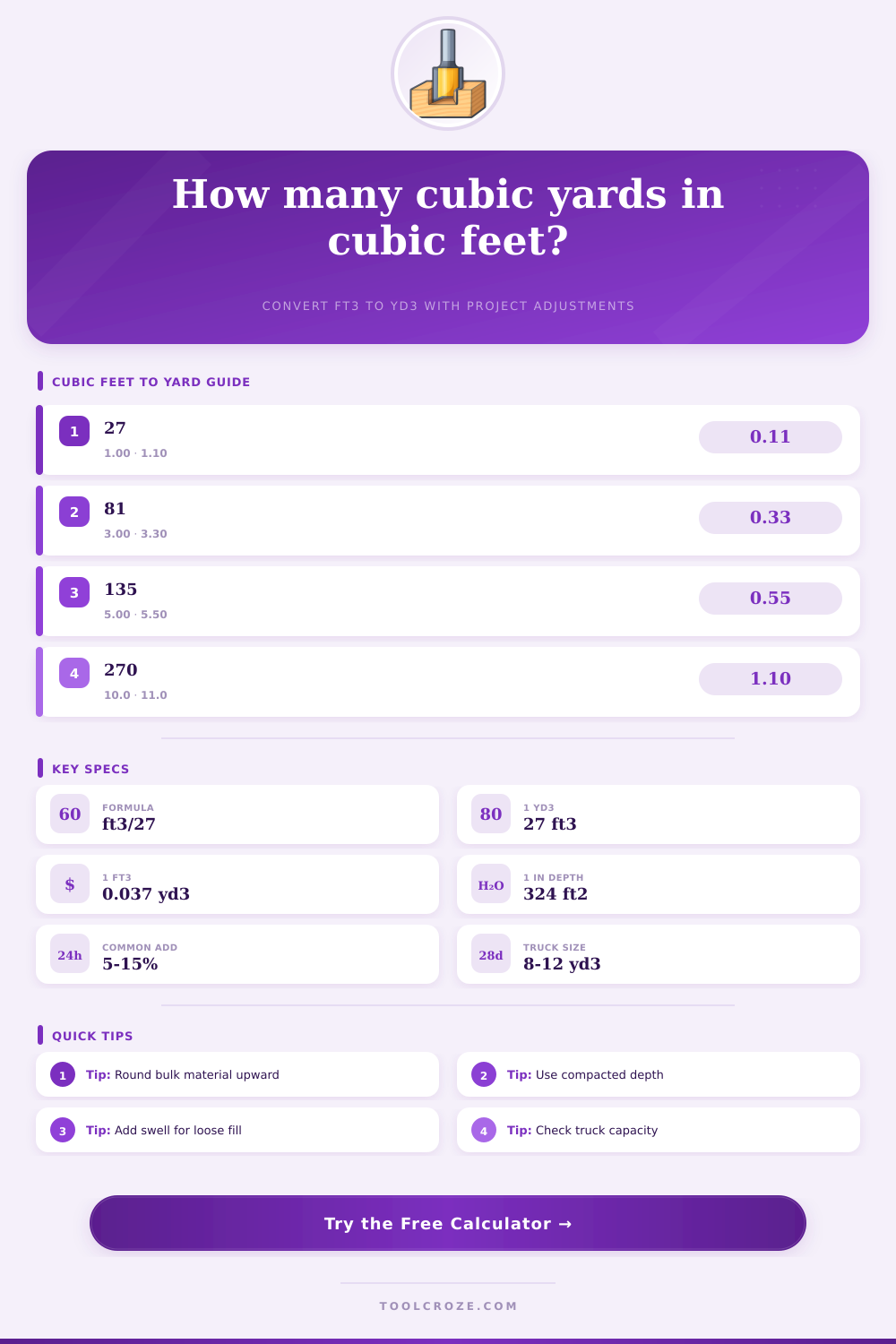
| 27 ft³ | 1.00 yd³ | 1.10 yd³ | 15 bags |
| 54 ft³ | 2.00 yd³ | 2.20 yd³ | 30 bags |
| 81 ft³ | 3.00 yd³ | 3.30 yd³ | 45 bags |
| 135 ft³ | 5.00 yd³ | 5.50 yd³ | 75 bags |
| 270 ft³ | 10.00 yd³ | 11.00 yd³ | 149 bags |
| Material | Typical density | Common depth | Coverage per yd³ |
|---|---|---|---|
| Concrete | 4050 lb/yd³ | 4 to 6 in | 81 ft² at 4 in |
| Mulch | 800 lb/yd³ | 2 to 3 in | 108 ft² at 3 in |
| Topsoil | 2200 lb/yd³ | 2 to 6 in | 162 ft² at 2 in |
| Crushed gravel | 2800 lb/yd³ | 3 to 6 in | 81 ft² at 4 in |
| Sand | 2700 lb/yd³ | 1 to 4 in | 162 ft² at 2 in |
| Project | Typical dimensions | Base volume | Planning note |
|---|---|---|---|
| Small slab | 10 ft x 12 ft x 4 in | 1.48 yd³ | Add for forms and grade |
| Mulch border | 300 ft² x 3 in | 2.78 yd³ | Round to whole yard |
| Drive base | 12 ft x 40 ft x 4 in | 5.93 yd³ | Add compaction allowance |
| Raised bed | 4 ft x 8 ft x 12 in | 1.19 yd³ | Multiply by bed count |
| Round base | 18 ft dia x 2 in | 1.57 yd³ | Use diameter field |
| Hauling reference | Volume | Cubic feet | Best use |
|---|---|---|---|
| Pickup bed | 1 to 2 yd³ | 27 to 54 ft³ | Mulch or light soil |
| Small trailer | 2 to 4 yd³ | 54 to 108 ft³ | Soil and compost |
| Landscape dump | 5 to 7 yd³ | 135 to 189 ft³ | Gravel and fill |
| Concrete truck | 8 to 10 yd³ | 216 to 270 ft³ | Ready-mix pours |
| Large dump truck | 12 to 16 yd³ | 324 to 432 ft³ | Bulk aggregate |
💡Calculation Tips
When shopping for aggregate, the supplier only deals in units of cubic yards, whereas you’re measuring your house in feet because, hey, that’s what a tape measure says. This creates a gap between how suppliers sell material and what your project need. You can fix this by entering your measurements into the calculator to get the right number so you don’t have to worry about rounding error or conversion factors.
The answer is twenty-seven. Why? Because there are three feet on every side of the cube: $3 \times 3 \times 3 = 27$. There are twenty-seven cubic feet in one cubic yard. Cubic feet equal length × width × depth, all in feet. To order cubic yards, divide your total by twenty-seven.
Why You Should Use an Aggregate Calculator
In reality, people don’t remember to turn the depth into feet, so math is messy. Length and width tend to be expressed in feet; depth is usually expressed in inches. If you calculate a space that’s twenty feet long and thirty feet wide, and multiply it by four inches thick before turning the inches into feet, youll overestimate volume by twelve. This means you will waste time carrying out more material than necessary and waste money as well.
But when we are dealing with real world ordering of bulk material, things become less simple: Mulch settles; soil compacts; gravel moves around under the weight of people, tools, and vehicles. So what can you do? To account for all this, the tool allow you to enter an allowance for compaction (usually 5-15% depending on the degree of unevenness in your area) or waste. This represents the difference between loose bulk density and the density of your choice as rolled and/or raked down. Without this allowance, odds are you’ll have to make another pass to top things off. Enter this up front to avoid this additional effort.
What’s heavy? Besides volume, also plan for weight. How many bags do you need to reach your desired volume? It weighs next to nothing. How many do you want to load onto your little trailer or in the back of a pickup truck? Knowing how dense your materials will be helps prevent safety hazard and possible structural damage.
For example, a cubic yard of loose topsoil weigh about half as much as a cubic yard of concrete, which weighs about two tons! The page’s reference section explains those densities and will help you size up what you should haul with what. Even though two loads might appear equal in volume, the heavier stone require sturdier equipment.
Then there’s the added math of bags. Soils in particular can be delivered by the cubic yard in bulk or as 2- or even 3-cubic-foot bags (most landscape fabrics are also in two-bag unit). Converting your needs from bulk cubic yards to bags makes it easier to plan purchases for small-scale job that don’t make sense with a whole-truck load. It will also help show you the savings of purchasing bulk versus each bag: The cost of packing, shipping, and all those handles inflates the price of each bag considerablly.
Before you break out the calculator, consider the shape of what you’re working with. Is it simple? A rectangular slab is easy. You might have an irregular garden bed or a circular patio. You’ll need to split the thing up in easier-to-compute parts or average its diameter(s). For a circle, the interface has you covered: it lets you enter a radius (and uses pi to calculate its base area), then add depth to get volume. You won’t have to guess if that circle fits inside a rectangle after the fact.
Estimating volume well is all about giving the job its due respect. A half-yard discrepancy can appear insignificant in pencil form; but in real life, that’s like taking an extra couple dozen bags, or filling up another truck bed…maybe just halfway full. Do yourself a favor: measure correctly, factor in shrinkage, and know your carrying capacity before committing to anything. It’s basic math with serious weight behind any miscalculation. You should of known this before you start.