Crusher Run Gravel Calculator
Estimate compacted crusher run depth, loose cubic yards, tons, truck loads, bag equivalents, lift count, and waste allowance for driveways, pads, paths, and road bases.
📌Project Presets
⚙Units and Site Dimensions
Full Breakdown
🧱Material and Spec Grid
📊Crusher Run Reference Tables
| Project use | Compacted depth | Recommended lifts | Planning allowance |
|---|---|---|---|
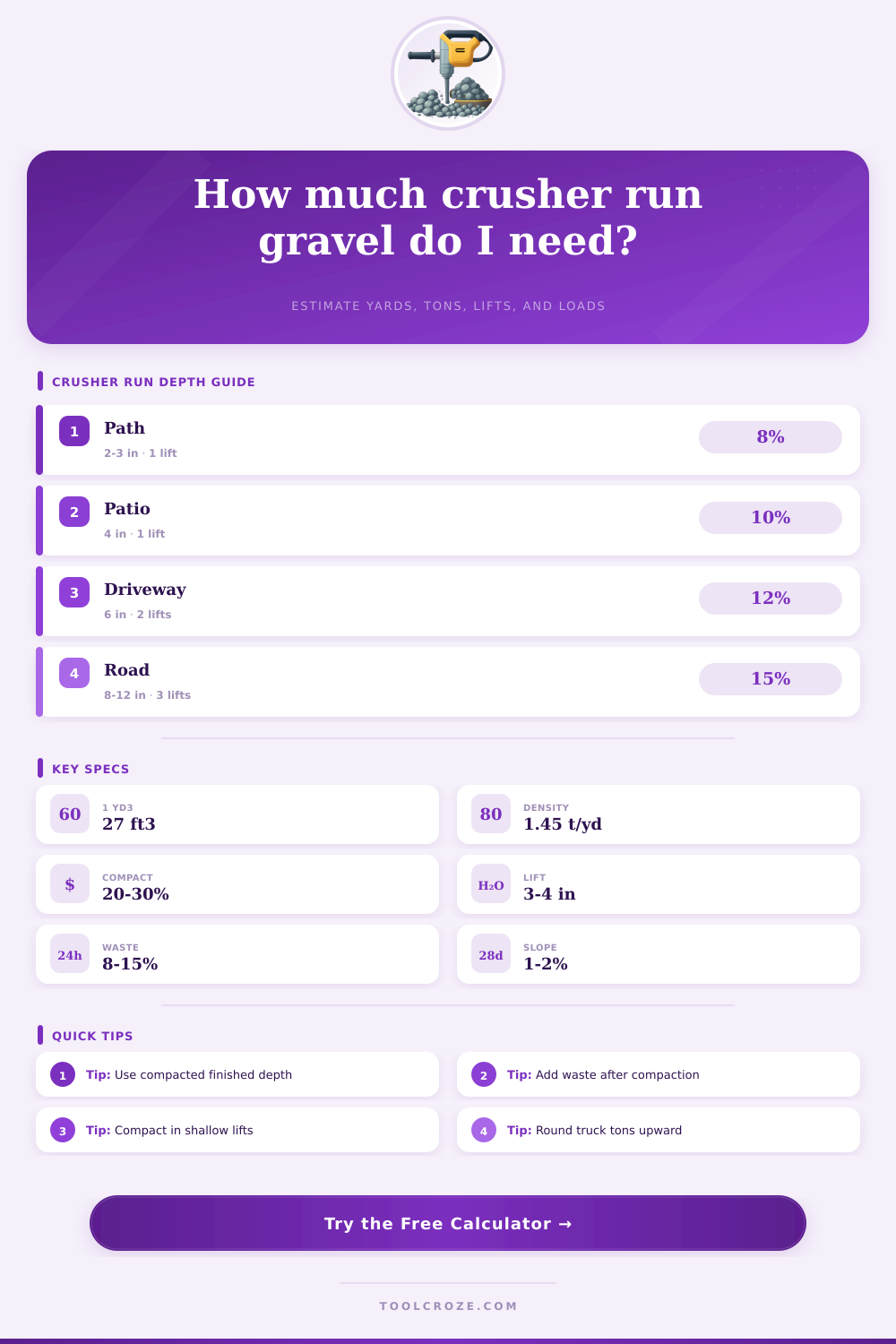
| Garden path or walkway | 2 to 3 in | 1 lift | 8% to 10% waste |
| Paver base over stable soil | 4 in | 1 to 2 lifts | 10% waste |
| Residential driveway | 5 to 6 in | 2 lifts | 12% waste |
| Trailer or RV parking pad | 6 to 8 in | 2 to 3 lifts | 12% to 15% waste |
| Private road or farm lane | 8 to 12 in | 3 to 4 lifts | 15% waste |
| Crusher run type | Typical density | Compaction factor | Best use |
|---|---|---|---|
| Dense grade crusher run | 1.45 tons / yd³ | +20% | General driveway base |
| Limestone crusher run | 1.50 tons / yd³ | +20% | Firm pads and lanes |
| Granite quarry process | 1.55 tons / yd³ | +22% | High traffic road base |
| Recycled concrete crusher run | 1.35 tons / yd³ | +18% | Economical sub-base fill |
| MOT Type 1 sub-base | 1.70 metric t / m³ | +20% | Patios, drives, roads |
| Area size | 4 in compacted | 6 in compacted | 8 in compacted |
|---|---|---|---|
| 100 ft² | 1.5 yd³ loose | 2.2 yd³ loose | 3.0 yd³ loose |
| 250 ft² | 3.7 yd³ loose | 5.6 yd³ loose | 7.4 yd³ loose |
| 500 ft² | 7.4 yd³ loose | 11.1 yd³ loose | 14.8 yd³ loose |
| 1,000 ft² | 14.8 yd³ loose | 22.2 yd³ loose | 29.6 yd³ loose |
| Delivery unit | Typical capacity | Use when | Calculator output |
|---|---|---|---|
| Small pickup | 0.5 to 1 ton | Small patch or short path | Compare with bag count |
| Single axle dump | 5 to 7 tons | Short driveway repair | Loads rounded up |
| Tandem dump | 12 to 16 tons | Driveway or pad base | Default 15 tons |
| Tri-axle dump | 18 to 22 tons | Large lane or road base | Adjust payload field |
💡Calculation Tips
When most people think about gravel they think that it’s just random pieces of rock that you dump and leave. They envision the delivery truck pulling up, dropping off a nice even pile and then walking away knowing that it will support there weight.
The truth is far from this; crusher run is an engineered mixture of angular crushed stone and fines (dust) that is meant to hold together. When compacted it hardens and shrinks into a form similar to pavement. And that’s why calculating how much gravel you’ll require is so important beforehand, not enough and your driveway has dips and humps; too much and you have waste material.
Why Gravel Calculations Are Important
What folks tend to do wrong is they go by just what their target depth will be when completed. So let’s say you need a 6″ deep bed then it’s easy to assume you’ll order that amount of material. That makes no sense because crusher run will compact substantialy.
The calculator considers how much loose material there is compared to the compacted material (loose to compact). This allows it to include extra bulk required to achieve your desired depth after roller compaction (which eliminates the need to guess at stone fines vs. Moisture content).
Total volume is important but so is depth. If you think you can throw down eight inches of rock all at once, think again; there isn’t enough compaction energy to reach that far down. That’s where lift count comes into play.
Spreading three to four inch layers at a time ensures every slice will bind together tight. It’s tedious work, but if you don’t do it, you’ll have soft spots later on. With the tool, you are able to see how many times you need to pass over with your spreader, making big pile into manageable steps instead of an overwhelming task.
Another variable that throws DIYers for a loop is your choice of materials. Every type of crushed rock has a different density (for example, limestone is not the same as granite, which differ from recycled concrete). Because they are not all created equal, denser materials weighs more by the cubic yard. This totally alters math on what will fit into a truck. For example, you may be able to fit ten yards of light aggregate in the truck, but only seven yards of heavy granite. If you don’t get this right, you’ll either have under-delivery issues or be charged extra. The reference tables shows how the type of stone changes the tonnage needed even when yardage stays the same.
The area of optimism meets gravity: waste allowance. Reality says no driveway is perfectly square. The edges feather out into the lawn, and certain sections are lower than others and require more fill. Spreading some rock will roll some off. There’s always a percentage for waste that accounts for all this inevitability. On the one hand, it seems like padding the bill, but on the other hand it’s payment for reality. Without the cushion, your corners might not get finished, or worse yet, you’ll make emergency runs to the supplier.
It’s more behavioral than complex geometry. You are building a structure to hold up your weight while letting water through. Filling in a hole isn’t enough. You’re creating a structure with layers. Then you remove the arithmetic from calculations so you can concentrate on actualy doing the work physically.
Measure correctly, do some planning for how things will be lifted, account for shrinkage due to compaction, and order a little bit more then what you feel like you’ll need. You should of ordered based off these numbers. It will all come together and form something sturdy.
That’s the point of this exercise, solid footing under your feet, not a stack of rocks in your backyard.