👑 Crown Molding Spring Angle Calculator
Set crown molding miter, bevel, and blade settings for inside or outside corners with a layout that stays practical on the saw.
✨Spring Angle Presets
⚙Calculator Inputs
📖Reference Tables
🛠Spring Reference and Saw Guide
✅Practical Tips
⚠Safety Note
The spring angle are the angle that crown molding makes against a wall when the crown molding is install. The spring angle is important in that the spring angle will determine the angles that must be set on an miter saw to cut the crown molding. If the spring angle isnt measured correct, the corners of the crown molding may have gap in them or the corners may overlap on each other.
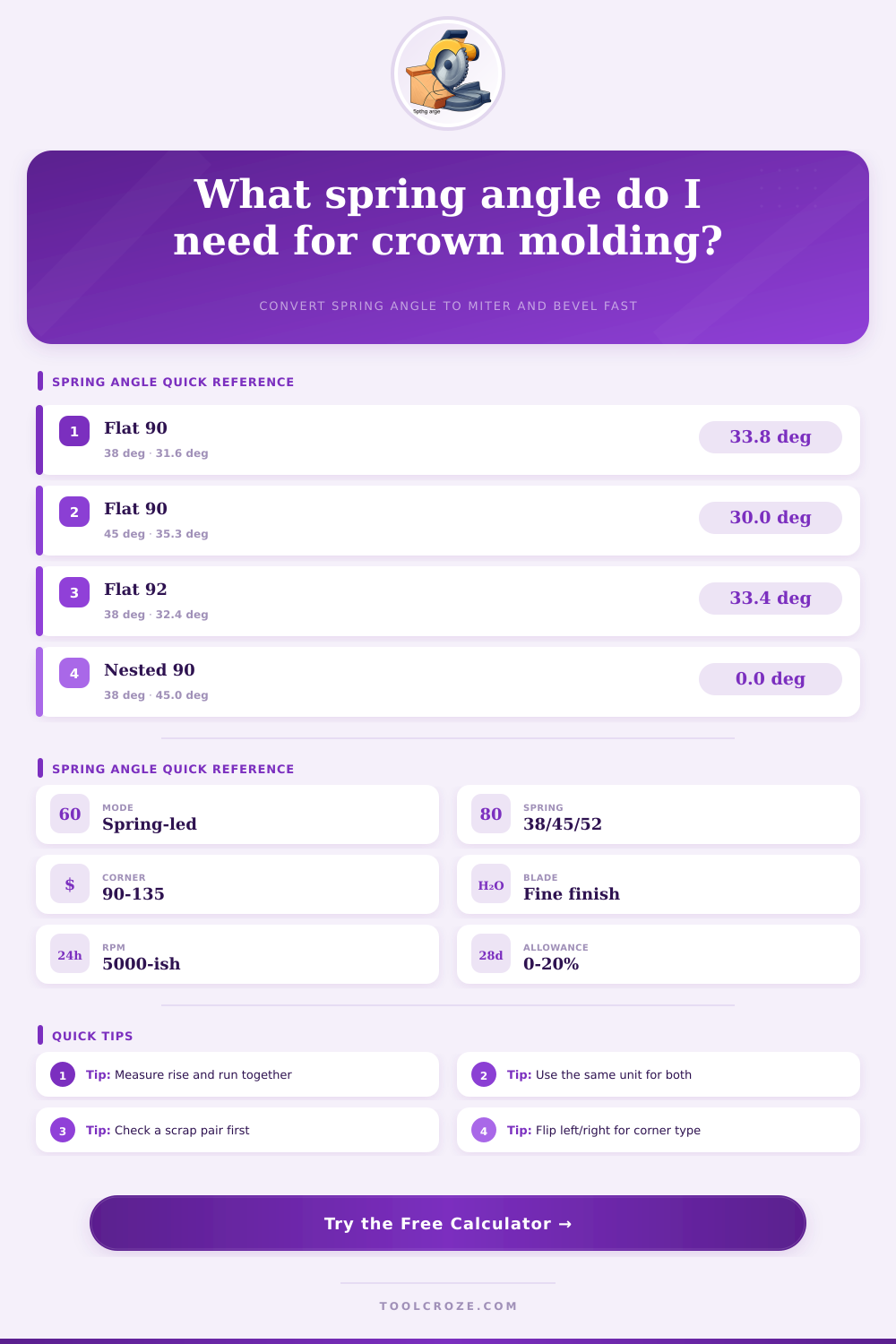
The spring angle is usually between 35 and 55 degree, but the spring angle may change based off the specific type of crown molding that is to be install. The spring angle can be found by measuring both the rise and the run of the crown molding. The rise is the vertical measurement from the wall to the molding and the run is the horizontal measurement from the ceiling to the molding.
How to Measure Spring Angle and Cut Crown Molding
Divide the rise by the run and calculate the arctangent of the number found. Since each piece of crown molding may have a different rise and run measurement, these measurement must be taken for each piece of crown molding that is to be cut. Not all walls in a house are construct to be more perfectly square to each other, so you should measure the spring angle for every room that is to be accented with crown molding.
There are two main ways to cut crown molding with a miter saw; flat cutting and nested cutting. When cutting crown molding with flat cutting, the crown molding is place flat against the saw fence and both a miter angle and a bevel angle must be set on the saw. For nested cutting, the crown molding is standing upright against the saw fence so that it is at the same angle as it would be against the wall, and the nested cutting method allow for the saw to have a zero degree bevel setting.
Flat cutting may be preferred for deep crown because of the precision that can be obtained with this saw adjustment method, but many individuals think nested cutting to be more easier method since the bevel setting for the saw is zero degree. The material of the crown molding will impact how the saw is to be use. For instance, if the molding is made of pine, which is a relatively soft wood, a 60-tooth saw blade can be used to cut the molding.
However, if the molding is made of red oak, which is a denser wood than pine, you should use a saw blade with 80 to 100 teeth to avoid burning the red oak. Finally, if the molding is made of plastic, such as PVC trim, the saw should be set to a lower RPM to the saw to avoid melting the plastic trim pieces. Before cutting the crown molding that is to be install in the room, test the saw settings on scrap pieces of crown molding.
Any small error in the angle settings of the saw will create a gap in the corner of the crown molding. Additionally, as the corners of the walls are not exactly 90 degree, it is important to use a digital protractor to measure the corners of the walls. If the angles are not 90 degree, a 45 degree cut on the miter saw will not result in a proper joint between the corner edges of the crown molding.
Finally, it is also important to use one of the cutting methods for the entire room so that the joints between the crown molding are the same. To calculate the amount of crown molding to purchase, the length of the wall must be calculated as well as the spring angle. The length of the wall must be added to the length of the wall as calculated using the spring angle.
Furthermore, additional length must be purchased to account for the kerf loss of the saw blade. Adding an additional 10 percent of length to the total length of the wall will provide for errors in cutting the crown molding. Additionally, if not enough molding is purchase, it will be necesary to splice the crown molding pieces together which isnt the preferred method for installing crown molding.