🔧 Torque Offset Calculator
Correct torque wrench settings for crowfoot, flare nut, and offset adapters, then compare angle effect, handle force, and estimated clamp load before final tightening.
📌 Preset Torque Jobs
⚙ Offset Inputs
🎯 Torque Results
📊 Fastener Grade Comparison
📋 Reference Tables
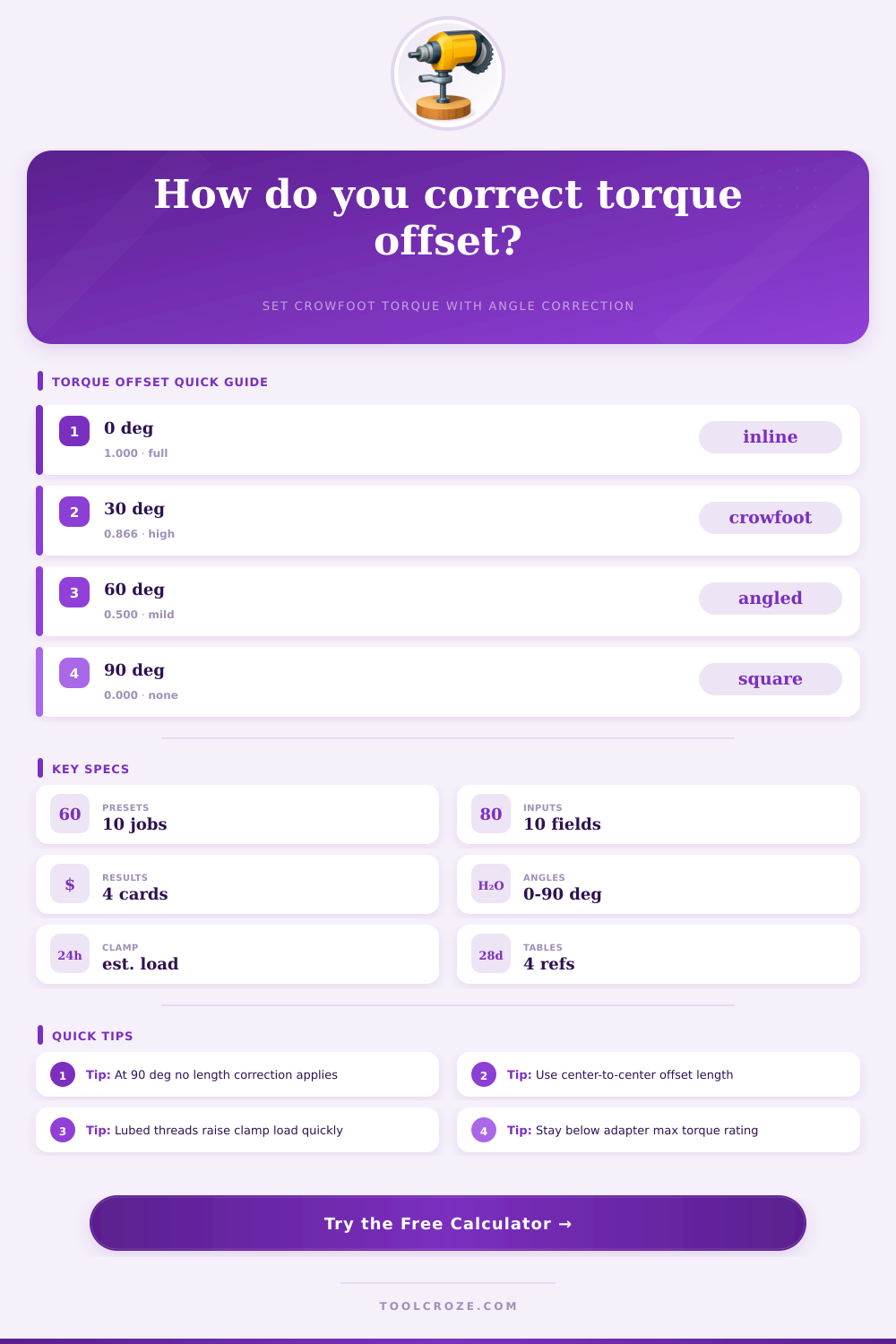
| Angle | Cosine | 0.25 x L effect | Setting trend |
|---|---|---|---|
| 0 deg | 1.000 | Full offset | Largest reduction |
| 30 deg | 0.866 | Strong effect | Noticeable reduction |
| 45 deg | 0.707 | Moderate effect | Mid-range correction |
| 60 deg | 0.500 | Half effect | Small reduction |
| 75 deg | 0.259 | Light effect | Minor correction |
| 90 deg | 0.000 | No effect | Dial equals target |
| Thread condition | Nut factor K | Clamp trend | Typical use |
|---|---|---|---|
| Dry steel | 0.20 | Baseline | General hardware |
| Oiled steel | 0.17 | +18% preload | Assembly oil |
| Zinc flake | 0.16 | +25% preload | Coated bolts |
| Nickel anti-seize | 0.15 | +33% preload | Hot joints |
| Moly lube | 0.13 | +54% preload | Stud tensioning |
| Stainless dry | 0.22 | -9% preload | Anti-gall care |
| Diameter | Stress area | Common pitch | Torque region |
|---|---|---|---|
| 3/8 in | 0.0775 in2 | 24 TPI | 20-45 lb-ft |
| 1/2 in | 0.1419 in2 | 13 TPI | 55-110 lb-ft |
| M10 | 58.0 mm2 | 1.5 mm | 35-70 N-m |
| M12 | 84.3 mm2 | 1.75 mm | 70-140 N-m |
| M16 | 157 mm2 | 2.0 mm | 170-310 N-m |
| M20 | 245 mm2 | 2.5 mm | 300-580 N-m |
| Adapter style | Best angle | Strength | Watch for |
|---|---|---|---|
| Inline crowfoot | 0 deg | Access in-line fittings | Largest setting correction |
| Angled crowfoot | 30-60 deg | Clear nearby hoses | Cosine changes every setup |
| Flare nut foot | 15-45 deg | Line nut engagement | Thin head torque limits |
| Offset box head | 0-30 deg | Stud clearance | Head flex under high load |
| Square-drive head | 90 deg | No length correction | Reaction arm positioning |
🗃 Material and Spec Comparison Grid
SAE Grade 5
SAE Grade 8
ISO 10.9
A4-80 Stainless
💡 Practical Notes
This calculator corrects torque wrench settings for offset adapters and estimates preload from fastener size, grade, and lubrication so you can tighten fittings and bolts with fewer torque-setting mistakes.
When you use a torque wrench with an offset adapter, such as a crowfoot wrench or a flare nut adapter, the torque that the tool measures change. A torque wrench measure the amount of force being apply to the fastener based on the distance between the handle of the wrench and the center of the drive of the fastener. By using an offset adapter, the distance between the handle of the wrench and the fastener are changed, which alter the amount of torque that is delivered to the fastener.
If you dont take this offset into account when tightening a fastener with a torque wrench, the fastener may be under-torqued. Under-torquing the fastener in instances such as hydraulic or brake line can lead to the development of leak in those lines. The length of the wrench is the distance between the point at which force is applied to the fastener and the fastener’s axis.
How an Offset Adapter Changes Torque
By using an offset adapter, the length of the wrench are increased. A longer wrench will apply more torque to the fastener. The angle of the offset also has an impact on the torque that is applied.
The effective length of the wrench can be calculated by multiply the length of the wrench and the offset of the adapter by the cosine of the angle between those two lengths. The target torque that should be applied to the fastener can be found by dividing the product of the desired torque of the fastener and the length of the wrench by this effective length. Using an adapter that is at a 90-degree angle will produce a cosine value of zero, which indicate that the offset length will have no impact upon the length of the wrench.
Torque is used to create the clamp load that is required to hold the joint together. Torque itself does not clamp the joint; instead, it overcome the friction between the threads of the joint that must be removed in order for the fastener to clamp the joint. The force created by the fastener is known as the preload.
The relationship between the torque that is applied to a fastener and the preload that is created by the fastener is represented by the nut factor (the letter K in the equation for the torque). The nut factor change based upon the degree of lubrication of the threads. For dry threads, such as those made of steel, the nut factor is 0.20.
For lubricated threads, such as those that are oiled prior to tightening, the nut factor is 0.15. Because the nut factor is lower for lubricated threads, the preload will be higher for fasteners with lubricated threads than dry thread. Applying lubrication to dry fasteners will, therefore, increase the preload in those joints; too high of a preload may stretch or even break the fastener.
The grade of the fastener will impact the preload that the fastener can create. Fasteners of Grade 8 can handle more preload than fasteners of Grade 5, for instance. Thus, the Grade 8 fastener can apply a higher percentage of its strength to the joint than the Grade 5 fastener.
Because materials have inherent strength, each fastener will have a different fastener grade. Care must be taken when using fasteners of lower strength; for instance, if utilizing a fastener made of stainless steel. Care must also be taken when measuring the offset of the adapter.
It is possible that many adapters will be measured from the wrong point on the tool. For example, the offset should be measured from the center of the drive of the wrench to the center of the axis of the fastener. Measuring from the edge of the tool from the center of the fastener will produce an incorrect reading of the offset of the tool.
Additionally, the angle of the offset of the adapter should also be taken into account. If the angle is too large, the adapter may become bound or slip in relation to the fastener. For these reason, it is best to use an offset adapter with an angle less than 60 degree.
Actually, when your working with these tools, its important to be careful. You should of checked the offset carefully. Many people finds that they make mistakes based off teh wrong measurements.
It can be alot of work to ensure the torque is correct, but you cant afford to be wrong with brake lines. The accuracy of the tool is more important then the quality of the wrench itself. Its a moddern problem where people dont take the time to measure correctly.
If you dont measure the offset correctly, the reading is wrong. This can be problematic for a mechanic. If the length is changed, the results changes too.
Most people isnt aware of how much the angle matters. Youll need to be precise to recieve the correct results.