🔧 Crow Foot Torque Calculator
Correct your torque wrench setting for crow foot extension length, working angle, lubricant condition, and wrench accuracy before tightening flare nuts, injector lines, brake fittings, and hydraulic adapters.
📌 Preset Jobs
⚙ Calculator Setup
🎯 Results
📊 Specification Grid
📑 Reference Tables
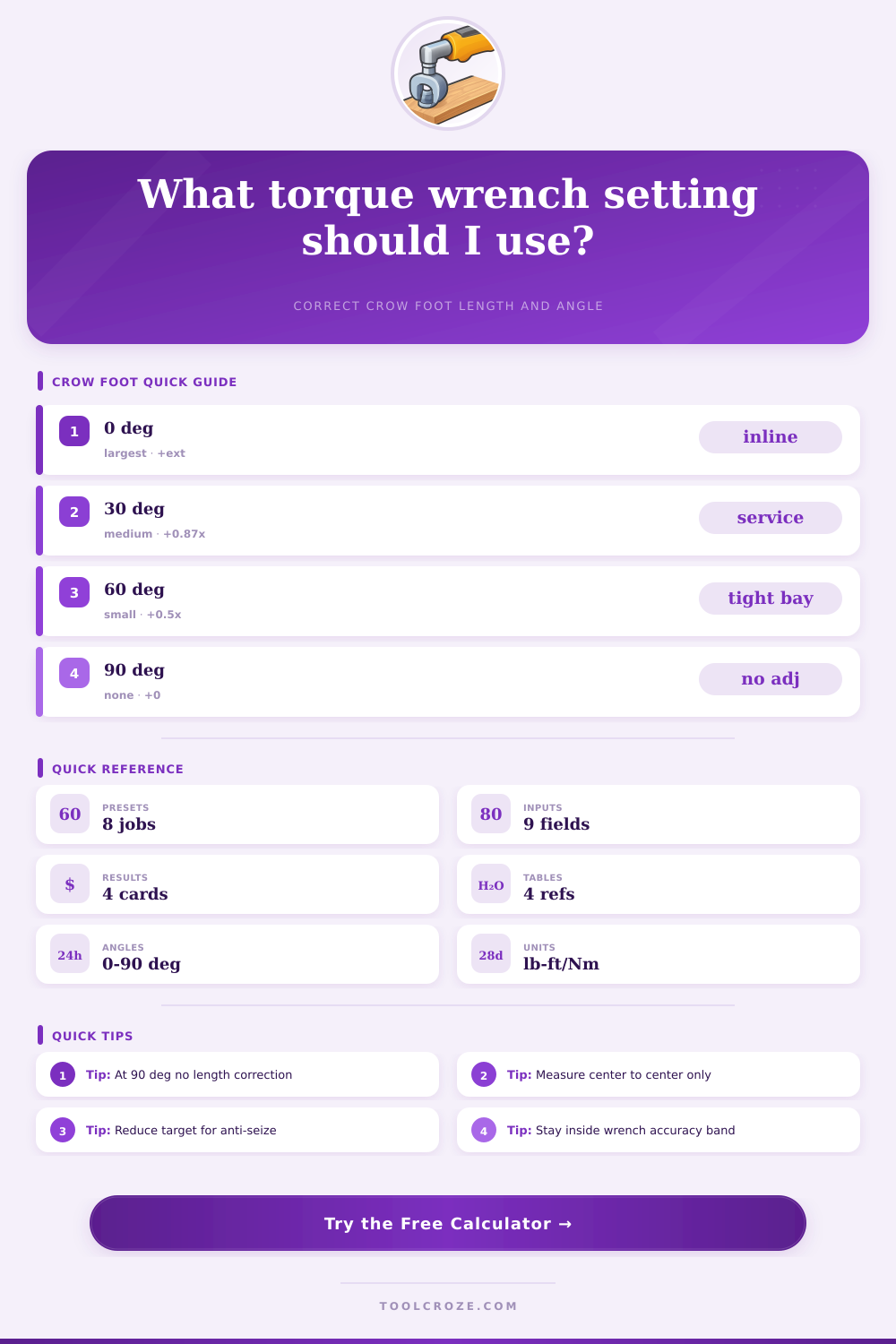
| Angle | Cos Factor | Added Length | Practical Effect |
|---|---|---|---|
| 0 deg | 1.000 | 100% of E | Largest reduction to wrench setting |
| 30 deg | 0.866 | 86.6% of E | Useful when tubes block a straight pull |
| 60 deg | 0.500 | 50% of E | Smaller correction in tight engine bays |
| 90 deg | 0.000 | 0% of E | No length correction if held true |
| Lubrication | Factor | Torque Effect | Typical Service |
|---|---|---|---|
| Dry plated | 1.00 | Baseline spec torque | Factory dry fittings |
| Engine oil | 0.92 | About 8% lower target | Threaded adapters and banjos |
| Hydraulic oil | 0.95 | Mild torque reduction | JIC and ORFS service |
| Anti-seize | 0.85 | Strong reduction needed | Hot exhaust or corrosive duty |
| Spec | Typical Torque | Common Crow Foot | Drive |
|---|---|---|---|
| M10 banjo | 22–26 lb-ft | 14 mm | 3/8 in |
| M14 flare nut | 28–35 lb-ft | 17 mm | 3/8 in |
| -8 JIC | 27–34 lb-ft | 3/4 in | 3/8 in |
| -10 JIC | 44–53 lb-ft | 7/8 in | 1/2 in |
| Preset Job | Angle | Extension | Adjustment Note |
|---|---|---|---|
| Injector line union | 30 deg | 50 mm | Small but real setting drop |
| Brake banjo bolt | 90 deg | 38 mm | Usually no length correction |
| Hydraulic JIC nut | 0 deg | 57 mm | Inline extension matters most |
| A/C liquid line | 60 deg | 44 mm | Half-length effect from angle |
💡 Torque Tips
This calculator adjusts torque wrench settings for crow foot length, angle, lubrication, and accuracy so you can tighten fittings closer to specification without guessing in cramped service positions.
When you use a crowfoot adapter with a torque wrench, you change the lever of the torque wrench. The crowfoot adapter will change the measurement of the torque wrench because the crowfoot adapter will increase the distance between the torque wrench’s pivot point and the fasteners. If you dont adjust the torque wrench settings when you use a crowfoot adapter, then the torque that is applied to the fastener will not match the setting on the torque wrench.
The physics of torque are the measurement of how much force is applied to a machine multiplied by the distance that that force is from the pivot point of that machine. If you place a crowfoot adapter onto a torque wrench, then the crowfoot adapter will act as an extension of the torque wrench. If the crowfoot adapter is positioned at zero degree from the wrench (in other words), if the crowfoot adapter is in line with the torque wrench, then the length of the crowfoot adapter will be added to the length of the torque wrench.
Using a Crowfoot Adapter with a Torque Wrench
Thus, the torque wrench will click before the desired torque is applied to the fastener. To compensate for this, you should of increase the torque wrench setting. If you hold the crowfoot adapter at a certain angle to the torque wrench, then the cosine of the angle of the crowfoot adapter will reduce the length of the crowfoot adapter that is added to the torque wrench.
If you hold the crowfoot adapter at 90 degrees to the torque wrench, the crowfoot adapter will not add any length to the torque wrench. Thus, the torque wrench will display the correct reading without any mathematical adjustment. If you lubricate the component that are to be tightened with the torque wrench with a lubricant, the torque that is required to create the desired clamp load will change.
If you lubricate the components with engine oil or hydraulic fluid, the friction between the components will be reduced. Thus, you will have to reduce the torque wrench setting to account for the decreased friction between the components. If the components are lubricated with anti-seize lubricant, the friction between the components will be reduced even more than with engine oil.
Thus, the torque wrench setting will have to be reduced even more further to avoid over-tightening the components. Over-tightening the fastener can crush soft materials like aluminum or damage the flare face of a fitting. To ensure that the torque applied to the fastener is accurate, you must measure the length of the crowfoot adapter correct.
The length of the crowfoot adapter is not the distance from one jaw tip to the other jaw tip on the crowfoot adapter. The length of the crowfoot adapter is the distance from the center of the square drive of the crowfoot adapter to the centerline of the fasteners hex. If you measure the length of the crowfoot adapter incorrectly, you will apply the wrong amount of torque to the fastener.
In addition to measuring the crowfoot adapter correctly, you must also make sure that you identify the calibrated pivot point of the torque wrench. The torque wrench is calibrated from the pivot point, not from the end of the handle of the torque wrench. Another source of error are if the person is not maintaining the proper angle with the crowfoot adapter.
If the person is trying to set the crowfoot adapter to a specific angle, such as 60 degrees from the fastener, but the crowfoot adapter wobbles or does not maintain that angle, then the length of the crowfoot adapter will change. Because the length of the crowfoot adapter change, the torque applied to the fastener will change. To avoid these type of errors, always attempt to use the perpendicular angle of 90 degrees between the crowfoot adapter and the fastener whenever the work area permits the use of a 90-degree angle.
The type of torque wrench that you use will also affect the accuracy of the torque that you apply to the fastener. Click-type torque wrenches are the most accurate when in the middle third of the calibrated torque wrench setting. The accuracy of the torque wrench decreases if you use it at the very bottom or very top of the calibrated torque wrench setting.
Swivel heads on the torque wrench can also decrease the accuracy of the torque wrench reading. This is due to the fact that the swivel head may flex when applying torque to the fastener. To ensure that a fastener installation is successful, perform the steps described below.
First, calculate the effective length of the crowfoot adapter. The effective length is based off the angle of the crowfoot adapter. Second, adjust the torque wrench setting to account for the length of the crowfoot adapter.
Third, adjust the torque wrench setting for the lubrication of the fastener. Some lubrication may reduce the amount of torque that must be applied to the fastener. Finally, tighten the fastener until the torque wrench click, but also ensure that you snug the fastener into place by feel before using the torque wrench to tighten the fastener to the calibrated torque setting.
It is also important to recieve the proper training for moddern tools. Youll find that many people finds this task difficult if they dont have the right experence. Alot of people uses the wrong tool.