🏗 Corner Stair Stringer Calculator
Turn lower and upper flight dimensions into code-aware riser counts, tread depth, stringer angle, blank length, and turn layout needs before you cut.
| Rise | Tread | 2R+T | Status |
|---|
| Type | Total rise | Steps | Angle |
|---|
| Item | Formula | Use | Check |
|---|
When building stairs in a corner, its essential to calculate the measurement for the lower flight, the landing, and the upper flight. Building a corner staircase is more complex than building a staircase in a straight line because building stairs in a corner require a landing. The landing will take up space in the run of the stairs.
Additionally, the lower and upper flights has to be built to accommodate the size of the landing. If the landing is too shallow, there will be an awkward overhang on the upper stringer. However, if the landing is too deep, the stairs will take up too much space in the floor.
How to Measure and Build Corner Stairs
Furthermore, risers has to be equal on the lower and upper stair flights to prevent someone walking on the stairs from tripping. A person has to determine the total rise and total run of the stairs before construction begins. If the rise of the stairs is 63 inches, for instance, divide that value into several risers.
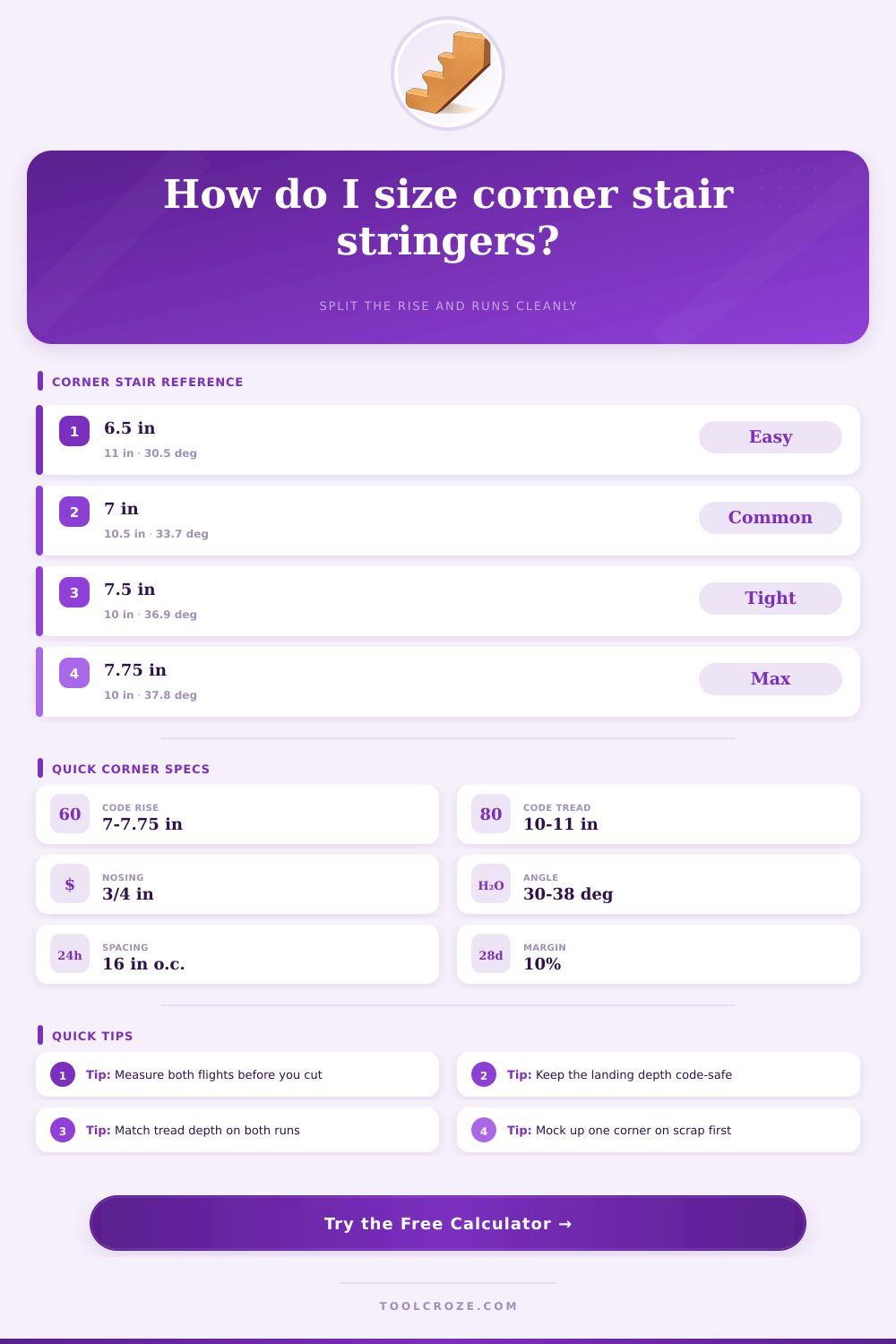
Risers should be between 6.5 and 7.25 inches tall. The tread depth should be between 10 and 11 inches deep. Additionally, you should construct the staircase so that the stairs are between 30 and 38 degrees in angle.
If the stairs are too steep, the leg of the individuals walking on the stairs will fatigue easy. The stringer determine the slope that the stairs will follow. Furthermore, the lower and upper stringers may not have the same angle if the length of the flights differ.
When purchasing the lumber for the stringers, add six to eight inches to the length of each stringer. This allowance will allow for saw kerf when cutting the lumber to the size of the stringers. You may use two-by-ten lumber for the stringers.
However, if the stairs will be steeper or travel a more further distance, use two-by-twelve lumber. There are specific rule for staircases that must be followed to ensure that the construction of stairs will be both safe and pass inspection. One rule is the two-riser-plus-tread rule.
This rule states that the height of two risers and one tread must not exceed 25-1/2 inches. If the height of these component of the stairs is equal to or greater than 25-1/2 inches, the stairs will fail inspection. Additionally, the angle of the stairs should be between 25 and 42 degrees so that individuals walking on the stairs will have traction.
Furthermore, the spacing of the stringers must be correct. For instance, stringers should be 16 inches on center. Before installing the stairs, test each stringer to see if the riser and tread are plumb and level.
The depth of the tread for the lower and upper stairs should be equal. If the depth of the treads are of different measurement, an individual may trip when transitioning from one flight of stairs to another. If constructing the stairs as winers stairs, the inner treads of the stairs will be narrower than the outer treads.
When constructing the stairs, include a safety margin in the measurements. For example, using a 10 percent margin could add to the total measurements required for the stairs. Use kiln-dried lumber for the stairs as opposed to green lumber.
Kiln-dried lumber will not twist and will not shrink over time. Also, make sure that the measurement of the header match the measurements of the stairs as determined from actual measurements of the headers. If only the initial measurements are taken, the floor may settle and the stairs may be of the incorrect size.
Additionally, if the corner stairs create a left turn in the stairway, the upper staircase flights will be constructed to move in a clockwise direction. In contrast, a right turn will require that the upper flight of stairs curve in a counter-clockwise direction. Another aspect of constructing corner stairs is the landing.
The width of the opening that must be framed for the stairs will depend on the size of the landing and the width of the stairs themselves. The opening must be wide enough to allow the landing and stairs to fit into the space. If the opening is too small for both the stairs and the landing, the joists will have to be recut to create the appropriate space for the stairs to be constructed.
Furthermore, you must measure the measurements for each flight of stairs twice to ensure that the measurements are accurate. Then, split the measurements in half to determine the size of each flight of stairs.