Corner Cabinet Calculator | Cut List Planner
Estimate corner cabinet sheets, fronts, shelves, and waste so you can plan a cleaner cut list before the first panel is broken down.
🛠Preset Corner Layouts
⚙Corner Cabinet Inputs
📊Results
Calculation breakdown
🧰Material / Spec Grid
📑Corner Cabinet Reference Tables
| Corner cabinet style | Depth | Default shelves | Notes |
|---|---|---|---|
| Base | 23 1/4 in | 1 | Toe kick base |
| Wall | 12 in | 1 | Upper box |
| Tall | 24 in | 4 | Full height |
| Pantry | 24 in | 5 | Large storage |
| Sheet size | Area | Common use | Buy note |
|---|---|---|---|
| 4 x 8 ft | 32 sq ft | Base boxes | Most shops |
| 4 x 10 ft | 40 sq ft | Tall carcases | Fewer seams |
| 1220 x 2440 | 2.98 m2 | Metric builds | Cabinet core |
| 1250 x 2500 | 3.13 m2 | Deep panels | Extra margin |
| Part | Formula | Allowance | Note |
|---|---|---|---|
| Sides | 2 x H x D | Plus waste | Main structure |
| Top and bottom | 2 x (W - 2T) x D | Kerf reserve | Cabinet core |
| Shelves | S x (W - 2T) x D | Edge trim | Fixed shelves |
| Back | W x H | Fit tolerance | Panel or HDF |
| Allowance | Waste | Extra area | Use |
|---|---|---|---|
| Light | 6% | Small jobs | Simple cuts |
| Normal | 10% | General use | Most cabinets |
| Heavy | 15% | Mixed grain | Pantry jobs |
| Custom | 20% | Complex sets | Corner builds |
💡Practical Corner Tips
⚠Safety Note
Corner cabinets is used to occupy the space where two kitchen walls meets. Since the intersection of two walls create the corner, many people feels that the corner cabinet can be used to utilize that space within the kitchen that might otherwise be wasted. However, corner cabinets require precise measurement of the space to be occupied by the cabinet to avoid potential problems with the doors to the cabinet or the depth of the shelving within the cabinet.
For instance, if the cook measured the depth of the corner cabinet incorrect, the doors to the cabinet may not clear the countertop within the kitchen. Furthermore, if the depth of the shelves within the cabinet are measured incorrectly, the interior of the cabinet may not be usable for the placement of kitchen item. In most kitchen, the cabinets will be at least 24 inches deep along each of the walls that form the corner of the kitchen.
How to Measure and Install Corner Cabinets
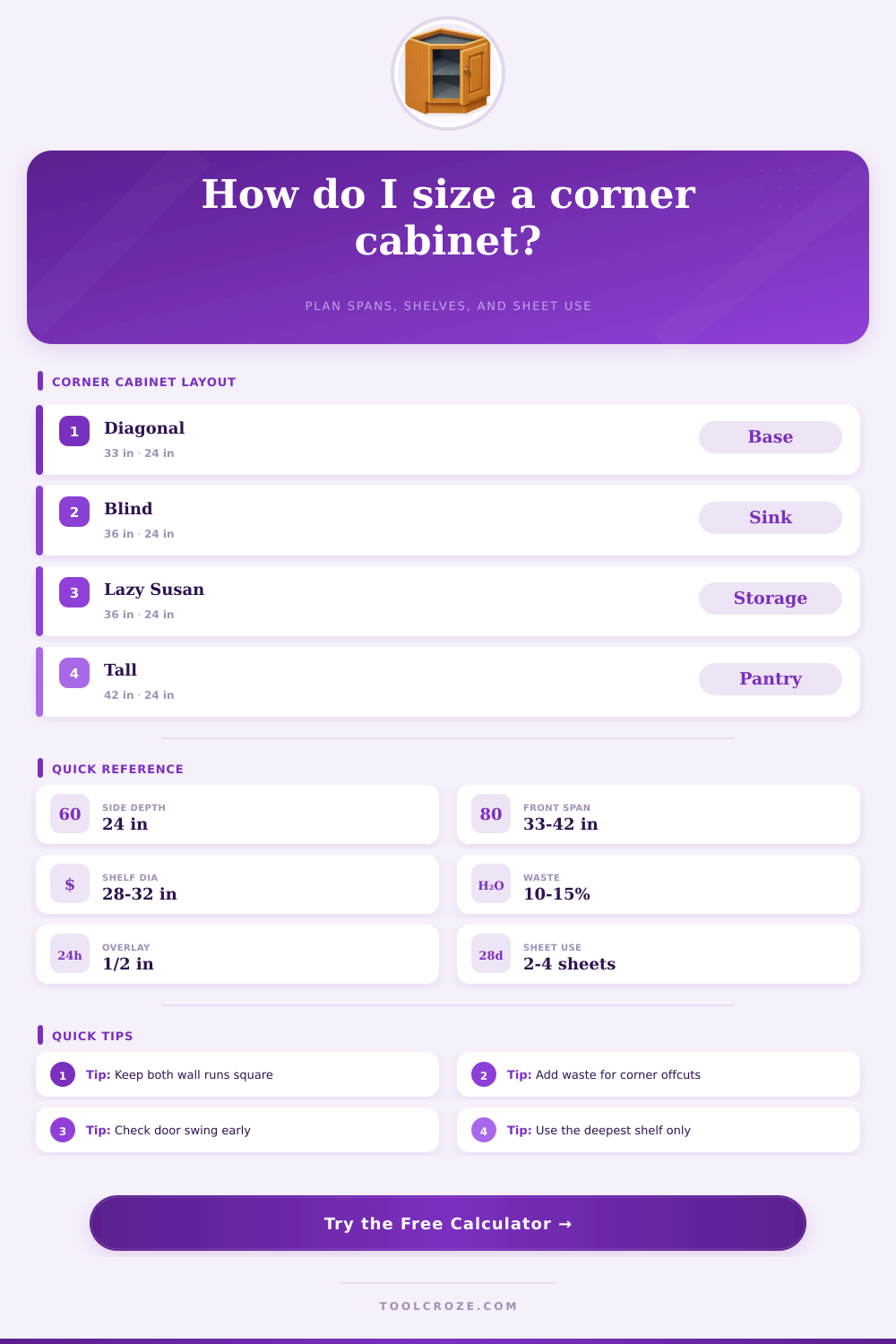
The depth of the front of the corner cabinet can be either 33 inches deep for a corner cabinet with a diagonal (non-flat) front face, or 42 inches deep for a corner cabinet that incorporate a “pie-cut” style front face. Because corner cabinets are typically placed in a corner of the kitchen, the corner of the kitchen is often a difficult area to reach into the cabinet to retrieve items that is placed in the back of the cabinet. To solve this problem, some kitchens may employ “blind” corner cabinets that include an access panel to allow access to the deep interior of the cabinet.
Additionally, some kitchens may use corner cabinets that incorporate Lazy Susans to allow easy access to the items within the cabinet. However, the Lazy Susans that may be included within the corner cabinets will be limited to Lazy Susans with diameters of 28 to 32 inches in diameter to allow for the Lazy Susans to rotate within the cabinet without impact the walls of the cabinet itself. The walls of the kitchen should be square to allow for the proper placement of the corner cabinet.
If the walls are not square, it will be necessary to trim the side panels of the cabinet or the toe kick of the cabinet to allow the corner cabinet to fit into the kitchen. The dimensions of the cabinet that should be measured to ensure that the cabinet will have the proper dimensions are the finished dimensions of the cabinet box. For example, most standard base cabinet are 34.5 inches in height and 23.25 inches deep.
Pantry cabinets may be up to 84 inches in height. If building fixed shelves within the corner cabinet, the width of the shelves is the opening width of the cabinet minus twice the thickness of the cabinet carcass. Since corner cabinets are typically built with odd angles, some waste of the material will be created during the building of the corner cabinet.
The type of material that is utilized for the construction of the corner cabinets will impact both the durability of the cabinets and the weight of the cabinets. For instance, Baltic birch is a type of material that is stiff which makes it less likely to sag within the cabinets. Thus, Baltic birch may be a good material to use for the shelves within corner cabinets.
Cabinet plywood is another material that may be used to construct corner cabinets; it is a material that provides a good balance between cost and weight. Medium density fiberboard (MDF) is another possible material for the cabinets; it is a smooth material that is typically used to paint the cabinets. However, MDF is heavier than plywood.
Particleboard is another material that may be used to construct corner cabinets. However, since particleboard may swell if the kitchen is often humid, particleboard is a more low-cost material may be used for the construction of the cabinets. Additionally, another consideration regarding the type of material that may be used to construct the corner cabinets is the density of the material.
For instance, if a face frame is to be incorporated into the corner cabinet, hardwood stiles and rails may be used. However, if a frameless “Euro” style cabinet is to be built, fewer panel of wood will be used overall. In addition to the considerations of the size and dimensions of corner cabinets, the amount of material that will be wasted during the construction process should be considered when planning the corner cabinets.
For instance, there will always be waste of the material when cutting the wood; 10 to 15 percent of the material may be lost due to the kerf of the saw, defects in the wood, and waste of the corners of the boards of wood. Standard sheet goods typically come in sizes of 4 by 8 feet in each sheet of wood, which is 32 square feet of wood of the same type. To determine the amount of wood that will be required to build the corner cabinets, multiply the height and depth of each of the side panels of the cabinet, the width and depth of the top and bottom panels of the cabinet, and the width and depth of each of the shelves within the cabinet.
Because corner cabinets are often constructed of odd angles, an additional 28 percent of the total amount of wood should be allowed for waste created due to the angles of the corner cabinets. Some mistakes that may be made in the installation and design of corner cabinets include the choice of the hinge for the doors to the corner cabinets. For instance, the manufacturer may make the hinge to swing in the wrong direction for the layout of the cabinets.
Additionally, another potential mistake is the depth of the shelves that are provided within the corner cabinets. For instance, if the shelves are too deep, it may be difficult to access the items that are placed within the back of the corner cabinet. The depth of the doors to the corner cabinets can be checked to ensure that the doors do not impact the countertop within the kitchen; the depth of the doors should be measured to ensure that the doors do not extend beyond the countertop by an amount of, for instance, a half-inch.
In addition to ensuring that the doors do not impact the countertops, another consideration for the installation of upper corner cabinets is the shallow depth of the upper cabinets; if the depth of the cabinets are too deep, it is possible for individuals to hit their forehead against the countertop. Finally, the cabinet box into which the shelves will be mounted should be square; otherwise, the doors will not align properly to the cabinet box.