⚡ Copper Wire Gauge Calculator
Calculate AWG wire size, ampacity, resistance, and voltage drop for any electrical run
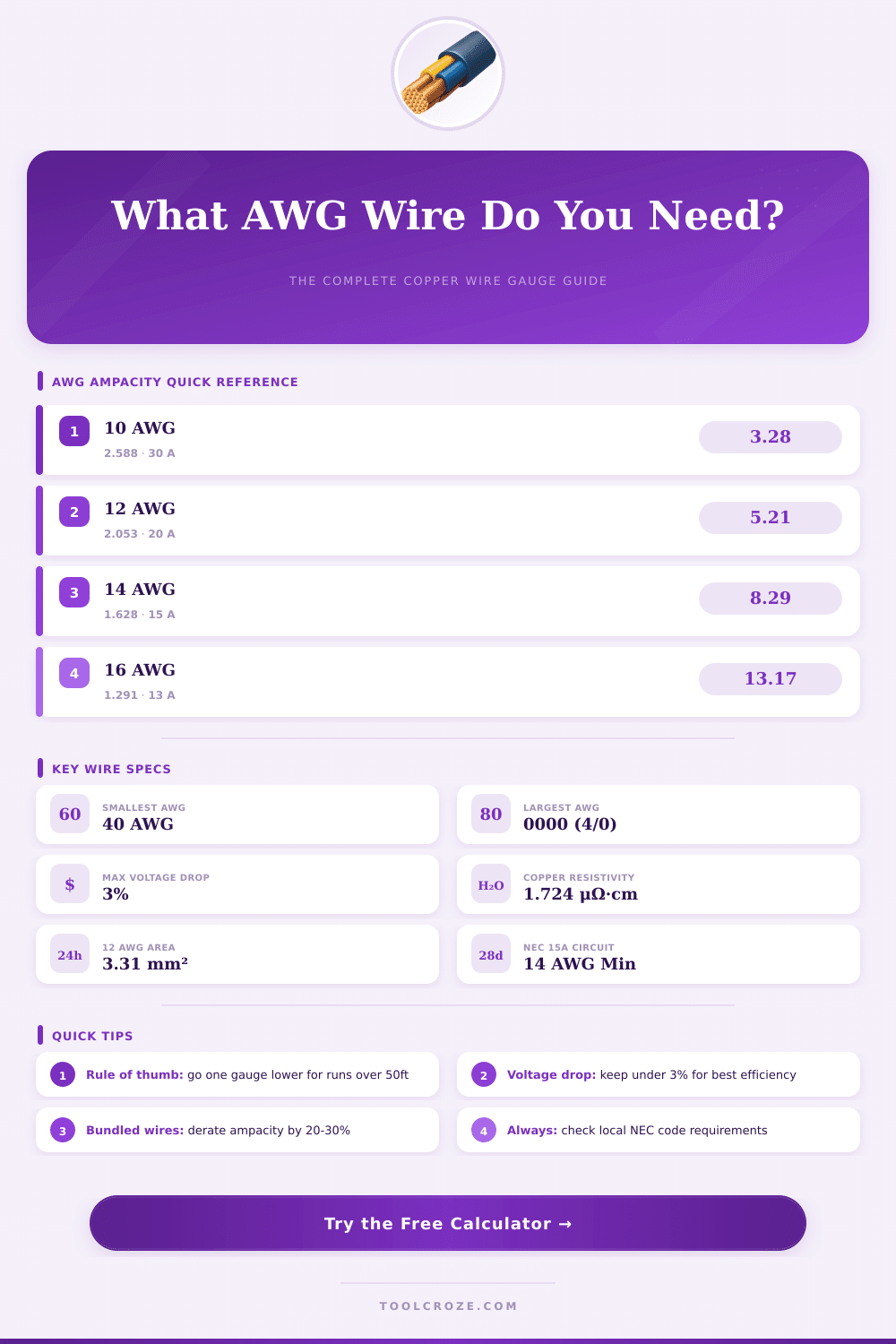
| AWG | Diameter (in) | Diameter (mm) | Area (mm²) | 60°C Amps | 75°C Amps | 90°C Amps | Ω/1000ft | Ω/km |
|---|---|---|---|---|---|---|---|---|
| 18 AWG | 0.0403 | 1.024 | 0.823 | — | — | 14 | 6.385 | 20.95 |
| 16 AWG | 0.0508 | 1.291 | 1.31 | — | — | 18 | 4.016 | 13.17 |
| 14 AWG | 0.0641 | 1.628 | 2.08 | 15 | 20 | 25 | 2.525 | 8.29 |
| 12 AWG | 0.0808 | 2.053 | 3.31 | 20 | 25 | 30 | 1.588 | 5.21 |
| 10 AWG | 0.1019 | 2.588 | 5.26 | 30 | 35 | 40 | 0.9989 | 3.28 |
| 8 AWG | 0.1285 | 3.264 | 8.37 | 40 | 50 | 55 | 0.6282 | 2.06 |
| 6 AWG | 0.1620 | 4.115 | 13.3 | 55 | 65 | 75 | 0.3951 | 1.296 |
| 4 AWG | 0.2043 | 5.189 | 21.2 | 70 | 85 | 95 | 0.2485 | 0.8152 |
| 2 AWG | 0.2576 | 6.544 | 33.6 | 95 | 115 | 130 | 0.1563 | 0.5127 |
| 1 AWG | 0.2893 | 7.348 | 42.4 | 110 | 130 | 150 | 0.1239 | 0.4066 |
| 1/0 AWG | 0.3249 | 8.252 | 53.5 | 125 | 150 | 170 | 0.09827 | 0.3224 |
| 2/0 AWG | 0.3648 | 9.266 | 67.4 | 145 | 175 | 195 | 0.07793 | 0.2557 |
| 3/0 AWG | 0.4096 | 10.40 | 85.0 | 165 | 200 | 225 | 0.06180 | 0.2028 |
| 4/0 AWG | 0.4600 | 11.68 | 107.2 | 195 | 230 | 260 | 0.04901 | 0.1608 |
| Application | Voltage | Typical Load | Min AWG (NEC) | Rec. AWG (Long Run) | Circuit Breaker |
|---|---|---|---|---|---|
| Standard Outlet Circuit | 120V AC | 12–15A | 14 AWG | 12 AWG | 15A |
| Kitchen / Bath GFCI | 120V AC | 20A | 12 AWG | 12 AWG | 20A |
| Electric Dryer | 240V AC | 30A | 10 AWG | 10 AWG | 30A |
| Electric Range / Oven | 240V AC | 40–50A | 8 AWG | 6 AWG | 50A |
| EV Charger (Level 2) | 240V AC | 32–40A | 8 AWG | 6 AWG | 50A |
| Sub-Panel Feed | 240V AC | 60A | 6 AWG | 4 AWG | 60A |
| A/C Unit 3-Ton | 240V AC | 20–25A | 10 AWG | 10 AWG | 30A |
| LED Strip Lighting | 12V DC | 5A | 16 AWG | 14 AWG | Fuse 7.5A |
| Solar Panel String | 24–48V DC | 10–20A | 10 AWG | 10 AWG | MPPT Fuse |
| Garage Subpanel | 240V AC | 100A | 1/0 AWG | 2/0 AWG | 100A |
| AWG | 10A / 25ft | 10A / 50ft | 15A / 50ft | 20A / 50ft | 20A / 100ft | 30A / 100ft |
|---|---|---|---|---|---|---|
| 14 AWG | 0.63V (0.5%) | 1.26V (1.0%) | 1.89V (1.6%) | 2.52V (2.1%) | 5.04V (4.2%) | 7.56V (6.3%) |
| 12 AWG | 0.40V (0.3%) | 0.79V (0.7%) | 1.19V (1.0%) | 1.59V (1.3%) | 3.18V (2.6%) | 4.76V (4.0%) |
| 10 AWG | 0.25V (0.2%) | 0.50V (0.4%) | 0.75V (0.6%) | 1.00V (0.8%) | 2.00V (1.7%) | 3.00V (2.5%) |
| 8 AWG | 0.16V (0.1%) | 0.31V (0.3%) | 0.47V (0.4%) | 0.63V (0.5%) | 1.26V (1.0%) | 1.88V (1.6%) |
| 6 AWG | 0.10V (0.1%) | 0.20V (0.2%) | 0.30V (0.2%) | 0.40V (0.3%) | 0.79V (0.7%) | 1.19V (1.0%) |
Voltage drop increases with wire length. For runs over 100ft (30m), always calculate the actual voltage drop and consider using one wire gauge larger than the minimum ampacity requirement. This also reduces resistive heat losses and improves efficiency.
NEC Article 210.20 requires that continuous loads (operating 3+ hours) must not exceed 80% of circuit breaker rating. A 20A breaker should carry no more than 16A continuous load. Always factor this into your wire selection when calculating ampacity requirements.
copper wire sizes can seem hard at first, even so they really get simple after one understands the basics. The American system of wire ratings commonly called AWG, are made up of standard measures for electrical leads. A key spot to recall is this: the lower the number of the wire size, the thicker the wire itself.
Like this, wire of 10 AWG beats the thickness of that of 14 AWG.
How Copper Wire Sizes Work
The scale of AWG comes from the amount of steps, that one required to draw the copper down until the wanted thickness. Because of that, big AWG numbers point to small widths of the wire. Such details matter, because the size of the wire affects, how much flow it carries and what resistance it shows.
When we talk about resistance, some handy rules of thumb help. For copper wire of 10 AWG, the resistance barely reaches one ohm per thousand feet. If one drops the size by ten spots, for instance from 24 AWG until 14 AWG, the surface, weight and ability grow around tenfold.
The specific resistance of copper at 20 degrees Celsius is well known, although it a bit changes according to the cleaning and the making of teh wire.
Different sizes answer for various uses. Copper wire of 14 AWG offers good electrical flow together with flexibility, so it well suits for building tasks. Also, copper wire cares about safety thanks to its high melting point for heat.
16 AWG wire answers for many uses, if the distance does not pass 50 feet. For lighting works serve well 18 or 20 AWG wires, while 22 AWG well fits in circuit boards, especially if one chooses solid core type, because it slips in holes more easily then stranded wire.
Stranded wire differs from the solid. The size relates to the whole thickness, not to one alone strand, except in case of single wire. Stranded wire comes in several types, that all bear the same number, but differ a bit according to what.
One must consider also the coating and rules.
An important detail to know is the difference between pure copper and copper-covered aluminum. Copper-covered wire has aluminum core with copper layer outside. Cutting it crosswise, one sees different color inside.
Something, what seems copper, often hides as copper-covered aluminum. In addition, copper and aluminumspread and shrink at different speeds according to temperatures, what can create problems with resistance in the lead.
For big loads require heavy sizes of wire. Copper wire of 2/0 AWG comes in stranded and pure form for power transfer. For service of 100 amps, copper wire number 3 answers best.
To choose the right size, one starts by means of figuring the maximum flow according to the load, checking the specs of the devices.