
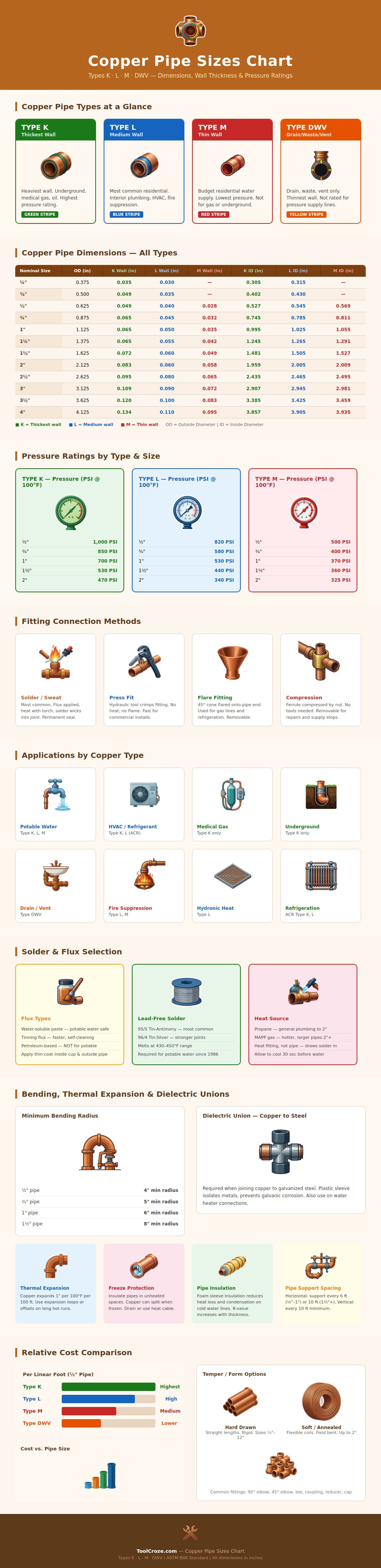
Standing in the aisle of hardware store, facing a wall of seemingly identical-looking copper pipes, you wonder: Which one do I buy? All these pipes is shiny. All of them reek of a faint metallic odor. All of them look just as ready to solve my plumbing problems. But just beneath their surface similarity lies a hierarchy of price, durability, and thickness. Pick the incorrect type, and you could be looking at anything from a wasted afternoon spent soldering joints, to a burst pipe on the coldest night in January.
Before you go digging holes in your walls (or laying lines under your driveway), it would of helped if you had a roadmap. To break this down further, let’s look at the three main supply types (K, L, and M) in table above. The letters aren’t random designations; they are actualy different wall thicknesses according to industry standard.
How to Pick the Right Copper Pipe
Type K is the thickest walled, making it very strong, heavy, and costly. This would be used on any medical gas line where absolute integrity are required. It would also be used on underground runs exposed to rocks that may come into contact with pipe.
In the middle we have Type L, the most popular selection for residential interior plumbing. This gives a nice compromise between flexibility and strength while not carrying the premium cost of K.
Finally, we have Type M, the thinnest walled type. This means it can’t withstand high pressure or underground abuse, but it is cheap and easy to bend by hand. It is perfect for budget conscious supply lines running inside walls, just make sure you’re not driving your car over them.
This is where most homeowners get tripped up: they confuse the inside diameter with the outside diameter. The outside diameters of all copper of any given nominal size are identical. So no matter what type of copper pipe you purchase, it fit your fitting. Where the variation occurs is inside. Since Type K is thicker walled, its interior passage is smaller different than Type M.
That may seem like a small detail, but remember: restriction matters in fluid dynamics. If you’re attempting to push a lot of water through a big fixture, then that lower inner diameter could restrict the flow rate more then you’d imagine. With Type K, you pay for durability, but you lose capacity if you don’t account for the smaller bore.
Another aspect of the tale is the pressure rating. As the chart indicates, even a thick half-inch pipe made of Type K can withstand more than a thousand pounds per square inch at moderate temperatures, a pressure strong enough to flatten a car, and that’s why such pipe remains safely underground. A skinnier Type M may not be able to manage half as much. But most home systems operates well within those limits, typically between 40-80 PSI… And all three could technically be used indoors.
Knowing the ceiling gives you comfort if you hear a water hammer bang or fear a surge in pressure from the municipal supply. The way it’s installed will change your thinking on the pipe as well.
The old school route is soldering, which makes a solid connection for decades if performed properly. Heat the joint, add some flux, allow capillary action to pull the solder into place. Takes a little getting used to but there are no tool expenses at all.
For professional use, press-fit systems goes up more quickly (no open flame, no waiting for things to cool down) but the machinery is expensive. For gas lines or for supply stops where you want the option of removal, flare and compression fittings do the trick. These are useful when you want to replace an appliance, say, and don’t want to cut pipe.
And then there is the nature of materials. Copper warms, it grows; copper cools, it shrinks. If you run enough hot water through a long length of copper pipe without accommodating its growth, the pipes is eventually going to shove back against your walls. One thing or another will have to give. That takes place in an expansion loop or offset, which absorbs the stress.
How do you join steel pipe to copper? You need a special union called a dielectric union to keep them apart. This is because two different kinds of metal in contact with water and each other eat themselves apart over time, a process known as galvanic corrosion. It’s a tiny part, but keeps your system from slowly decaying without notice.
The point here is that pipe selection is an environmental match. Use thin-wall for sinks in closets. Don’t use thin-wall tubing beneath your driveway. Check the table. Think about the location. Select appropriately. New copper shines nicely, but the engineering behind the walls make the house function.
