🔄 Conveyor Belt Roll Length Calculator
Calculate exact belt length from roll dimensions — supports metric & imperial units
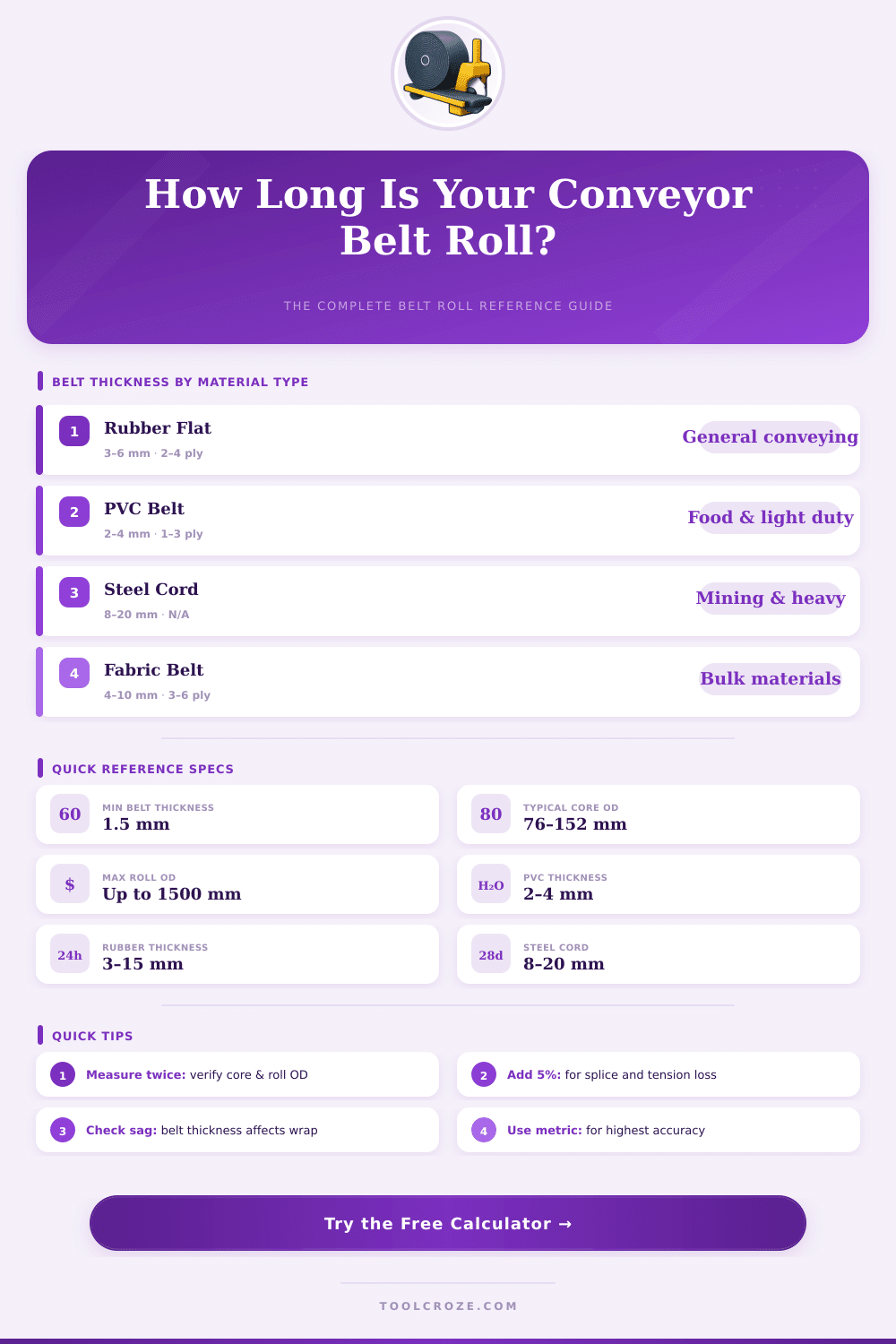
| Belt Type | Thickness Range | Typical Plies | Density (g/cm³) | Max Temp | Common Use |
|---|---|---|---|---|---|
| Light Rubber | 2–5 mm | 2–3 | 1.2 | 80°C | General conveying |
| Heavy Rubber | 6–15 mm | 4–6 | 1.4 | 100°C | Mining, bulk materials |
| PVC Belt | 1.5–4 mm | 1–3 | 1.45 | 60°C | Packaging, light industry |
| Food Grade PVC | 1.5–3 mm | 1–2 | 1.45 | 50°C | Food processing |
| Fabric / Woven | 4–10 mm | 3–6 | 1.35 | 90°C | Bulk, aggregates |
| Steel Cord | 8–22 mm | N/A | 3.5–5.0 | 120°C | Long-distance, mining |
| Polyurethane | 1–6 mm | 1–3 | 1.2 | 70°C | High-flex, precision |
| Neoprene | 3–8 mm | 2–4 | 1.3 | 110°C | Oil/chemical resistant |
| Outer Diameter | Roll Area (cm²) | Est. Length (m) | Est. Length (ft) | Approx. Weight (kg/m, 500mm wide) |
|---|---|---|---|---|
| 200 mm | 281 | ~31 m | ~102 ft | ~1.8 kg/m |
| 300 mm | 681 | ~75 m | ~246 ft | ~1.8 kg/m |
| 400 mm | 1,232 | ~136 m | ~446 ft | ~1.8 kg/m |
| 500 mm | 1,934 | ~214 m | ~702 ft | ~1.8 kg/m |
| 600 mm | 2,787 | ~309 m | ~1,014 ft | ~1.8 kg/m |
| 800 mm | 5,045 | ~560 m | ~1,837 ft | ~1.8 kg/m |
| 1000 mm | 7,954 | ~884 m | ~2,900 ft | ~1.8 kg/m |
| 1200 mm | 11,463 | ~1,274 m | ~4,180 ft | ~1.8 kg/m |
| Core OD (mm) | Core OD (in) | Application | Max Roll OD (typical) | Belt Width Range |
|---|---|---|---|---|
| 50 mm | 2 in | Light-duty, packaging | 300 mm | 100–300 mm |
| 76 mm | 3 in | Standard industrial | 600 mm | 200–800 mm |
| 100 mm | 4 in | Medium-duty | 800 mm | 300–1000 mm |
| 152 mm | 6 in | Heavy-duty industrial | 1200 mm | 500–1600 mm |
| 200 mm | 8 in | Mining, steel cord | 1500 mm | 800–2400 mm |
| 300 mm | 12 in | Very heavy / long runs | 2000 mm | 1000–3000 mm |
Count the length of rolled Conveyor Belt Roll maybe seems a difficult task, even so it simply comes down to some basic formulas and ratings. Well know the precise amount of belt on a roll have big value. That helps to escape costly mistakes for instance when one orders too much or too little material for the setup.
One can estimate the length of Conveyor Belt Roll using the diameter of the roll, the core diameter, the number of revolutions and the thickness of the belt. Those four data are enough for understanding how many belt wraps on the roll. Practical equation for all this is: length of belt in feet times number of revolutions times 0.131, where the diameter of revolution in inches plus diameter of the central hole in inches.
How to Calculate the Length of a Conveyor Belt Roll
There exists another version of this equation: L equals (3.14 divided by 2T) times (outer diameter minus inner diameter), where T shows the thickness of every layer and L the length of the roll. Simply care to use same units for the whole computation.
When belt runs between two pulleys, one requires another formula. Length of belt equals pi divided by two, multiplied by the sum of the big and small pulley diameters, plus twice the central distance, except the square of the differnece between pulley diameters divided by four times the central distance. Here everything looks complex written, but actually it only requires the sizes of pulleys and the space between them.
There are also online calculators, that allow you to enter the length of belt, thickness and core diameter to estimate the roll diameter. These are useful for planning of storage and moving. Knowing the diameter of a roll ensures, that the belt can be kept and moved without passing limits of space ore weight.
All this matters a lot, when one deals with big belts.
To physically measure belt, flexible measures help to check the central distance between pulleys and the edge of every pulley. One can roll a measuring tape along the belt to get the whole length directly.
The cost of a Conveyor Belt Roll depends on its material and sizes. Rolls from rubber usually cost more, because they well resist wear and tearing. PVC rolls are widely cheaper, even so not as lasting.
Special materials like silicone or Teflon, that one uses in certain branches, can raise the price even more. Also the width and length of the roll seriously affects thetotal amount.
Correct belt according to width is another spot to consider. While one arranges two or three belts around three quarter thicknesses of inch, tools like a band saw or table saw work well. Even so setup for long cuts requires time, especially when one unrolls and rerolls 150 feet of belt.