Concrete Slab Weight Capacity Calculator
Estimate slab load capacity from thickness, span or support condition, concrete strength, reinforcement, load footprint, soil support, wheel load, safety factor, flexure, punching shear, and bearing pressure.
📌Slab Load Presets
⚙Slab and Load Inputs
Concrete Slab Capacity Estimate
Full Breakdown
⚖Concrete and Rebar Grid
📐Support Condition Factors
| Support Condition | Best Use | Point Load Behavior | Uniform Load Behavior |
|---|---|---|---|
| Slab on compacted subbase | Garage, patio, driveway, equipment pad | Load spreads through slab and base before soil bearing check | Joint spacing is used as a conservative panel length |
| One way simply supported | Small supported panels and trench covers | Midspan bending usually controls long spans | Uses simple span bending estimate |
| One way continuous | Interior bay with support continuity | Continuity improves bending distribution | Higher estimate than simply supported panel |
| Four side supported panel | Reinforced slab panel with edge beams or walls | Two way action can distribute concentrated loads | Uses a higher two way distribution factor |
| Cantilever slab edge | Overhangs, loading near free edge, thin balcony edges | Edge bending can govern quickly | Uses the most conservative flexural factor |
🧱Reinforcement Reference
| Rebar or Mesh | Steel Area Used | Typical Slab Role | Calculator Note |
|---|---|---|---|
| Plain concrete only | Cracking strength estimate | Light sidewalks and noncritical pads | Bending capacity is limited because no tension steel is counted |
| Fiber mesh, nonstructural | Reduced cracking estimate | Shrinkage control and light residential slabs | Not treated as full flexural reinforcement |
| 6x6 W1.4/W1.4 mesh | 0.028 in² per ft | Crack control for small slab panels | Small steel area gives limited bending increase |
| 6x6 W2.9/W2.9 mesh | 0.058 in² per ft | Heavier mesh for garage and shop slabs | Uses fixed mesh spacing in both directions |
| #3 bars each way | 0.11 in² per bar | Residential slab reinforcement | Area per foot changes with entered spacing |
| #4 bars each way | 0.20 in² per bar | Garage, lift, driveway, and equipment pads | Default steel choice for reinforced slab screening |
| #5 bars each way | 0.31 in² per bar | Heavy equipment panels and suspended slabs | Check cover and slab depth before relying on capacity |
🛞Load Footprint and Wheel Load Guide
| Load Case | Typical Footprint | Load Concentration | Capacity Check to Watch |
|---|---|---|---|
| Passenger car tire | 5 in by 7 in to 7 in by 9 in | Moderate wheel load with flexible contact patch | Subbase support and slab thickness |
| Pickup or trailer tire | 6 in by 8 in to 8 in by 10 in | Higher axle load with repeated rolling stress | Flexure near joints and edges |
| Forklift solid tire | 3 in by 5 in to 6 in by 8 in | Very concentrated wheel pressure | Punching shear and surface bearing |
| Column base plate | 8 in by 8 in to 18 in by 18 in | Static point load through steel plate | Punching shear around the plate |
| Equipment skid | 12 in by 12 in or larger bearing pads | Load can be shared by several feet | Footprint pressure and soil support |
⛏Soil and Subbase Reference
| Support Quality | Typical Bearing Range | Use in Calculator | Load Capacity Effect |
|---|---|---|---|
| Soft or uncertain subgrade | 0.75 to 1.5 ksf | Old fill, wet soil, or unknown prep | Often controls wheel and equipment loads |
| Granular base, fair compaction | 1.5 to 2.0 ksf | Residential slab with modest base prep | Usable for light vehicles when slab is sound |
| Compacted crushed stone base | 2.0 to 3.0 ksf | Garage, driveway, and shop floor base | Default bearing support for this calculator |
| Thick compacted structural base | 3.0 to 4.0 ksf | Heavy vehicle lanes and reinforced pads | Improves spread load resistance |
| Verified engineered subbase | 4.0 ksf or more | Documented geotechnical support value | Use actual project value where available |
💡Concrete Slab Capacity Tips
Concrete slab floors are static, they don’t move, right? Sure, if you’re thinking about a concrete slab floor like a heavy fixed object. You may be shocked when you drive over your garage floor and feel a forklift tire sink into the floor. Or crack up a workshop pad with heavy equipment.
Why? Because although concrete perform well under downward loads (compression), it’s surprisingly poor at resisting being bent or stretched (tension). When a concrete slab floor fail, that tension weakness is often the issue. Once you input your load specifics and slab thickness, the above calculator will perform the math for you, so there’s no guessing as to what bending stress your floor can withstand.
How to Build a Strong Concrete Floor
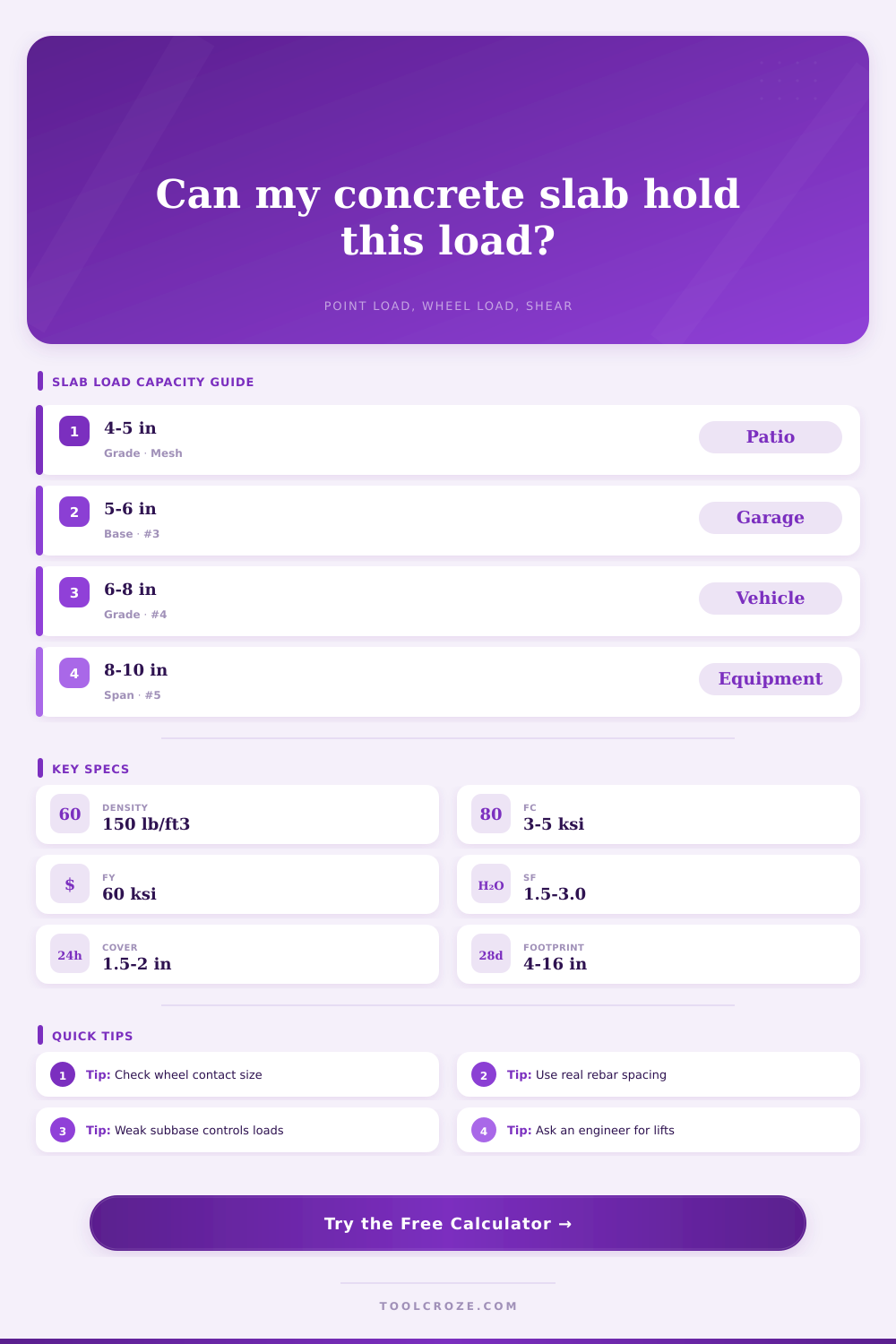
The other thing that most home owners obsess over is slab thickness. A 4 inch slab is weaker than a 6, right? Well, yes, unless soil below is strong enough to hold up weight of the slab. Put a 10 inch slab on soft wet clay and no matter how much concrete you throw down, that slab is going to crack because the soil compress underneath it. There’s only so much the ground can take, and it’s measured by engineers in terms of bearing capacity, which is expressed in tons per square foot. That’s what you’re asking when you look at the options for subbase quality under the tool… Just how good is the ground holding up? Soft fill won’t do it. Compacted crushed stone base spread out the load, protecting the soil.
The other thing that confuses folks is reinforcement. For example, you may have heard that adding rebar prevents cracks in a slab. That is not true. Rebar prevents your slab from breaking up if/when it crack. It’s the concrete that bear the load and the steel that keeps things glued back together. The types of tools used vary depending on how heavily you reinforce the slab. These range from heavy deformed bars down to simple wire mesh. And just like size of rebar, spacing is also critical. The closer the spacing, the more steel there is per square foot making it more flexible.
You can’t cheat however on the thickness requirement. Using a lot of rebar won’t help if you bury it too deep in a very thin slab. Top layer will still have no protection against surface cracks.
Most people notice the load footprint. Sure, 1 ton of forklift sounds like not such a big deal, but it’s all in just two little tires! A car distributes the weight over four bigger contact patches, so when we make our slab too small (i.e. High pressure on the slab surface can punch a cone-shaped hole in the concrete. This is called punching shear, and it is a common way for slabs to fail in industrial or workshop settings. Because it is so commonly encountered, the calculator includes this as a failure mode to check. Before any concern about bending strength is raised, the shear limit will probably rule your results if your load has a narrow footprint (such as a narrow tire or a small post base).
There are safety factors. Building isn’t perfect. Moisture travels beneath the slab. Joints will settle unevenly. Concrete cures at different speeds. The tool multiplies your load by a safety factor. So that’s why if you use a higher safety factor, it increases your confidence. However, it reduces how much weight the slab can carry. Maybe that’s fine for a temporary work site. But not for a permanent home garage where you’d like a conservative estimate so the floor lasts for decades. Better to be safe than have to explain to your insurance adjuster how your floor cracked.
Remember: These results aren’t your final engineering stamp, but rather a screening estimate. Actual slabs vary in their behavior based off their edge conditions, anchors, control joints and dowels. When the stakes is high… Such as when you’re hanging heavy racking off a suspended slab or installing a two-post car lift, there’s no substitute for a call to a structural engineer. He’ll examine construction photos and real soil reports.
In most light commercial and residential projects, you can make smart decisions just by knowing how to balance load concentration, soil support, and thickness. Concrete doesn’t forgive; it rewards proper preparation and patience. The objective is holding the weight without breaking apart.