Concrete Post Footing Calculator
Estimate hole size, concrete volume, bag count, gravel base, frost embedment, bearing area, and wind or uplift allowance for deck, fence, gate, and pergola posts.
⚙Project Presets
📏Footing Inputs
Footing Estimate
🧱Post / Spec Grid
📋Reference Tables
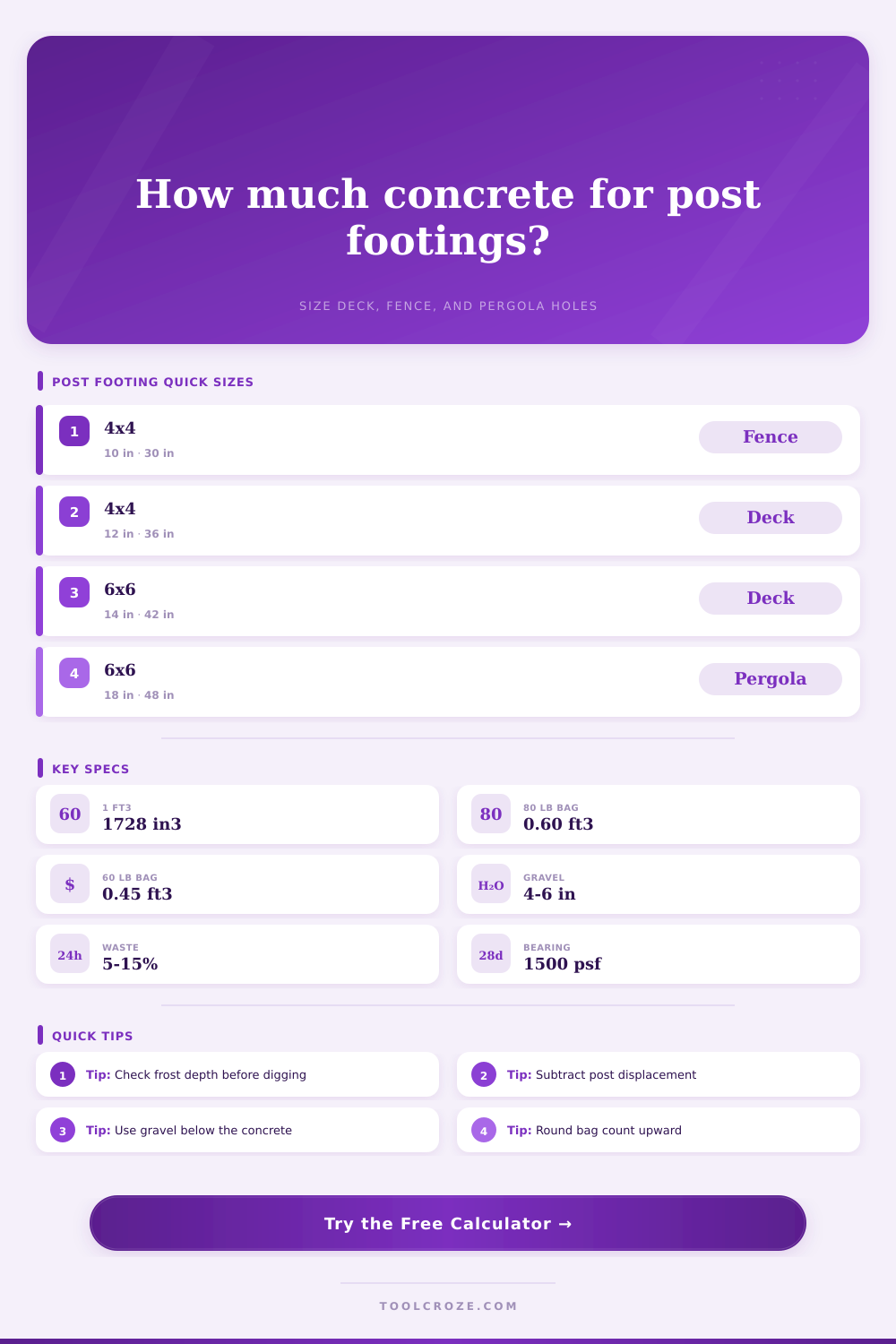
| Project | Post Size | Typical Hole | Typical Depth | Gravel Base |
|---|---|---|---|---|
| Light fence line | 4x4 actual 3.5 in | 8-10 in diameter | 24-36 in | 4 in |
| Tall fence corner | 4x4 or 6x6 | 12-14 in diameter | 36-42 in | 4-6 in |
| Deck support | 6x6 actual 5.5 in | 12-18 in diameter | Below frost line | 6 in |
| Pergola or gate | 6x6 or 8x8 | 16-24 in diameter | 42-60 in | 6 in |
| Bag Size | Approx Yield | 1 ft³ Needs | 5 ft³ Needs | Best For |
|---|---|---|---|---|
| 40 lb concrete | 0.375 ft³ | 3 bags | 14 bags | Small repairs |
| 60 lb concrete | 0.45 ft³ | 3 bags | 12 bags | Fence posts |
| 80 lb concrete | 0.60 ft³ | 2 bags | 9 bags | Deck posts |
| Bulk concrete | 27 ft³ per yd³ | 0.04 yd³ | 0.19 yd³ | Many footings |
| Soil Type | Default Bearing | Footing Behavior | Field Cue | Use With Care |
|---|---|---|---|---|
| Soft clay or fill | 1000 psf | Needs larger base | Ruts easily | Heavy decks |
| Firm clay | 1500 psf | Common default | Holds shape | Wet seasons |
| Dense sand or gravel | 2000 psf | Good drainage | Granular cut | Loose edges |
| Engineered fill | 3000-4000 psf | High capacity | Compaction proof | Unknown fill |
| Exposure | Allowance | Typical Posts | Sizing Effect | Check |
|---|---|---|---|---|
| Sheltered yard | 10% | Fence line | Small depth bump | Embedment |
| Open deck | 20% | Deck rail posts | Larger hole check | Ledger loads |
| Gate or pergola | 35% | 6x6 posts | More diameter | Bracing |
| High wind | 50% | Tall fences | Deeper footing | Local code |
💡Calculation Tips
Think of the post hole as an empty cylinder? Grab a shovel, dig till it’s “deep enough.” Pour some concrete, stop when it starts to slop over. Easy-peasy… until there’s a strong breeze or frost set in. Then your poor fence/deck gets put through its paces, the strength of that structure will depend on quality of those holes.
The calculator above help you get the sizing right for actual loads. It accounts for the frost depth where you live, the shape of your post, and the level of wind exposure you’re prepared to accept.
How to Build Strong Post Foundations
Wet soil is no good for curing concrete. You don’t want water running off too fast leaving you with a weak spot right where you need it most. That’s why you need gravel. You want a compacted layer of stone at the bottom of the hole, usually four to six inches thick, to provide drainage and a stable platform.
Four to six inches is a good depth for stone. If you’re getting a lot of rain you might need more. When you go to buy your bags of mix, you don’t want to end up having to get an extra bag because of all the gravel that you put down. The tool takes that into account. It subtracts volume of both post and the gravel.
DIYers tend to skimp on depth. Dig below the frost line. What’s that? That depends. In milder areas, 30 inches may suffice. In colder zones, you may need more. Otherwise the soil pushes up on your posts. If you don’t have sufficient footing, it would of pry them out.
The calculator compares your embedment with the local requirement. It alerts you if you’re underbuilding. And it factors in wind uplift. That’s the force tugging on post and pulling it out of the ground. A tall fence behaves as a sail. It creates substantial leverage at those buried footing. To ensure it is heavy enough, it adds a percentage to account for wind.
Mud underfoot makes the concept of soil bearing capacity real. Dense sand is different than soft clay. Firm clay supports weight; loose clay do not. Clay expands when wet, contracts when dry. Sand provides less friction but drains well. The tool will set the bearing strength based off your chosen soil type.
If you’re sinking posts into soft earth, use a bigger diameter so that more of the soil support the weight. That reduces the force on each part of the surface. Sinking a narrow hole in poor soil causes the structure to settle. That means a leaning fence or wobbly deck. Typical diameters for standard-sized post appear in the reference tables. The calculator refines those estimates according to your actual loading.
How much concrete should you buy? It is primarily logistical. Eighty-pound bags are standard for deck posts because they offer a good balance of yield and manageability. That’s a nice sweet spot between manageable and yield. 40# bags are easy to handle, when mixing by hand. You will have to make more trips to the store. The cubic feet per bag calculation turns that into bags needed, including some waste (for spilled concrete). Better too much than not enough. It hardens quicky.
You don’t just want it to be a hole, but rather a solid link between the land and the structure. When you get the dimensions correct, it seem like a part of the ground. It requires more pre-planning, which saves you having to re-do the foundation down the road.
Once you know what goes into it, the math is easy. And when you see the outcome, you’re confident that what you’re building isn’t going anywhere.