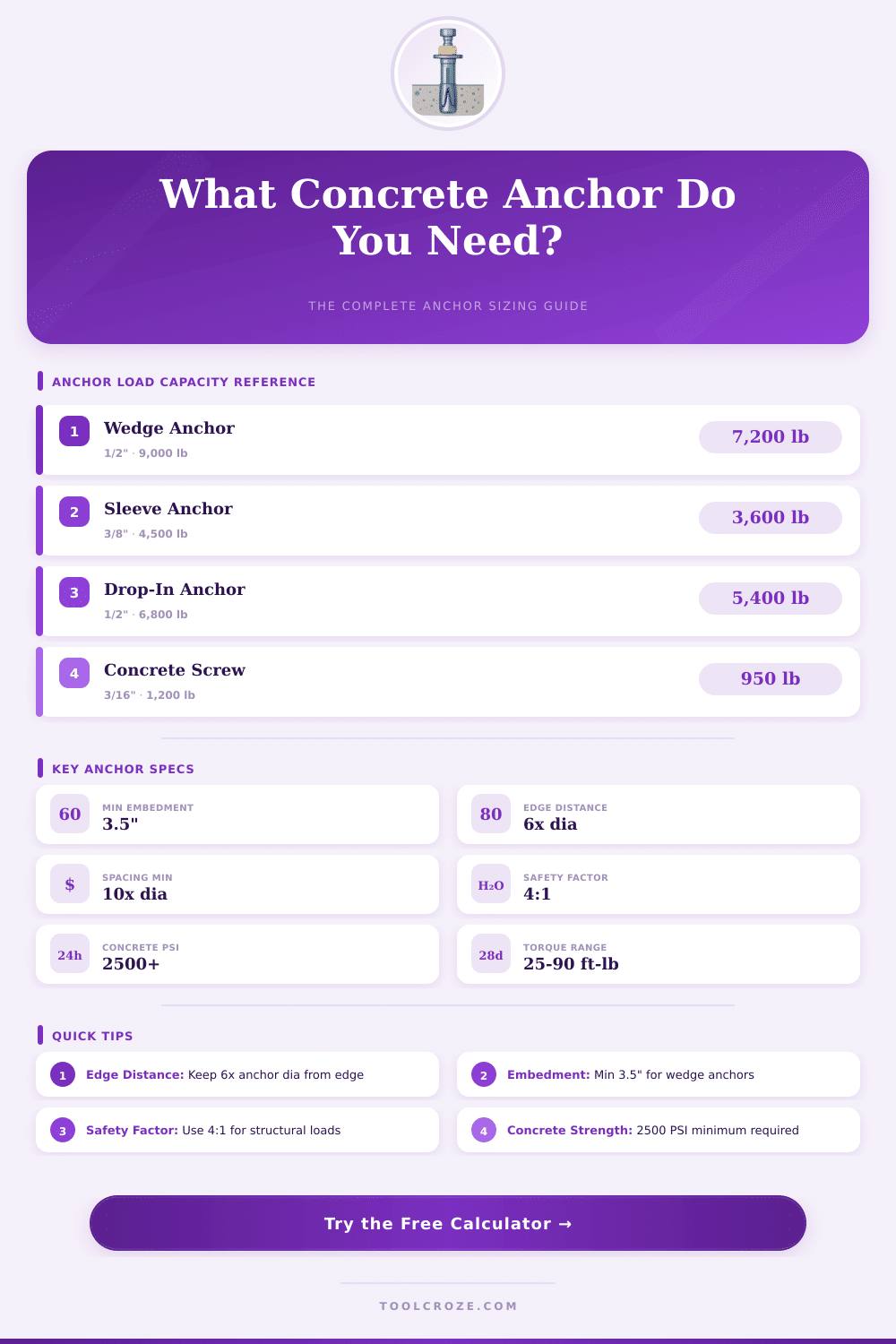
⚓ Concrete Anchor Calculator
Calculate anchor embedment depth, load capacity, spacing & edge distance for wedge, sleeve, drop-in, and screw anchors
| Anchor Type | Diameter | Min Embed (in) | Tensile (lb) | Shear (lb) | Torque (ft-lb) |
|---|---|---|---|---|---|
| Wedge Anchor | 1/4" | 1.125 | 1,730 | 1,590 | 5 |
| Wedge Anchor | 3/8" | 1.75 | 4,310 | 4,070 | 25 |
| Wedge Anchor | 1/2" | 2.25 | 9,000 | 7,220 | 50 |
| Wedge Anchor | 5/8" | 2.875 | 13,890 | 11,650 | 80 |
| Wedge Anchor | 3/4" | 3.375 | 18,540 | 17,400 | 130 |
| Sleeve Anchor | 1/4" | 1.25 | 950 | 1,100 | 4 |
| Sleeve Anchor | 3/8" | 1.5 | 2,250 | 2,800 | 15 |
| Sleeve Anchor | 1/2" | 2.0 | 4,500 | 5,200 | 30 |
| Drop-In Anchor | 3/8" | 1.25 | 2,600 | 2,100 | — |
| Drop-In Anchor | 1/2" | 1.75 | 6,800 | 5,400 | — |
| Concrete Screw | 3/16" | 1.0 | 620 | 530 | — |
| Concrete Screw | 1/4" | 1.0 | 1,200 | 950 | — |
| Epoxy / Chem. | 1/2" | 4.5 | 10,800 | 8,700 | 50 |
| Epoxy / Chem. | 3/4" | 6.75 | 22,000 | 17,500 | 130 |
| Epoxy / Chem. | 1" | 9.0 | 38,000 | 30,000 | 240 |
| Anchor Dia | Hole Dia (in) | Hole Dia (mm) | Drill Type | Min Hole Depth (in) | Notes |
|---|---|---|---|---|---|
| 3/16" | 3/16" | 4.8 mm | SDS Masonry | Embed + 1/2" | Vacuum clean hole |
| 1/4" | 1/4" | 6.4 mm | SDS Masonry | Embed + 1/2" | Vacuum clean hole |
| 3/8" | 3/8" | 9.5 mm | SDS Plus | Embed + 1/2" | Clean & blow out |
| 1/2" | 1/2" | 12.7 mm | SDS Plus | Embed + 1/2" | Clean & blow out |
| 5/8" | 5/8" | 15.9 mm | SDS Max | Embed + 1/2" | Wire brush + blow |
| 3/4" | 3/4" | 19.1 mm | SDS Max | Embed + 1/2" | Wire brush + blow |
| 7/8" | 7/8" | 22.2 mm | SDS Max | Embed + 5/8" | Wire brush + blow |
| 1" | 1" | 25.4 mm | SDS Max Core | Embed + 3/4" | 3x clean cycles |
| Anchor Dia | Min Edge Dist (in) | Min Spacing (in) | Min Member Thick (in) | Max Fixture Thick (in) |
|---|---|---|---|---|
| 1/4" | 1.5 | 2.5 | 3.0 | 0.75 |
| 3/8" | 2.25 | 3.75 | 4.0 | 1.125 |
| 1/2" | 3.0 | 5.0 | 5.0 | 1.5 |
| 5/8" | 3.75 | 6.25 | 6.0 | 1.875 |
| 3/4" | 4.5 | 7.5 | 7.0 | 2.25 |
| 7/8" | 5.25 | 8.75 | 8.0 | 2.625 |
| 1" | 6.0 | 10.0 | 9.0 | 3.0 |
| Project | Recommended Anchor | Diameter | Embedment | Qty per Point |
|---|---|---|---|---|
| Sill Plate / Mudsill | Wedge or Epoxy | 1/2" | 3.5" | 1 |
| Shelf Bracket (50 lb) | Sleeve or Screw | 1/4" | 1.25" | 2 |
| Water Heater Strap | Sleeve Anchor | 3/8" | 2.25" | 4 |
| Handrail Post | Wedge Anchor | 1/2" | 3.5" | 4 |
| Machinery Base | Epoxy / Wedge | 3/4" | 6" | 4–6 |
| Deck Ledger (seismic) | Epoxy Anchor | 5/8" | 5.5" | 2 per bay |
| Column Base Plate | Epoxy Anchor | 1" | 8" | 4 |
| Overhead Pipe Hanger | Drop-In Anchor | 3/8" | 1.5" | 1 per hanger |
Concrete Anchor fasteners attach objects to concrete, brick or block. One installs them in the concrete after it already stabilized. There are various kinds, for example wedge anchors, expansion fasteners, sleeved variants and gluing solutions.
Each of them works somehow differently, mainly according to the needs of the work.
Different Concrete Anchors and How to Use Them
Wedge anchors enjoy big popularity. One puts them in a hole that one drills in concrete. Inside, the anchor extends and sets itself flat by means of its own tension.
In dense concrete they commonly become the main method for lasting installation. When the load is very high there exist options like Titen HD-anchors, that own threads that grip the concrete along the whole length. They are made of type 316 stainless steel with carbon steel cut threads, which makes them a reliable choice where corrosion is a risk.
Such anchors store less than one percent of carbon steel, which helps to reduce size compared to other stainless screw fasteners.
Some anchors are self-tapping. One makes a hole a bit smallre than the thread, and with a good driver the Concrete Anchor taps into concrete by itself. For them no usual anchor sleeve or plug is needed.
For light and medium-load tasks on concrete, block or brick, there are corrosion-resistant anchors in blue, white and black variants. They come in different lengths and thicknesses, like 3/16, 1/4 and 5/16 inches. Other options are sleeved anchors, that work for connecting in porous concrete or in hollow and grouted block and brick.
Blocks require separate thought. An expansion screw usually fails, if the block has a cavity. In bricks, concrete screws can seize the mortar between them, and four small loads like quarter-inch bits, soft metal inserts that receive a threaded screw can work well.
Epoxy and gluing anchors also win favor. They involve drilling a hole and filling it with two-part concrete epoxy before putting in a threaded rod. One uses epoxy anchors mainly in old concrete, that would not last the expanding force of a wedge anchor, or in places with strong vibration.
With some anchors one uses a setting tool. One puts it in the anchor and strikes with a hammer, which forces the anchor to extend and press the sides flat. Like this one gets a safe hold.
A hammer drill is the basic tool for drilling holes in concrete. Brands like Milwaukee, DeWalt and Bosch all offer good models for that kind of concrete work without trouble.
Drop-in anchors help, when an object must sit flat with the floor when not in use. The hole simply needs to be deep enough, so that a flat machinescrew sits level with the surface. For removable setups, threaded inserts that receive bolts are worth keeping in mind.