Compressor Tank Air Volume Calculator
Estimate receiver free air, usable pressure-band volume, tool run time, recharge time, duty cycle, and pressure drop from actual tank and compressor settings.
Calculation Breakdown
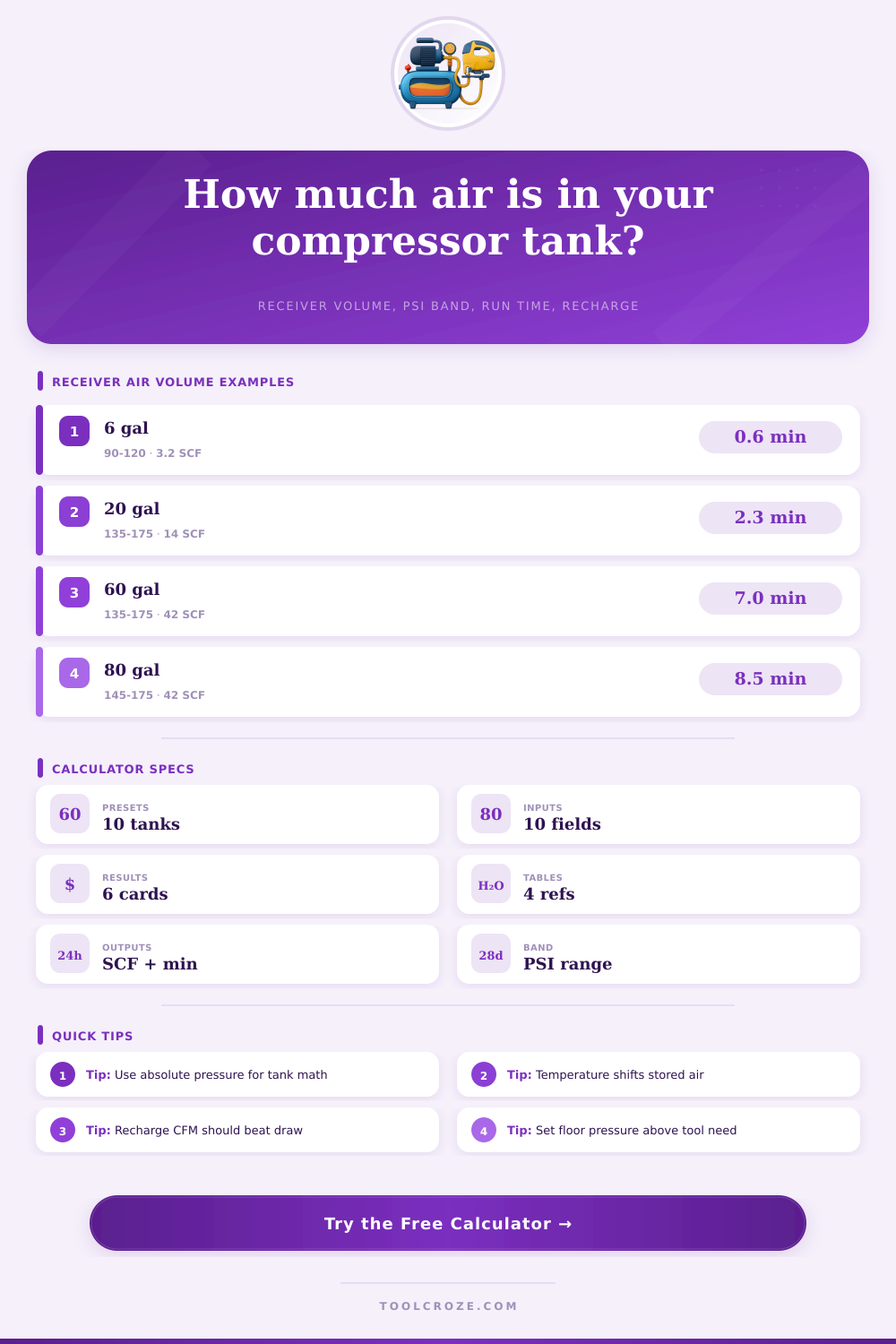
Usable Free Air By Common Receiver Size
| Receiver | Pressure Band | Usable Air Before Reserve | Typical Short-Burst Use |
|---|---|---|---|
| 4.5 gal twin-stack | 95 to 125 PSIG | About 2.3 SCF | Trim nailers, small inflators |
| 6 gal pancake | 90 to 120 PSIG | About 3.2 SCF | Brad nailers, staplers |
| 20 gal high-pressure portable | 135 to 175 PSIG | About 14.2 SCF | Impact bursts, tire work |
| 60 gal shop receiver | 135 to 175 PSIG | About 42.8 SCF | Intermittent grinders, blast cabinet buffer |
| 80 gal duplex receiver | 145 to 175 PSIG | About 42.8 SCF | Two-tool surge reserve |
Receiver / Spec Comparison Grid
| Receiver Type | Water Volume | Common Switch Range | Best Calculation Focus |
|---|---|---|---|
| Pancake portable | 4 to 6 gal | 90 to 120 PSIG | Short tank-only run time |
| Hot-dog portable | 8 to 20 gal | 105 to 135 PSIG | Inflation and impact recovery |
| Vertical shop | 30 to 80 gal | 125 to 175 PSIG | Cycle timing and duty load |
| Auxiliary receiver | 30 to 120 gal | System dependent | Added buffer volume |
| Rotary screw receiver | 80 to 240 gal | 100 to 150 PSIG | Demand trim and pressure stability |
Tool Draw Reference For Receiver Planning
| Air Tool | Typical SCFM | Use Pattern | Receiver Planning Note |
|---|---|---|---|
| Brad nailer | 0.3 to 1.0 | Very intermittent | Small tanks recover between shots |
| 1/2 in impact wrench | 4 to 6 | Short bursts | High cut-out helps lug-nut bursts |
| Air ratchet | 4 to 5 | Moderate bursts | Watch pressure floor near 90 PSIG |
| Die grinder | 6 to 10 | Long trigger time | Needs pump SCFM more than tank size |
| Dual-action sander | 10 to 15 | Continuous | Tank delays pressure drop only briefly |
| HVLP spray gun | 9 to 14 | Steady passes | Recharge output controls fan stability |
Pressure And Temperature Corrections
| Condition | Calculator Entry | Effect On SCF | When To Adjust |
|---|---|---|---|
| High altitude shop | Lower atmospheric PSIA | Less absolute compression per PSIG | Mountain locations |
| Hot compressor room | Higher receiver temperature | Lower standard cubic feet | After long pump cycles |
| Cold detached garage | Lower receiver temperature | Higher standard cubic feet | Winter startup estimates |
| Regulator pressure drop | Higher floor pressure | Smaller usable band | Spray guns and grinders |
| Leaky hose run | Higher reserve allowance | Lower practical usable air | Long temporary lines |
When you buy a compressor, the size of the tank indicated on the compressor nameplate is the volume of water the tank hold. However, the size of the tank dont indicate the volume of air you can use. The compressor tank holds air that are compressed to high pressures to allow your air tool to reach high pressure.
However, three factor determine the amount of air that your tool can use: the pressure band settings of the compressor, the temperature of the air within the tank, and the floor pressure your regulator must maintain. If you dont consider these three factors when reading the specifications of the compressor manufacturer, you will overestimate the lifespan of the air within the tank and overestimate the speed with which the compressor pump will be able to refill the tank with compressed air. To find the correct air volume in your tank, you must use the calculator once you have entered the tank volume, switch settings, atmospheric pressure, and the demand of the air tool.
How Much Air Can You Use from a Compressor Tank
The calculator will convert the volume of water in the tank into cubic feet. Then, it will calculate the standard cubic feet of air that the tank can hold at the cut-out pressure using the absolute pressure ratio and the temperature of the air. From here, the calculator will subtract the volume of air at your floor pressure.
Then, it will also subtract the reserve volume of air for air loss through the air fittings. The result is the usable air that your compressor can deliver before the pump must replenish the tank. Focusing on the tank volume only is a habit of many compressor buyers.
However, focusing on the tank volume alone will lead to errors in the understanding of the compressors capability. For instance, a 20-gallon compressor tank may be smaller than the 60-gallon vertical compressor tank. However, the two tanks may deliver the same amount of usable air from the same pressure band and floor settings.
The larger the pressure band between the cut-in and cut-out pressure settings, the more usable air you can extract from the tank. The warmer the air inside the tank, the more air the tank can hold due to the law of expansion of gases. A tank filled with warm air will hold fewer standard cubic feet of air at 90 degrees than the same tank filled with cold air at 60 degrees.
Many workshops that use their compressors in hot temperature in the summer will find that there compressors have shorter run times than those indicated on the nameplate. Another parameter to consider with air compressors is the recharge time for the tank. The air compressor tank will refill based on the average draw of the tools in use.
The calculator will show you the amount of air that the pump can deliver to the tank to increase the pressure from the cut-in to the cut-out pressure. If the pump output is less than the draw of the air tools, the tank may empty while performing a job. If the tools that use compressed air are continuous tools, they will eventually deplete the air in the tank.
However, intermittent tools will allow time for the tank to refill before the next use of the air tool. The duty cycle of the air tools is another factor to consider when determining the lifespan of the compressor motor. For example, if the tool draws six cubic feet of air per minute but is only used 40 percent of the time, then the tool will only draw 2.4 cubic feet of air per minute on average.
If the air compressor can supply 4 cubic feet of air per minute, the motor will rest for more than half of the time. The motor will run less and remain cooler due to the reduced duty cycle. The calculator will help you to understand whether the motor will overheat during an eight-hour day or will remain within a comfortable temperature range.
Many shop may have additional factors that will affect the amount of usable air in the tank. For example, the length of the air hose that connects the tool to the compressor will create a pressure drop at the tool that the floor pressure must overcome. Additionally, air that leaks from the couplers will reduce the reserve air volume in the tank.
The altitude at which you use the air compressor will lower the atmospheric pressure that the tank must overcome to supply air to the air tool. These factor will affect the number of standard cubic feet of air that the compressor will deliver. The best method of determining the size of the air compressor tank is to size it to the longest burst of air that you will need between the time that you start the compressor and the time that the motor will have to start again.
Additionally, the size of the pump that you buy will depend on the average demand for air from your tools after you have accounted for the duty cycle. If the size of the tank and the size of the pump match the demand for air from your air tools, the tank will even out the demand for air peak. If the size of the tank and the size of the pump do not match the demand, the tank will empty or the motor will overheat.
Therefore, the numbers that you enter into the calculator when you buy your compressor are important in determining how much usable air your compressor will have.