Compression Spring Calculator
Calculate spring rate, working load, corrected shear stress, solid height clearance, coil index, and buckling risk from wire diameter, OD or ID, active coils, free length, and deflection.
Load a shop-sized spring scenario, then adjust wire diameter, OD or ID, active coils, free length, solid height, deflection, load, material, and guide style.
Compression spring results
Calculation breakdown
| Material | Shear modulus | Screening allowable | Typical compression spring use |
|---|---|---|---|
| Music wire ASTM A228 | 11.5 Mpsi / 79.3 GPa | 130 ksi / 896 MPa | Accurate indoor shop and fixture springs |
| Hard drawn ASTM A227 | 11.4 Mpsi / 78.6 GPa | 95 ksi / 655 MPa | Light hardware and low-duty return springs |
| Oil tempered ASTM A229 | 11.2 Mpsi / 77.2 GPa | 110 ksi / 758 MPa | Rugged mechanical compression springs |
| 302 stainless | 10.0 Mpsi / 69.0 GPa | 100 ksi / 690 MPa | Corrosion resistant spring setups |
| Chrome silicon A401 | 11.5 Mpsi / 79.3 GPa | 150 ksi / 1034 MPa | High stress cyclic and shock service |
| Phosphor bronze | 6.3 Mpsi / 43.4 GPa | 60 ksi / 414 MPa | Nonmagnetic or electrical duty springs |
| Output | Formula | Inputs | Design meaning |
|---|---|---|---|
| Mean diameter | D = OD - d or ID + d | Wire, OD or ID | Diameter used in rate and stress formulas |
| Spring rate | k = Gd^4 / (8D^3Na) | G, wire, mean diameter, active coils | Load per unit deflection in the linear range |
| Working load | F = kx | Rate and deflection | Predicted load at the entered travel |
| Wahl factor | Kw = (4C - 1)/(4C - 4) + 0.615/C | Spring index C | Correction for curvature stress in the wire |
| Shear stress | tau = Kw x 8FD / (pi x d^3) | Load, mean diameter, wire | Screening stress before material verification |
| Solid margin | Free length - deflection - solid height | Lengths and travel | Clearance before coil bind at working travel |
| Check | Good range | Warning range | Shop response |
|---|---|---|---|
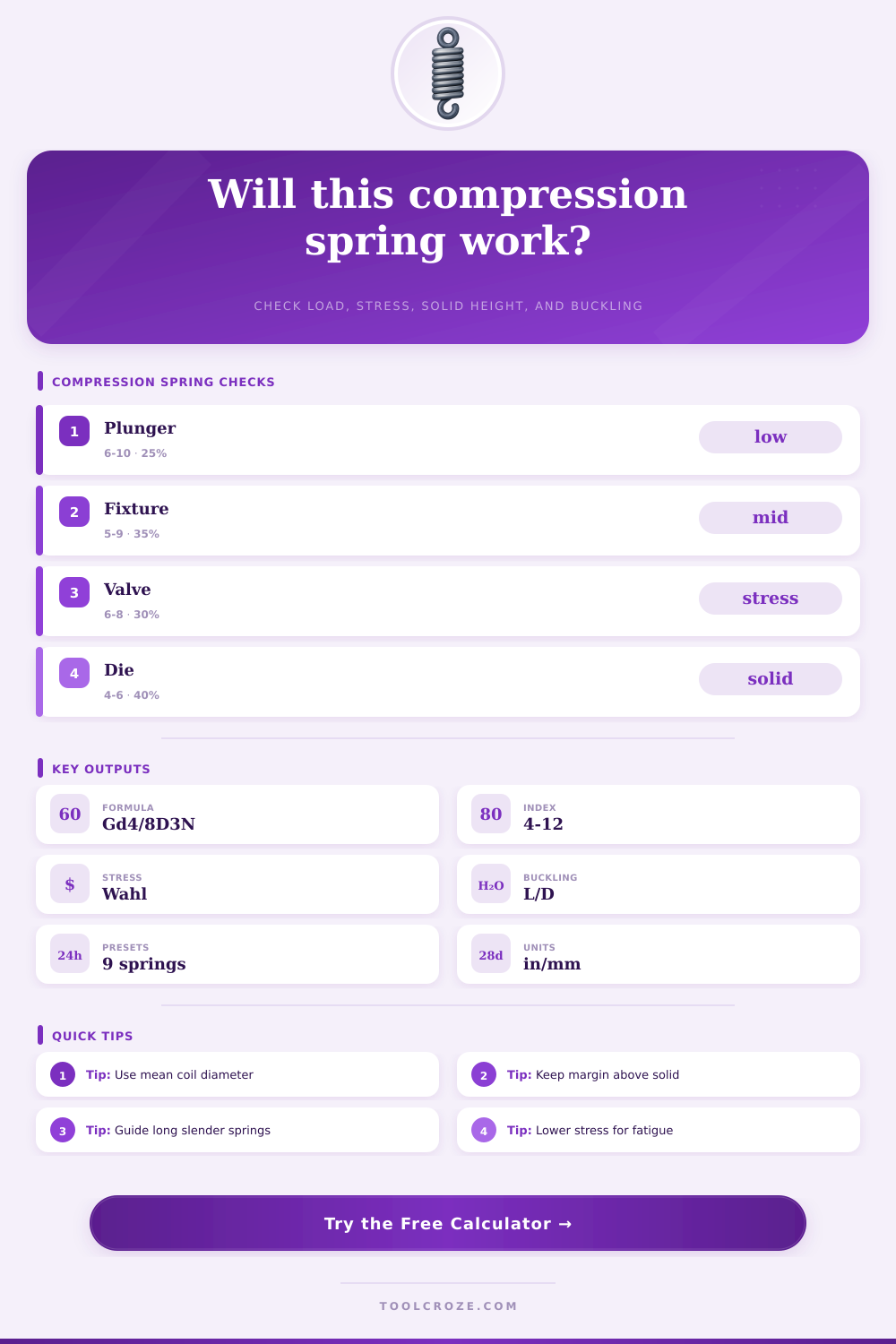
| Spring index C | 6 to 10 | Under 4 or over 12 | Change wire diameter or coil diameter |
| Solid clearance | At least one wire diameter | Zero or negative margin | Increase free length or reduce travel |
| Unguided L/D | Below about 2.6 | Above about 2.6 | Add a rod, pocket, or wider spring |
| Guided L/D | Below about 4.0 | Above about 4.0 | Confirm rod fit and end squareness |
| Closed ground ends | Stable seating | Taller solid height | Use measured solid height when known |
| Plain ends | Shorter solid height | Less stable seating | Guide the spring and check tilt |
| Application | Typical load | Travel range | Main calculator check |
|---|---|---|---|
| Bench plunger return | 5 to 30 lbf | 0.20 to 0.75 in | Load feel and solid clearance |
| Fixture clamp | 40 to 200 lbf | 0.30 to 1.25 in | Stress with service factor |
| Valve return | 20 to 150 lbf | 0.10 to 0.60 in | Fatigue stress and rate repeatability |
| Die stripper | 150 to 800 lbf | 0.25 to 1.00 in | Solid height and guide support |
| Metric guide pin | 100 to 900 N | 6 to 25 mm | Buckling, pocket fit, and load margin |
In order to use an compression spring as a means of pushing an object back into place or to hold a fixture at a certain tension, there are several measurement that must be understood. Many people treats all of the measurements of a compression spring as the same. However, each of those measurement has a different function within the spring.
If each of these measurement is treated as if they are the same size, then the spring may buckle or the spring may bottom out. The calculator can determine the mathematical equations for each of these measurement once the values is entered into the spring calculator. The calculator will save you from having to calculate these coefficients and corrections for each of these spring measurements.
How to Measure a Compression Spring
Each of these spring measurement has a specific function for the spring. For example, wire diameter appear to the fourth power in the equation for spring rate. This means that if the user changes the wire diameter slightly, the load will change a great deal.
For this reason, many prototype shop will use a heavier wire and open up the coils rather than using a lighter wire with more coils. The mean diameter of a spring is a measurement that many spring designers and designers of spring-based mechanism measure incorrectly. The rate of a spring is calculated with the center-line diameter of the springs wire.
The outside diameter of the spring is not the same than the mean diameter. The inside diameter of a spring is also not the same as the mean diameter. If the user uses the outside diameter in the spring calculator, and the one wire thickness is not deducted from the calculated outside diameter, the rate that is calculated will be too low for the spring, and the stress that is calculated will be too high.
The spring calculator will provide field prompt to determine whether the diameter that is being entered in the spring calculator is the outside, inside, or mean diameter of the spring. If these parameter are entered correctly, the stress that is calculated for the spring will be accurate. The end condition for a spring will change the total number of spring coils and the solid height of the spring.
Springs with closed and ground ends will have different parameter than springs with plain ends. Closed and ground ends will have a higher solid height than springs with plain ends. This will reduce the travel distance that the spring can have before the coils of that spring touch.
This may be a crucial parameter for applications where the spring must compress to almost coil bind with the other spring or with another component. Springs made of different material will have different properties. The material choice impact the strength of the spring beyond its corrosion resistance.
For example, music wire is one of the strongest and most stiffest materials. Therefore, shops often use music wire for shop fixture. Chrome silicon is a material that has less stiffness than music wire but has a higher fatigue strength.
If the spring will cycle thousands of times, higher fatigue strength is a benefit. The modulus and the allowable stress of the spring can be pulled from the material that is selected. These two value will be multiplied by the duty factor to determine the actual stress that will be placed upon the spring.
Buckling is a failure mode that springs can encounter when they are designed in a way that promote buckling. If a spring is too long and slender, it may bow out of alignment of its axis before the stress upon the wire becomes too great. The ratio of the length of the spring to its mean diameter can be calculated with the spring calculator.
If the ratio of the length to the mean diameter is 2.6 or higher with unguided ends, the calculator will flag the possibility of buckling. If the spring has a rod going through the center or if there is a pocket that receive the spring ends, then the allowable length to mean diameter ratio will be different. A field has been provided in the calculator to account for these change.
While not a replacement for testing the spring, this warning can help avoid ordering a spring that will not behave linear. The solid-height clearance for a spring is a measurement of the gap between the springs working length and its solid height. The solid height will be subtracted from the working length to determine the remaining gap.
This measurement is critical to understand to ensure that there is enough travel distance for the spring to cycle to its designed limit. If the gap between the solid height and the working length is smaller than the diameter of the wire used to construct the spring, the spring may reach coil bind. Many fixture designer will provide an additional 20 percent of travel for the spring into its limit as the dimension of the parts may not be exact to those calculated for the spring.
The index of a spring is the ratio of the springs mean diameter to its wire diameter. This value affect all other calculation for the spring. If the index is too low, it is difficult to wind the spring.
If the index is too high, the coils may become floppy and become prone to tangling. The preferred index range is between 6 and 10. If the spring calculator outputs an index outside of this range, then the size of the wire that is used for the spring should be changed or the diameter of the springs coil should be changed.
Where springs are used in actual application, there are additional variable that the spring calculator does not account for. The thickness of any plating, the scale that form when the spring is heat treated, and how the spring is packaged will all impact the length of the spring. The spring may measure to the proper length when the spring is sitting on a bench, but it may not seat correctly when placed between two cast metal surface.
Because of these variable, the spring calculator provides a great starting point for calculating the dimension of the spring. However, the spring should be physically tested to ensure that it will behave as expected. Each result that comes from the spring calculator should be treated as a question that the designer of the spring-based mechanism must answer.
For example, the stress ratio from the spring calculator may indicate that the spring will be under high stress. This will prompt the designer to consider whether the duty factor for the spring is realistic or whether the spring material should be changed. If the spring calculator indicates the potential for buckling, this will prompt the designer to consider whether the spring can be provided with guidance or whether the design of the spring can be changed.
While the spring calculator will provide the designer with answer to many question, the spring designer will make the final decision about the parameter of the spring.