Column Concrete Calculator
Estimate concrete for round and square columns with height, quantity, reinforcement displacement, waste allowance, fresh density, cubic yards, cubic meters, and bag yield.
Column Concrete Results
Calculation Breakdown
| Column preset | Typical size | Height range | Waste note |
|---|---|---|---|
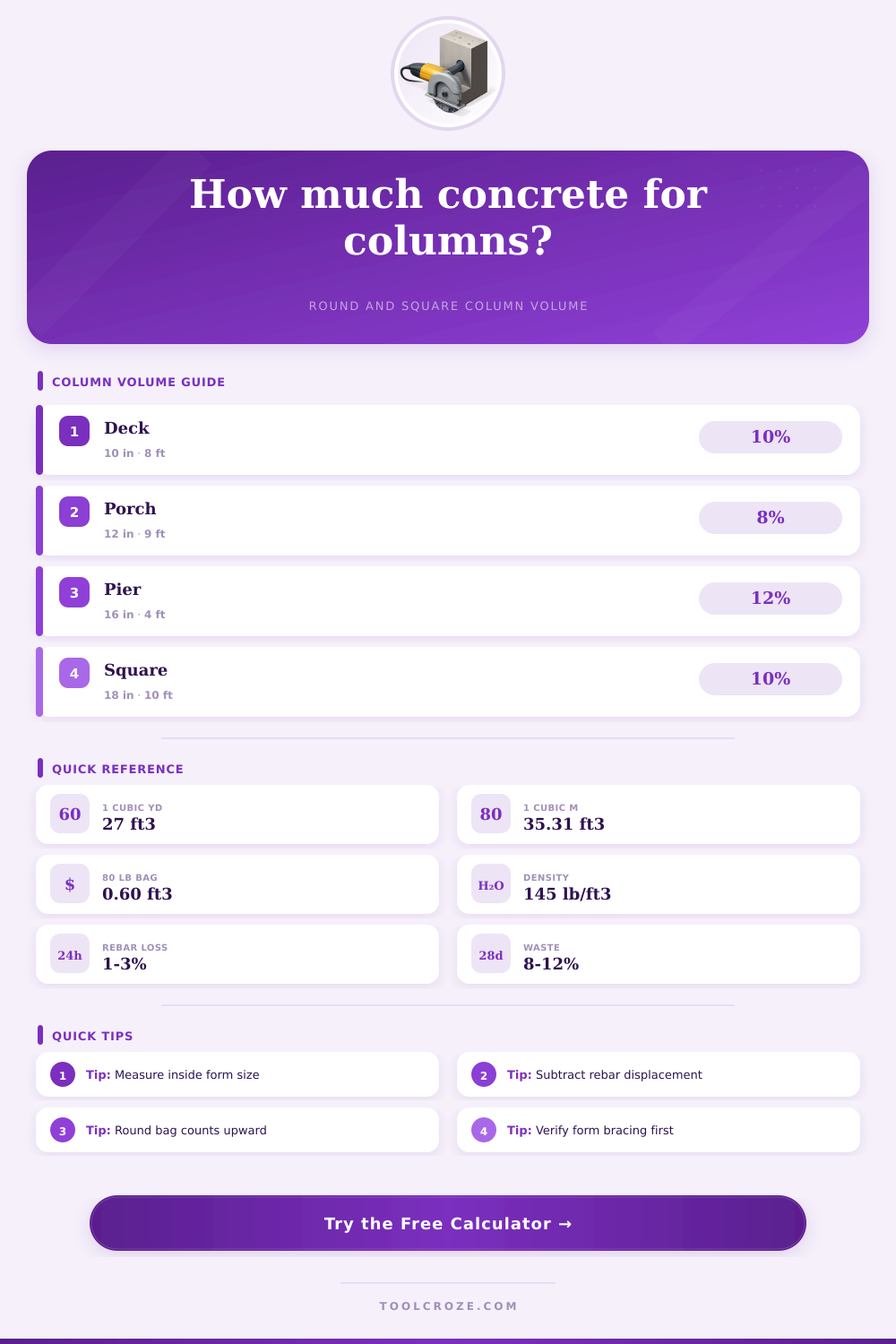
| Deck support pier | 8 in to 12 in round | 3 ft to 8 ft | Use 10% for tubes and minor overfill |
| Porch column core | 10 in to 14 in round | 8 ft to 10 ft | Use 8% when forms are straight and braced |
| Square formed column | 12 in to 18 in square | 8 ft to 12 ft | Use 10% for corners and consolidation loss |
| Basement support column | 16 in to 24 in round | 7 ft to 10 ft | Use 10% to 12% for pump or chute placement |
| Short grade pier | 12 in to 20 in round | 2 ft to 5 ft | Use 12% for hand-dug or uneven holes |
| Shape | Base formula | Dimension input | Takeoff caution |
|---|---|---|---|
| Round column | 3.1416 x radius² x height | Inside diameter and formed height | Small diameter errors change volume quickly |
| Square column | Width x depth x height | Inside form width and depth | Use clear inside form dimensions |
| Repeated columns | Single volume x quantity | Same size columns only | Split unlike columns into separate runs |
| Reinforced column | Gross minus steel volume | Bar count and diameter | Approximation excludes ties and chairs |
| Concrete / bag source | Approx yield | Density guide | Column use |
|---|---|---|---|
| 40 lb bag mix | 0.30 ft³ | Normal weight | Very small piers and patches |
| 60 lb bag mix | 0.45 ft³ | Normal weight | Short posts and tube forms |
| 80 lb bag mix | 0.60 ft³ | Normal weight | Common small column work |
| 90 lb bag mix | 0.68 ft³ | Normal weight | High-output bag mixing |
| Ready mix | By yd³ or m³ | Batch plant spec | Multiple columns or structural pours |
| Specification | Normal weight | High strength | Lightweight |
|---|---|---|---|
| Fresh density | 140 to 150 lb/ft³ | 145 to 155 lb/ft³ | 105 to 120 lb/ft³ |
| Metric density | 2240 to 2400 kg/m³ | 2320 to 2480 kg/m³ | 1680 to 1920 kg/m³ |
| Typical column use | Posts, piers, footed columns | Structural cores and high loads | Weight-sensitive construction |
| Takeoff risk | Uneven form height | Delivery and consolidation timing | Yield changes by supplier mix |
We all learn that concrete volume adds up pretty quickly with vertical pours. I mean, you’re thinking about a deck. It has four posts supporting a heavy composite floor. It’s easy math, right? You must factor in your formwork thickness, rebar displacement, and waste factors, and realize that what looked like a half-yard order will become a three-quarter yard reality.
Run out of material halfway through the pour, or pay for truckloads you didn’t need because you got it wrong. While the calculator will do the math for square forms or round tubes, its true power is in managing things that are hard to measure. Many online calculators will calculate gross volume of a rectangle or a cylinder and leave it at that. They don’t account for the steel cages within your column.
Why You Need This Concrete Calculator
While not a huge amount, vertical rebar still displaces concrete (and in these days of narrow piers), that can be important; filling out every square inch of form space isn’t cheap. By allowing you to enter number and size of bars used, the tool essentially takes away the steel volume from the overall mix needed. It is a tiny change in the spreadsheet, but on the ground, it means not over-ordering materials based off maximums rather than what you actualy need.
Experience divides the pro from the novice in waste allowance. Depending on what form type you use, the reference table on the page say to allow eight to twelve percent waste. Why so broad a range? Uneven pier footings, hand dug holes versus straight braced forms which consolidate well all lead to different waste allowances in poured concrete.
The soil is rocky and footing might not be level. You might also be pouring into Sonotubes that stretch under weight of the pour. That is why you should of need the additional cushion. Unlike other calculators that insist on some generic number for all sites, this one allow you to tweak the percentage according to your particular site conditions. It makes you think ahead about how messy real-world construction sites can be before you place that call to the ready-mix plant.
The other thing I didn’t realize, which should be mentioned, is weight of all that new concrete. That affects not just your equipment limits but also the need for structural bracing. On average normal weight concrete comes in at roughly one-hundred forty-five pounds per cubic foot; mixes made with heavier aggregate or higher strength may reach one-hundred fifty-five. Lightweight structural concrete could fall as low as one-twenty.
By specifying the density of your concrete, the tool total up the weight. This helps you make sure you’re not putting too much onto a residential driveway when space is limited and ensures your braces are enough to hold everything together. It ties the volume numbers to the real world.
For smaller jobs (less than a quarter yard) that require multiple trips with a wheelbarrow instead of a truck, there are also bag counts to consider. An 80 pound bag of concrete is roughly zero point six cubic feet. You can’t buy half a bag so you have to round way up. After considering waste and displacement, the calculator will let you know exactly how many bags you’ll need. This protects against the age-old problem of going out to purchase ten bags of concrete for an eleven bag job. There is nothing worse than having your concrete already start to set only to realize you’re one bag short.
But it has some good presets built-in for typical scenarios such as porch columns and other deck supports. But again, be sure to check your measurements against what you actualy have. For example: When ordering the concrete, measure the interior diameter of the cardboard tube, not the exterior. And also keep in mind that just making that switch will save you from ordering too much (at least once).
The interface switches easily between metric and imperial systems. This is great if you’re using newer plans from an architect where rebar diameters is measured in millimeters, or if you’re sourcing internationally.
Concrete columns are all about getting the right amount of concrete. You need enough to complete the pour without any voids but not so much that you create waste. The calculator gives you a simple way to factor in these variables which typically gets forgotten when doing a ballpark estimate. After seeing how the waste and rebar affects the overall volume, the figures no longer seem like guesses. They look like reasonable expectations. And when you have some certainty in the math, you’re making a more calculated decision rather than taking a risk on what might or might not show up.