Coilover Spring Rate Calculator
Estimate required spring rate from corner weight, motion ratio, spring angle, target sag, installed length, preload, and available travel.
Choose a baseline, then adjust the measured values from your own coilover installation.
Used for the suggested wheel-rate band and sag note.
Weight on one tire at ride height, with driver and fuel if relevant.
Wheel, tire, brake, hub, and a share of control arms or axle.
Measure vertically at the wheel and along the spring axis.
Higher angle reduces effective wheel rate through cosine squared.
Wheel movement from full droop to loaded ride height.
Travel before bump stop engagement or tire/body interference.
Uncompressed coilover spring length from the spring specification.
Measure between spring seats with the car settled at ride height.
Spring compression added by the collars at full droop.
Adds room for aero, passengers, load transfer, or a sharper platform.
Common catalog increments are 25 or 50 lb/in, or 1 kg/mm.
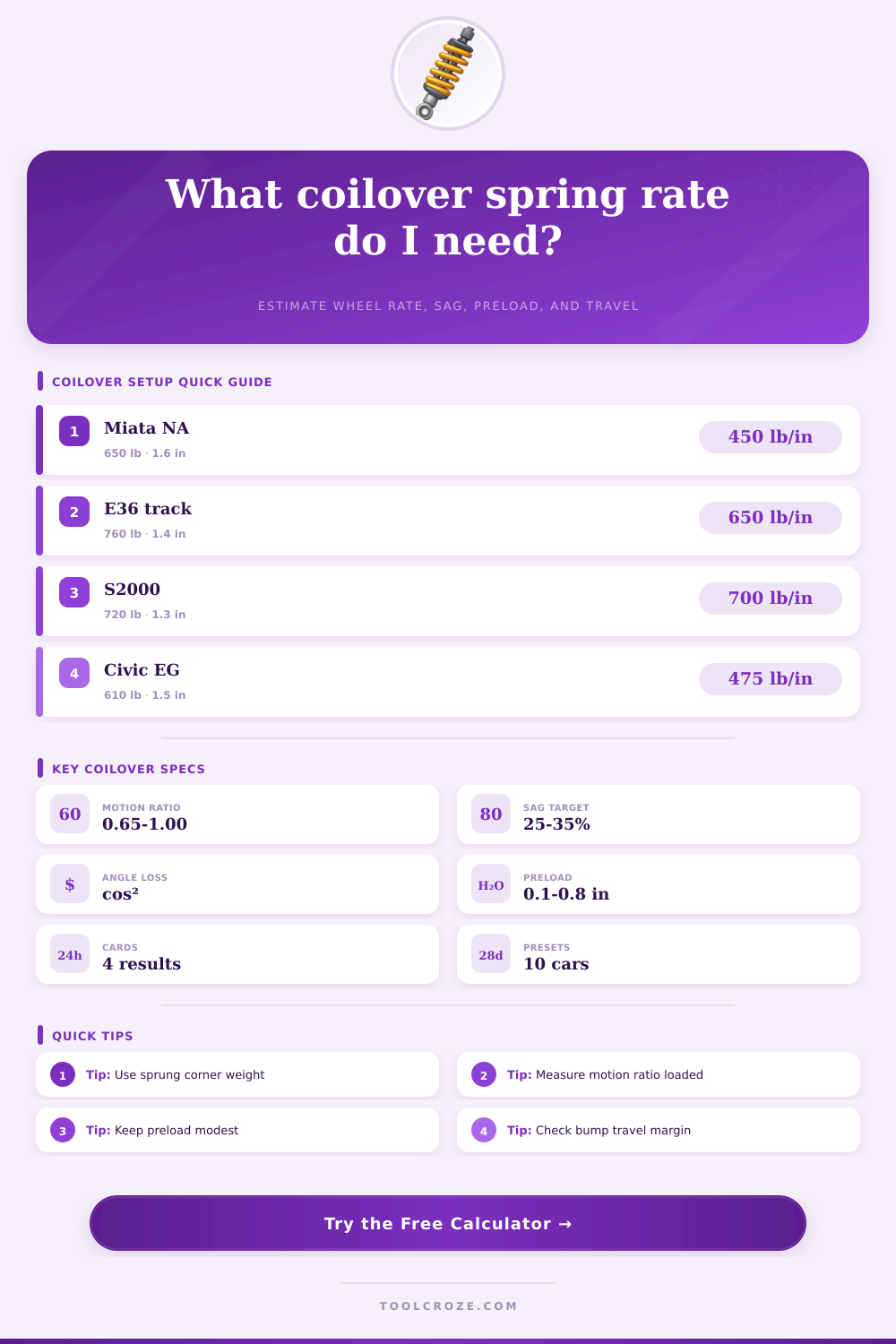
Use these tables as setup context after the calculator gives the math result.
| Preset baseline | Corner weight | Motion ratio | Spring angle | Typical rate |
|---|---|---|---|---|
| Mazda Miata NA front | 620-680 lb | 0.90-0.95 | 5-10° | 400-550 lb/in |
| BMW E36 track front | 730-820 lb | 0.88-0.94 | 6-12° | 550-750 lb/in |
| Honda S2000 rear | 680-760 lb | 0.82-0.90 | 8-15° | 650-850 lb/in |
| Mustang S550 rear | 780-920 lb | 0.70-0.82 | 10-18° | 700-1000 lb/in |
| C10 street truck front | 980-1200 lb | 0.55-0.70 | 8-18° | 850-1300 lb/in |
| Motion ratio | Rate multiplier | Meaning | Common location |
|---|---|---|---|
| 1.00 | 1.00× | Spring moves with wheel | Near vertical strut |
| 0.90 | 1.23× | Needs more spring rate | MacPherson strut |
| 0.75 | 1.78× | Levered inboard spring | Rear multilink |
| 0.60 | 2.78× | Large leverage loss | Truck arm or A-arm |
| Spring angle | Cosine squared | Rate loss | Setup note |
|---|---|---|---|
| 0° | 1.000 | 0% | Full vertical efficiency |
| 10° | 0.970 | 3% | Small correction |
| 20° | 0.883 | 12% | Measure carefully |
| 30° | 0.750 | 25% | Spring rate rises fast |
| Vehicle use | Sag target | Preload target | Travel priority |
|---|---|---|---|
| Street comfort | 30-35% | Minimal | Bump and rebound room |
| Sport street | 25-32% | 0.1-0.4 in | Keep bump stop clearance |
| Autocross | 22-30% | 0.2-0.6 in | Support quick transitions |
| Track day | 18-28% | 0.2-0.8 in | Control roll and aero load |
Selecting an correct spring rate for your coilovers requires measuring your car careful. If the spring rate is too soft, the car will feel unstable and move excessive through the corners. If the spring rate is too stiff, the car will ride harsh on the road and the tires may lose contact with the road.
The spring rate has to be calculated according to how the spring interact with the rest of the suspension geometry and this is a more complex calculation than people may think. Springs is used to support the sprung weight of the car. However, the spring does not always move the same as the wheel due to the motion ratio of the spring and the wheel.
Choose the Right Spring Rate for Your Car
Additionally, if you do not install the spring vertical in the suspension, the angle that the spring is installed at will reduce the effective spring rate that is provided by the suspension. The spring that you select for your car will have to be adjusted so that the spring rate match the wheel rate that is required for your suspension system. To measure your spring rate correct, you will have to measure your car.
You will need to calculate the corner weight of your car with the driver and the fuels in the car. Additionally, you will need to account for the unsprung weight at each corner of your car. However, instead of adding the unsprung weight to the corner weight, you will have to subtract the unsprung weight from the corner weight.
This remaining value is the sprung load that will be used to calculate the spring rate for your suspension system. The target sag for your car is another measurement that will determine how the suspension system will function. For street cars, the target sag should be between one-quarter and one-third of the total travel of the suspension system.
Setting the target sag too low will make for a harsh ride for the passenger. Setting the target sag to be too high will cause the car to sit too low on the ground which will cause the suspension on the car to lose it’s rebound travel. A calculator can help to calculate the target sag for your car.
The third variable to measure is the preload for your suspension system. This variable has to be measured careful as it is often set incorrect by suspension system enthusiasts. A small amount of preload can help to seat the suspension system properly.
However, if the preload is too high, it will make the suspension system work to adjust the ride height instead of the spring rate. Additionally, using too much preload will make the car feel too stiff when driving even with the proper spring rate. Ensuring that you measure the preload force will help to ensure that the preload is not fighting against the corner weight of the car.
The fourth variable that you can measure is the bump travel margin. This value represent the amount of suspension travel that your car has left after it reaches its ride height. Bump travel margin is important to ensure that the car is able to handle bumps in the road or even tracks.
If you dont have enough bump travel margin your car will hit bump stops which can cause the car to load in a way that the suspension system cannot handle. A calculator will show you the travel split of your car which will show you the bump travel margin. Another consideration when setting up your spring and sag settings for your car is your driving style.
Street cars that will be driven on smooth roads will have a softer wheel rate. Autocross cars will require a higher wheel rate to allow for the car to turn quick. Track cars will have the highest wheel rate because they need to have a consistent aerodynamic platform and better heat management.
The vehicle type selector will adjust the calculator to show the wheel rate band according to your driving style. The motion ratio of the suspension is another measurement that is used to calculate the spring rate. Suspension enthusiasts often measure motion ratio incorrectly.
Instead of measuring the travel of the wheel, you have to measure the travel of the spring. For instance, if the motion ratio of the spring and wheel system is 0.75, the spring will have to be 1.78 times stiffer than the wheel rate to allow for proper movement of the wheel during driving. The loss of leverage that the spring system has is why some cars will require stiffer suspension springs than others even with the same corner weight.
The spring angle will reduce the effective spring rate that is provided to the wheel. For instance, if the spring angle is 20 degree, the spring will reduce the spring rate by 12 percent. While this is not a drastic reduction in spring rate, it does work against the reduction of rate that is provided by the motion ratio.
This angle must be entered into the spring rate calculator in place of the spring rate so that the calculator calculates the correct spring rate for your car instead of your suspension enthusiasts. In some cases, the spring rate calculator will provide you with a rate for your springs. However, you will have to round the rate to the nearest spring rate that is available in the catalog of spring companies.
It is important that when you round the spring rate, that you ensure that the spring rate is within the wheel rate band that your driving style require. If the rate is too low, the car will feel like it is loose. If the rate is too high, the ride will feel harsh to the passenger.
The most common mistake that people will make when setting up the spring rates for their suspension systems are by using the numbers from other cars for their spring and sag settings. Each car has different corner weights, motion ratio and installed length for the spring so what will work for another car may not work for your car. Using preload to adjust for spring rate is another of the most common mistake that people will make.
However, preload does not adjust the spring rate of your car. It only adjusts the point at which the spring begin to move. The tables that are provided for you on the page are for additional context to the calculations that you will perform on your car.
These tables provide examples of how the spring rate, motion ratio, spring angle and sag are typically used in a variety of cars. These tables are not meant to replace your own measurements but they can help you to understand what you should expect from your cars measurements. In conclusion, there is no right or wrong spring rate for your car.
However, you can use the spring rate calculator to remove the mathematics from the equation. You will have to take the measurements of your cars corner weights and motion ratio, keep preload to a modest amount and leave enough bump travel margin for your car to travel over bumps in the road or on the track. By following these steps you will have a spring rate that will work for your car and that you can trust.