🧱 CMU Grout Calculator
Estimate core volume, cubic yards, and bags needed for concrete masonry unit walls
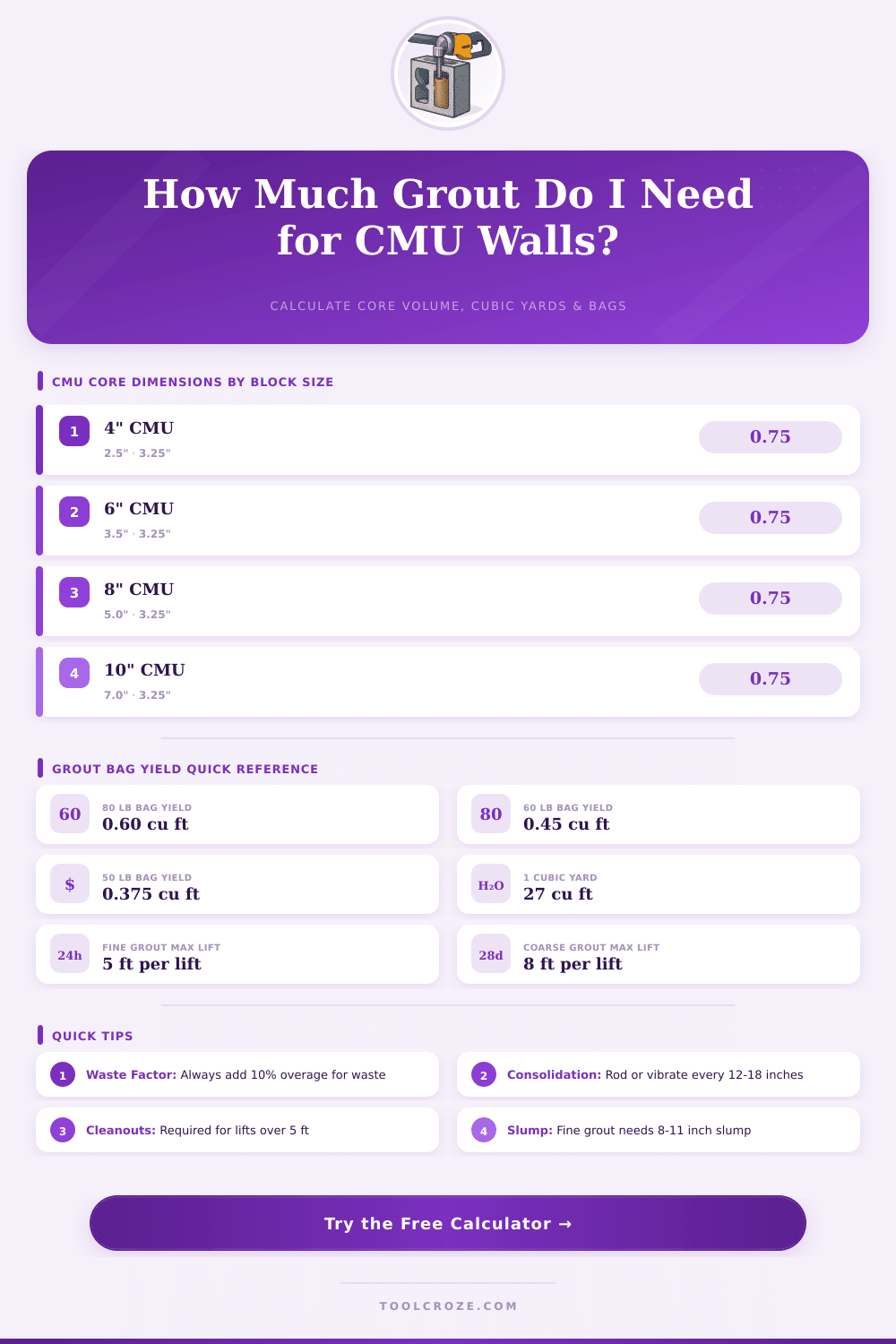
| Block Size | Core Width | Core Depth | Void Ratio | Cores/Ft | Vol/Core/Ft Ht |
|---|---|---|---|---|---|
| 4" CMU | 2.5" | 3.25" | ~25% | 0.75 | 0.034 cu ft |
| 6" CMU | 3.5" | 3.25" | ~33% | 0.75 | 0.047 cu ft |
| 8" CMU | 5.0" | 3.25" | ~45% | 0.75 | 0.067 cu ft |
| 10" CMU | 7.0" | 3.25" | ~52% | 0.75 | 0.094 cu ft |
| 12" CMU | 9.0" | 3.25" | ~58% | 0.75 | 0.121 cu ft |
| Grout Type | Max Lift Height | Consolidation Method | Slump Requirement |
|---|---|---|---|
| Fine Grout | 5 ft per lift | Rodding or low-lift vibration | 8–11 inch slump |
| Coarse Grout | 8 ft per lift | Mechanical vibration required | 8–11 inch slump |
| Self-Consolidating | Up to full story | No consolidation needed | Flow >18" spread |
| Pattern | Cores Filled | Typical Use | Cores/Ft (8" block) |
|---|---|---|---|
| Full Grout | 100% of cores | High seismic, shear walls | 0.75 |
| Partial Grout | Alternate cores (50%) | Standard reinforced walls | 0.375 |
| Bond Beam Only | Horizontal bond beams | Lintels, horizontal reinforcement | Varies by spacing |
| Specified Cores | Per structural plan | Columns, pilasters, custom | Per design |
CMU grout is a cement mix that one uses to fill the holes or spaces in concrete block units during construction. It holds cement, small rocks and enough water, so that it flows in those areas. A bit of lime, fly ash or other extras sometimes get added to the mix.
The main idea is that grout flows a lot so it is more watery than typical mortar or normal concrete. Because of that extra water it can reach the narrow and tight spaces inside the blocks.
CMU Grout: What It Is and How It Makes Walls Strong
grout and mortar do not match. One lays mortar between the blocks, to set them flat together. Grout fills the cells, to give more strength.
Grout differs also from concrete. It is meant to be mixed so that it flows, while too watery concrete blending is actually a problem. Also, grout bonds to CMU blocks better than concrete.
A big reason that one lays grout in the cells of CMU is to add strength to the walls, whether there is inner steel or not. If one uses vertical or horizontal boost, then filling those cells with grout helps the rebar do its job. The goal is to cover the empty part fully with material that matches the strenght of the CMU itself.
Walls from CMU commonly are fully grouted, which means that every single cell gets filled.
Even so not every wall requires full grouting. In lower buildings or simple walls, maybe only every fourth cell gets grouted. In high houses with several floors one can require full grouting from the first level upward threw some steps.
For home designs, twelve-inch walls sometimes do not get grouted everywhere.
The challenge is probably making the grout flow smoothly. Air pockets can happen deep in the wall, if grout jams on rebar, steel ties or mortar garbage. Making sure that the cells of CMU show clear from the top to the bottom helps a lot.
Mortar should not stick out more than half an inch in the cell area. Clean openings at the base of the wall allow workers to remove dry mortar from the holes before grouting. One puts grout in vertical parts, and the layers must be right, so that it flows without breaking apart.
There are pre-mixed grout products for core filling. They are dry bags with pre-blended cement materials and dried rocks. One makes them for good flow and high pressing strength.
As a rough guess, one eighty-pound bag covers around two cells of blocks. If one mixes too watery, that uses more material and fills more wall than needed. Too dry blending causes the grout to not flow right.
Some folks try to drill holes in already existing walls and pump grout from the side with high pressure. Others knocked away the face of a block, pumped in grout, then replaced the face. In existing walls, where the top is hardlyaccessible, grout-holding net can help keep the fill where it is needed.
Even heat tools were used to check for lost grout inside finished CMU walls.
Four-inch blocks get grouted almost impossibly, because their cells are too small. Six-inch or eight-inch blocks work much better and are simpler to handle whole.