Clamp Tonnage Calculator
Estimate mold or press clamp demand from projected part area, runner area, cavity count, cavity pressure, material class, safety factor, platen utilization, and machine rating.
Each preset fills a realistic press or injection mold case and runs the calculation automatically.
Formula Breakdown
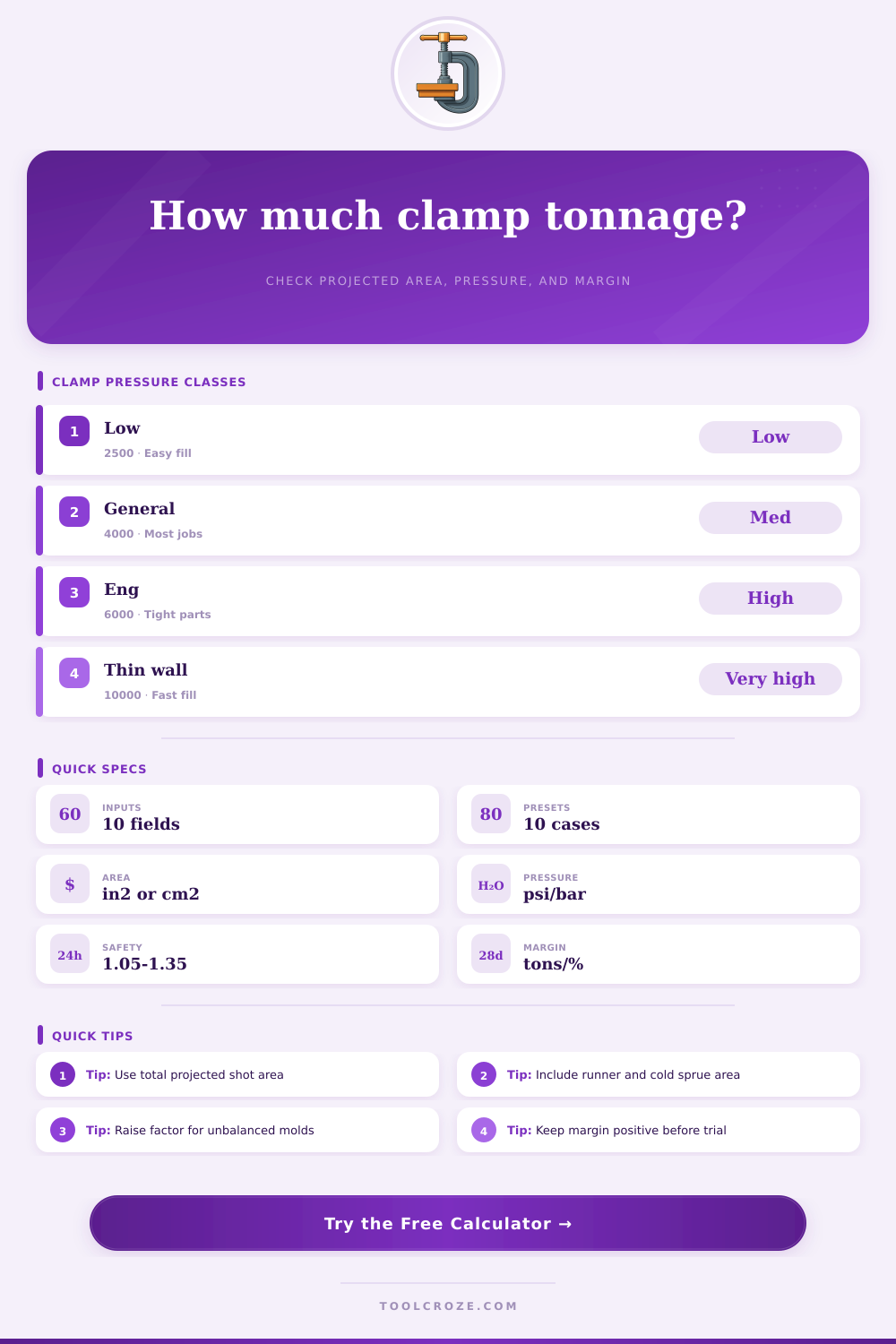
Flexible, rubber, compression, and low-viscosity parts.
Typical PP, PE, PS, and moderate-flow tools.
ABS, nylon, acetal, PC blends, and tighter fill paths.
Fast-fill, long-flow, optical, or flash-sensitive parts.
| Material / Process Class | Typical Cavity Pressure | Common Use | Clamp Planning Note |
|---|---|---|---|
| Compression rubber / TPE pad | 1500 to 3000 psi | Compression and insert molds | Watch platen flatness and mold parallelism. |
| General PP, PE, PS | 3000 to 5000 psi | Caps, housings, covers, trays | Good default when fill data is unknown. |
| ABS, nylon, acetal | 5000 to 7000 psi | Functional parts and tighter gates | Add margin for packing spikes and vents. |
| PC, glass-filled, long-flow parts | 7000 to 9000 psi | Structural, optical, and stiff resins | Verify tie-bar stretch and flash history. |
| Thin-wall packaging | 9000 to 12000 psi | Fast fill lids, cups, containers | Pressure decay and speed can drive clamp peaks. |
| Platen Utilization | When It Fits | Effect in Calculator | Typical Warning |
|---|---|---|---|
| 95% | Centered mold with compact projected area | Small adjustment to required clamp | Best case, still confirm mold support. |
| 90% | Normal production mold layout | Practical default for most tools | Use if no offset or family imbalance is present. |
| 85% | Wide mold, side actions, or mild offset | Raises required clamp by about 18% | Check wear plates and leader alignment. |
| 75% | Broad platen footprint or trim press | Raises required clamp by about 33% | Platen deflection may dominate the setup. |
| 65% | Poor centering or uneven load path | Large derating of available clamp | Engineering review recommended before trial. |
| Machine / Material / Spec Case | Shot Area | Pressure Class | Typical Machine Range |
|---|---|---|---|
| Two-cavity PP closure mold | 25 to 45 in² | General, 4000 psi | 70 to 130 tons |
| Four-cavity thin-wall lid mold | 80 to 130 in² | Thin-wall, 10000 psi | 450 to 850 tons |
| Single-cavity ABS control housing | 35 to 70 in² | Engineering, 6000 psi | 140 to 280 tons |
| Compression rubber pad mold | 70 to 160 in² | Low, 2500 psi | 120 to 300 tons |
| Large glass-filled auto bracket | 90 to 180 in² | High, 8000 psi | 450 to 900 tons |
| Margin Result | Machine Comparison | Setup Meaning | Action Before Trial |
|---|---|---|---|
| Above 20% | Machine rating comfortably exceeds requirement | Good clamp reserve for normal variation | Confirm mold support and start conservative pack. |
| 10% to 20% | Usable but not generous | Common production target | Watch flash at vents, parting line, and inserts. |
| 0% to 10% | Near machine limit | Risk rises with pressure estimate error | Review pressure class and actual fill data. |
| Below 0% | Required clamp exceeds rating | Likely flash, clamp alarm, or platen issue | Move to larger clamp or reduce projected pressure. |
Clamp tonnage are the amount of force that the injection molding machine use to hold the mold shut. Clamp tonnage is necessary to counteract the force of the molten material that is in the mold. If the clamp tonnage is not calculated correct, then the injected material may leak out of the parting line of the mold.
Furthermore, if the clamp tonnage is not correctly calculate, money can also be wasted by using an injection molding machine whose tonnage is higher then that which is required for the manufacturing of the plastic part. The first variable that must be calculated for the clamp tonnage is the projected area of the parts. The projected area is the total area over which the molten plastic parts pushes against the mold.
How to Find the Right Clamp Tonnage for Injection Molding
The projected area of the parts includes the projected area of the part itself, as well as the projected area of the runners, sprues, gates, and side action (also known as lifters). The injection molding clamp tonnage calculator can calculate the projected area, which is able to calculate the square inch or square centimeters of the projected area. The second variable that must be calculated is the cavity pressure.
Cavity pressure is the force of the molten plastic parts within the mold cavity. The cavity pressure can be different for each plastic material that is to be molded into the mold. For example, the mold may require four thousand psi of cavity pressure to successfully mold a cap out of polypropylene resin, but that same mold may require nine thousand psi of cavity pressure to mold an optical lens out of polycarbonate resin.
The cavity pressure can be entered into the clamp tonnage calculator in either general class of pressures, or in specific measurements that are obtained with a cavity pressure sensor within the mold. The third variable that is to be calculated is the safety factor. A safety factor is incorporated into the clamp tonnage calculation to account for the possible variation in the molding process.
For example, the pressure of the plastic parts within the mold may spike to higher levels during the packing phase of the molding process, so higher clamp tonnage are required at this phase of mold operation. Similarly, if the mold temperature vary from the desired temperature for the plastic materials, the clamp tonnage will have to be increased to compensate for the temperature differences. A safety factor of 1.15 is typically utilized for molds in most tools; however, molds that contain glass-filled plastic materials may have a safety factor of 1.25 or higher.
An additional consideration is platen utilization. Platen utilization accounts for the way in which the mold is positioned on the injection molding machine’s clamping platen. If the mold is centered upon the platen, then the mold will efficiently utilize the available clamp force of the injection molding machine.
However, if the mold is not centered upon the platen, the clamp force that is available from the injection molding machine may not be efficient utilized by the mold. Once the injection molding machine clamp tonnage calculator has calculated the clamp tonnage, that calculated tonnage must be compared to the rating of the injection molding machine. If the clamp tonnage that is calculated as being required by the mold is twenty percent higher than the clamp tonnage specification of the injection molding machine, then there is a large margin of safety for the injection molding machine.
If the clamp tonnage that is calculated is only ten percent less than the clamp tonnage specification of the injection molding machine, then the parting line of the mold must be closely monitor for the development of flash. However, if the clamp tonnage that is calculated is higher than the clamp tonnage specification of the injection molding machine, then either the operator must change the injection molding machine to one with higher specification of clamp tonnage, or the injection pressure that is utilized during the injection phase of the molding process must be reduce. The type of plastic materials that are to be molded into the injection mold will impact the clamp tonnage specification.
Plastic materials with low viscosity require less cavity pressure for injection into the mold than high viscosity materials. However, the flash that is created by low viscosity plastic materials is more easily seen than flash created with high viscosity plastic materials. Engineering plastic materials and plastic compounds that contain glass filler require higher levels of cavity pressure during the injection phase of mold operation to prevent the molded plastic parts from exhibiting sink mark.
However, the flash that is created by molded plastic parts that contain glass filler is less easily seen than plastic parts that does not contain glass filler. Finally, rubber and TPE (thermoplastic elastomers) molded parts require very low levels of cavity pressure within the mold to successfully complete the molding process. In this case, however, the injection molding machine utilizes the clamp force that becomes an important factor in the molding process; the molds for rubber and TPE materials are often very large in size.
Many mistake occur in the injection molding process if the operator does not fully consider all of the components of the projected area that must be considered. For example, the runner system may be forgotten in calculating the projected area; or, the cavity pressure specifications that are entered into the clamp tonnage calculator may have been collected from a different injection molding machine than the machine that will be molding the plastic parts. If the projected area measurements or the cavity pressure measurements are either incorrect or inaccurate, the clamp tonnage will be incorrectly calculate.
In this case, you can utilize the clamp tonnage specification tables that are provided with the clamp tonnage calculator to ensure that the plastic material and clamp force utilization values that are entered into the calculator are correct. Finally, it is important to understand that the clamp tonnage that is calculated for a specific mold and plastic injection process is only a guide for the clamp force that is to be utilized. There are other factors that impact the injection molding process and clamp tonnage that include factors like tie-bar stretch and mold deflection.
Regardless, however, the calculated clamp tonnage should always be used as a starting point for injection molding operations. Furthermore, during the initial startup of the injection molding machine, it is important to use reduced pressure for the packing phase of mold operation to reduce the chance of flash emerging from the parting line of the mold. If the projected area and cavity pressure measurements are accurate, the clamp tonnage that is calculated for a specific injection molding machine will be that which should be utilized during the injection molding process.