Clamp Force Calculator
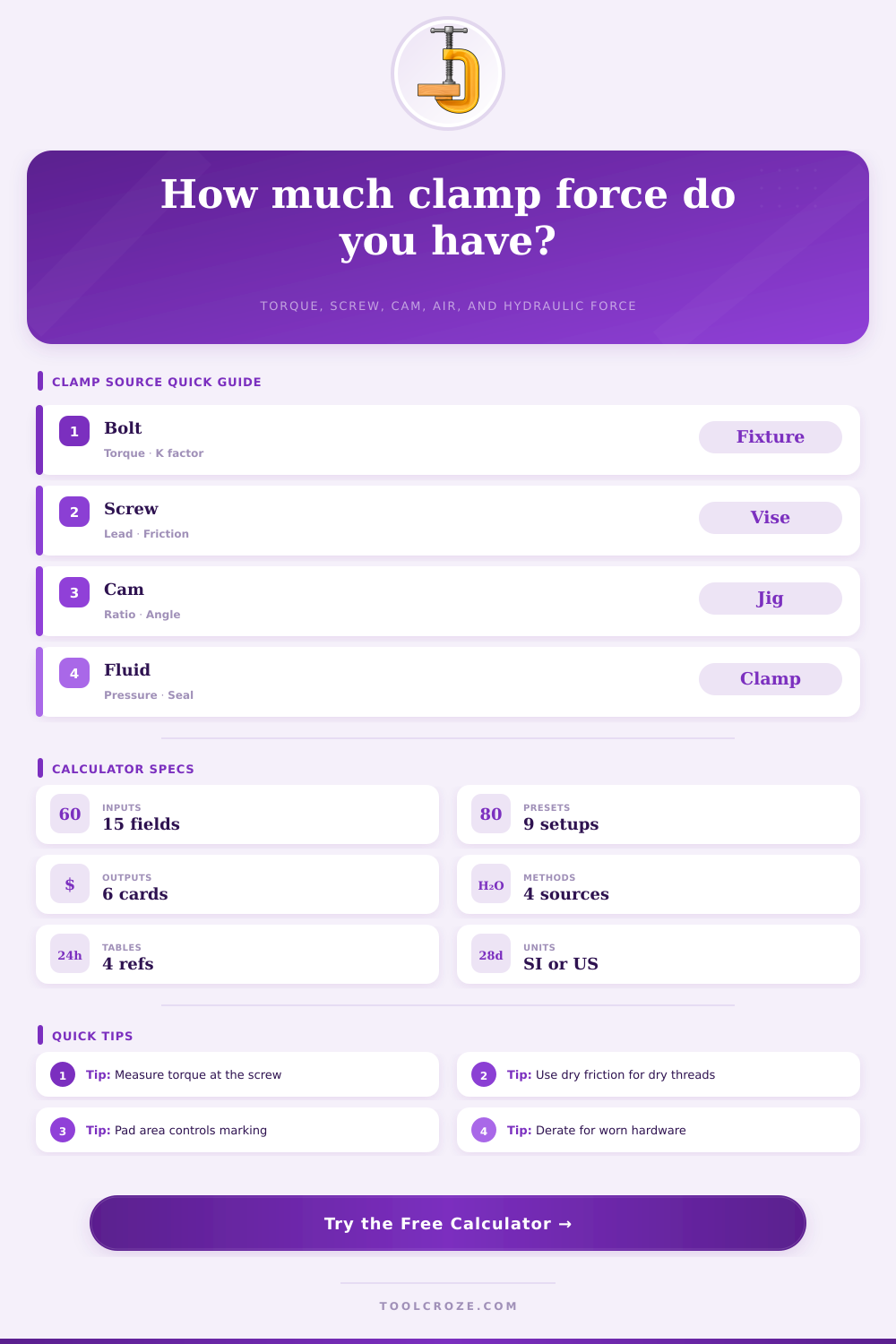
Estimate shop and fixture clamping force from bolt torque, power screw lead, thread friction, cam or lever ratio, hydraulic or pneumatic pressure, jaw geometry, contact pad area, and safety factor.
⚙ Shop Clamp Presets
Choose a realistic setup, then adjust the values for your hardware, contact pads, and holding requirement.
🔧 Clamp Inputs
Formula Breakdown
📊 Clamp Hardware / Material Spec Grid
⚒ Clamp Source Formula Reference
| Clamp Source | Main Inputs | Formula Used | Shop Notes |
|---|---|---|---|
| Bolt torque preload | Torque, diameter, K factor | F = T / (K × d) | Best for fixture screws, strap clamps, vise jaw bolts, and threaded hold-downs. |
| Power screw clamp | Torque, lead, efficiency | F = 2πTη / lead | Use for C-clamps, screw vises, acme screws, and handwheel fixtures. |
| Cam or lever clamp | Torque source, ratio, angle | F = source × ratio × cos(angle) | Ratio depends on pivot spacing, cam rise, handle location, and over-center geometry. |
| Hydraulic / pneumatic | Pressure, bore, transfer loss | F = P × πr² | Use actual port pressure and allow for seal drag, linkage loss, and return spring force. |
🧰 Hardware And Friction Comparison
| Hardware | Typical Spec | Friction / Efficiency | Best Use |
|---|---|---|---|
| Grade 5 / ISO 8.8 bolt | General fixture screw | Mu 0.16 to 0.22 dry | Moderate torque hold-downs and vise jaws. |
| Grade 8 / ISO 10.9 bolt | Higher proof load | Mu 0.14 to 0.20 lubed | Higher preload where threads and tapped holes are verified. |
| Alloy clamp screw | Hardened swivel pad | K 0.18 to 0.26 | Repeatable machine clamps and drill press hold-downs. |
| Acme screw with bronze nut | 29 degree thread form | Efficiency 25% to 40% | C-clamps, vises, presses, and handwheel fixtures. |
| Toggle linkage clamp | Over-center linkage | Transfer 80% to 95% | Fast repeated clamping where travel is short. |
| Hydraulic swing clamp | Oil pressure cylinder | Transfer 85% to 95% | Dense fixtures needing repeatable force and compact hardware. |
📐 Contact Pad Pressure Guide
| Work Contact | Typical Pad | Starting Pressure Range | Risk To Watch |
|---|---|---|---|
| Softwood or plywood | Rubber, cork, broad wood pad | 0.2 to 1.5 MPa | Denting, veneer crush, glue squeeze variation. |
| Hardwood or plastic | Smooth swivel pad | 1 to 5 MPa | Surface marking or localized bowing. |
| Aluminum fixture part | Brass, nylon, or serrated pad | 3 to 20 MPa | Pad witness marks and part movement. |
| Mild steel workpiece | Hardened steel pad | 10 to 60 MPa | Slipping if contact is oily or angled. |
🛡 Safety Factor Reference
| Setup Condition | Suggested Factor | When To Use | Extra Check |
|---|---|---|---|
| Light steady holding | 1.25 | Static assembly or gentle locating pressure. | Confirm part cannot rock under the pads. |
| General shop clamp | 1.50 | Routine drilling, routing, sawing, or fixture holding. | Check pad area and thread engagement. |
| Vibration or interrupted cut | 2.00 | Drill press work, milling chatter risk, rough cuts. | Use backup stops where sliding is possible. |
| Shock or uncertain geometry | 2.50 to 3.00 | Unknown friction, worn clamps, high overhang, or impact. | Test at low load and inspect hardware after use. |
💡 Practical Clamp Notes
Clamp force is the force that holds a part in place while a person uses a cutter, press, or hand tool. Many differents tools create clamp force, such as vice jaws, strap clamps, C-clamps, and pneumatic cylinders. Each of these tool has an input that is converted to a normal force.
The normal force ensure that the parts will not slide or lift during the task that is to be accomplished. A person must understand the way in which each clamp tool converts its input to normal force. The individual who dont understand this process may use a clamp that slip or one that marks the part that is to be held.
What Is Clamp Force and How to Calculate It
Many people use clamp force by guessing at the proper amount of clamp force to apply. People often tighten the clamp until it feel solid. However, the force that is applied in this manner isnt a reliable means of obtaining the clamp force that is necessary to safely complete a task.
A person should not focus solely upon the amount of force that is required to tighten a handle. The amount of clamp force that will be created will be less than the amount of force that is applied due to friction and angle losses. It is possible to use a calculator to determine the amount of clamp force in a set of hardware component.
The calculation of the torque that is applied to bolts is an important calculation. The relationship between the torque that is applied, the diameter of the bolt, and the nut factor is important in the setup of many clamps. However, the starting force of those bolts can change if the threads of the bolt change condition.
If the condition of the threads changes from dry steel to oiled steel, the clamp load will be higher due to the difference in the friction of those two steels. The hardware selector in the clamp force calculator allow the user to adjust the friction of the threads without memorizing the friction tables for different steels. Power screws and C-clamps use a different technique to create clamp force.
The lead angle of the screw and the efficiency of the threads will determine the amount of clamp force that is created. A multi-start Acme thread will move faster than other threads of the same specification. However, a multi-start Acme thread will provide less mechanical advantage than other types of threads.
Because there is less mechanical advantage, the same amount of torque applied to two different C-clamps will create different amount of clamp force. The efficiency of the screw is applied directly in the clamp force calculator to determine the actual clamp force of the screw. The force created by cam clamps or lever clamps are created using the mechanical ratios of the clamp tools.
The force created by a cam or lever clamp will be less if the angle between the clamp jaw and the workpiece is not 0 degrees. A five-degree angle between the clamp and the workpiece may seem small. However, this small angle will create a cosine loss in the clamp force that is calculated.
The ratio and angle field in the clamp force calculator will allow a person to determine if the pivot point of a lever clamp or a cam clamp need to be changed to provide more clamp force to the workpiece. Fluid clamps create clamp force through the use of pressure and area within the clamp tool. The shop air that is directed against the area of the piston will create clamp force.
However, other losses in clamp force will occur in the seal, linkages, and spring returns of the clamp. The percentage of clamp force that is lost in the seal can be entered into the clamp force calculator to derate the clamp force that is created by the piston. The contact pressure of clamp force exerted on the part is a value that is often ignored by those that use clamp force calculators.
It is possible to apply the same amount of clamp force with two clamps. However, each clamp may mark the part differently. Softwoods and plastics will develop witness marks if the clamp force is too high.
The area of the clamps pad can be entered into the clamp force calculator to ensure that the clamp force is within an acceptable range. The safety factor that is used in clamp calculations accounts for the possibility of errors in the clamp setup. The safety factor can be 1.25 for a steady machine operation.
For an operation such as milling with an interrupted cut on an overhanging part, a safety factor of 2.0 can be used. The margin field allows a person to see the difference between the clamps derated working hold with the load that is to be cut by the machining operation. Most clamp and fastener setups will not meet the ideal condition of clamp force calculations.
Factors such as thread engagement, material softness, and clamp flex allow for the seal-loss and ratio fields to be used in clamp force calculators. The status line will let a person know if the clamp force calculations meet the load that is to be clamped or if an adjustment to the clamp setup must be made. Some of the most common mistakes with clamp force calculations include reading the torque of a handle with a wrench instead of reading the clamp torque.
Another common mistake is to ignore the lead of a screw when the pitch is significantly different. Another common mistake is to ignore the fact that clamps do not divide the load equally. The preset buttons for clamp types will allow for the setup of clamps with realistic starting values.
It is common for an operator to believe that the clamp force that is calculated with the clamp force calculator is a fixed value of a clamp tool. However, clamp force is a function of the entire clamp system. A change in the angle of the clamp jaw or pad size will change the clamp force of a system.
Thus, the clamp force should of been calculated again. Calculating the clamp force in a setup is the best method of determining clamp force instead of discovering that a part has moved during a machine program. The overall benefit of clamp force calculators is that an operator can anticipate the outcome of a clamp setup.
Clamp force calculators allow a person to tighten a bolt to a known torque. The clamp force calculators will allow a person to ensure that the contact pressure of the clamp is within an acceptable range for the part being clamped. Clamp force calculators ensure that clamp setup forces will not be less than the force requirements of the machining operation.
Clamp force calculators allow a person to avoid the trial and error process of tightening clamps until the desired amount of clamp force is created.