Circumference to Linear Feet Calculator
Convert round pipe, tank, fence, pool, hose, strap, cable, and conduit loops into usable linear feet with turns, repeated circles, waste, material take-up, and roll reserve.
Choose a common pipe, tank, fence, or circular layout, then adjust the measured diameter, turns, waste, and roll length for the actual job.
Linear Foot Result
| Diameter | Radius | Circumference | Typical Job |
|---|---|---|---|
| 12 in | 6 in | 3.14 ft | Small pipe wrap, vent collar |
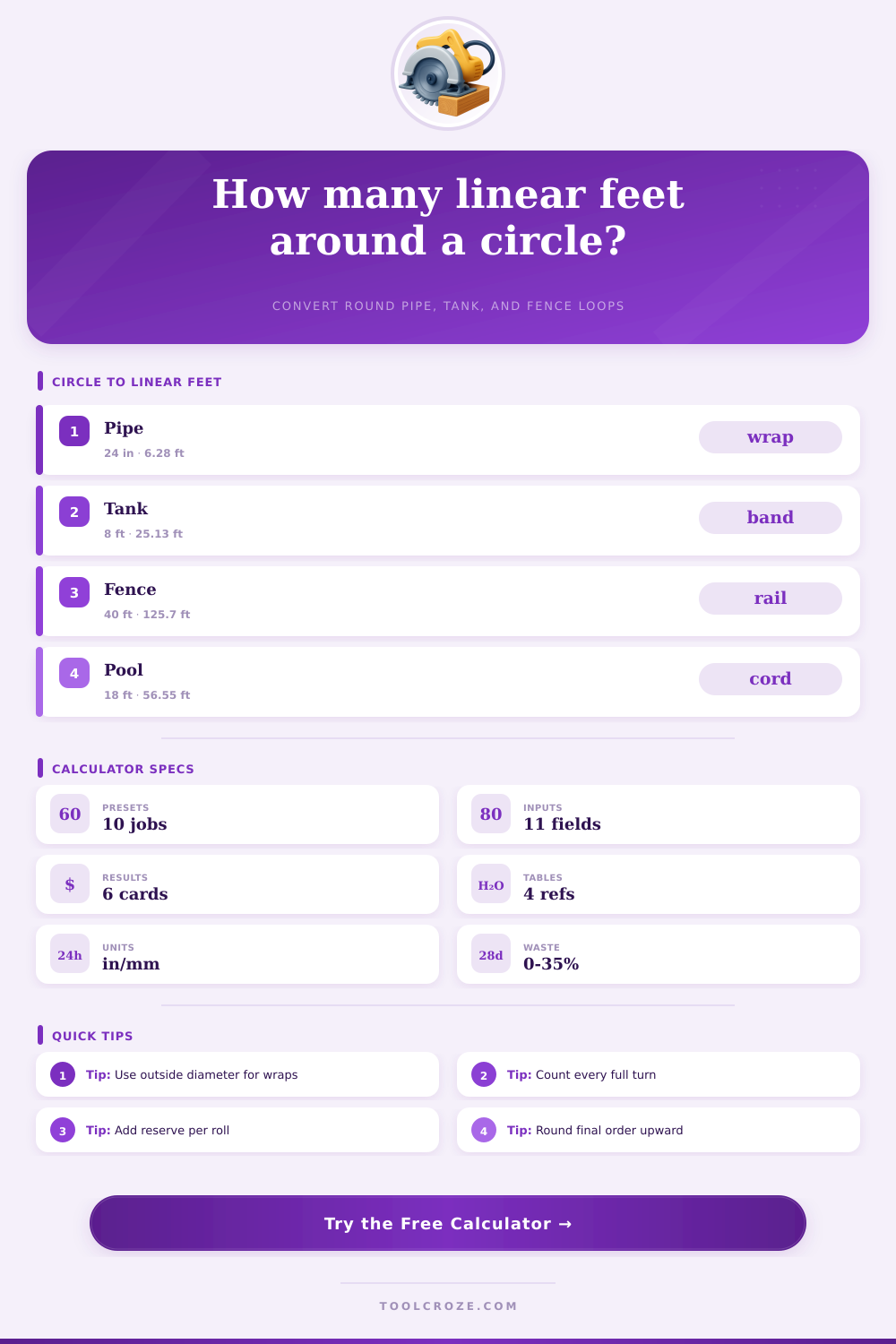
| 24 in | 12 in | 6.28 ft | Culvert band, barrel hoop |
| 36 in | 18 in | 9.42 ft | Large culvert, planter ring |
| 6 ft | 3 ft | 18.85 ft | Garden bed, round tank liner |
| 8 ft | 4 ft | 25.13 ft | Water tank band, pool pad edge |
| 18 ft | 9 ft | 56.55 ft | Pool cord, round patio edge |
| 40 ft | 20 ft | 125.66 ft | Round pen or circular fence rail |
| Material | Typical Weight | Take-Up Factor | Planning Note |
|---|---|---|---|
| PEX or poly tubing | 0.10 lb/ft | 3% | Use wider sweeps around tight tanks. |
| Copper tube | 0.28 lb/ft | 4% | Add allowance for formed bends and fittings. |
| EMT conduit | 0.35 lb/ft | 5% | Plan couplers and bend loss before cutting. |
| Galvanized steel cable | 0.17 lb/ft | 2% | Include turnbuckle and clamp tail length. |
| Steel or vinyl strap | 0.12 lb/ft | 2% | Use overlap allowance at every closure. |
| Garden hose | 0.33 lb/ft | 4% | Leave slack for fittings and seasonal movement. |
| Fence or tie wire | 0.06 lb/ft | 2% | Reserve extra length for twisting ends. |
| Chain link top rail | 1.35 lb/ft | 1% | Round up by rail sections after layout. |
| Preset | Diameter | Turns | Default Material |
|---|---|---|---|
| 24 in pipe wrap | 24 in | 2 | EMT conduit |
| 55 gal drum band | 22.5 in | 1 | Steel or vinyl strap |
| 8 ft water tank | 96 in | 1 | PEX or poly tubing |
| 40 ft round pen | 40 ft | 3 | Chain link top rail |
| 18 ft pool perimeter | 18 ft | 1 | Fence or tie wire |
| 36 in culvert band | 36 in | 2 | Galvanized steel cable |
| 12 ft grain bin seal | 12 ft | 1 | Steel or vinyl strap |
| Supply Type | Common Roll | Reserve | Use When |
|---|---|---|---|
| Small wire spool | 50 ft | 1-2 ft | Twisted ends and light fence loops |
| Tubing coil | 100 ft | 2-4 ft | Tank wraps and irrigation rings |
| Hose coil | 50 or 100 ft | 3-5 ft | Fittings need flexible slack |
| Strap roll | 25 or 100 ft | 0.5-2 ft | Overlap closures or clamp tails |
| Top rail section | 10.5 ft | 0 ft | Round up by full rail pieces |
When you are wrapping a length of pipe, cable, hose, or rail around an object, you must calculate the total length of material that is required to complete the project. The total length of material that is required to complete the project isnt simply the circumference of the object that is to be wrapped, but must also take into account every pass that the material make around the object, every overlap of the material that is made during the wrapping process, and every bit of material that is lost to necessary cuts to the material. The difference between the circumference of the object to be wrapped and the length of the material that is ordered introduces the potential for mistakes in the wrapping process.
The total length of material that is calculated for a wrapping job is somewhat straightforwardly to calculate, but a variety of different factors actualy influences the calculation. You can multiply the circumference of the object to be wrapped by the number of turns that are to be made around the object, the number of circles that is to be wrapped around the object, and additional allowances can be made for material waste, the length of the material rolls, and any extra length that is present within each new roll of material. Each of these factors will influence the total length that is calculated for the length of the material that is required for the project.
How to Calculate Material Needed for Wrapping
For instance, if the material that is to be wrapped is a soft poly tube, it will exhibit some stretch in the wrapping process, and it will require the creation of gentler curves around the object than if it was using a material like EMT conduit, which hold its shape during the wrapping process. Additionally, because the user will require the cutting of the conduit in order to fit it around the object, the EMT conduit will cost more than the soft poly tube due to the necessary cuts. Similarly, steel strap will require overlaps at each of the closure at which it is secured to the object to be wrapped, thus requiring more of the steel strap material for the project than if one of the other types of materials were to be used.
The various field within the calculator will ask for a variety of the same types of information. For instance, the user can select the diameter, radius, or circumference of the object, as each of these parameter will tell the calculator what type of measurement is present on the object to be wrapped. The number of turns that are to be made around the object will be requested, as making multiple passes around the object provides more strength or coverage with those multiple passes.
Additionally, the percentage of waste that will be created during the wrapping process will be requested, as this will account for the number of piece of material that will be cut from the total length that is ordered to fit the object to be wrapped. The length of each roll of the material and the amount of extra material that will be needed per spool will also be requested. Finally, the joint allowance for the material will be requested, which will account for the length of overhang or clamp tails that will dissapear once the material is secured to the object.
Each of these fields prevents the result of ordering too little of the material to perform the wrapping process on the object to be wrapped. In addition to the calculations that are requested of each field within the calculator, there are also physical considerations to the wrapping process. For example, the user will measure the outside diameter of the object after it is insulated, as measuring the outside diameter of the object after applying the insulation will be more accurate than measuring the diameter of the object prior to application of the insulation.
Any small error in the diameter of the object will be repeated in each pass that the material makes around the object. Additionally, the bending radius of the material will be considered, as each of the materials turn will be around the object; any turns that are too tight for the material may create kinks in the material that must be replaced; creating the necessary additional length for the replacement of kinks and flattened sections of the material increases the total length of the material to be purchased. Finally, the potential for the object to expand or contract due to changes in the surrounding temperature will be considered; any change in the length of the material due to changes in temperature will have to be accounted for in the purchasing of the material.
For many people, adding a flat ten or fifteen percent to the calculations will be performed, but in most cases, the addition of a flat percentage to the calculations is not accurate. Adding a flat percentage is accurate for wrapping jobs that are relatively simple, but a flat percentage does not account for the difference between a single wrap around the object to be wrapped to a series of full turns that are to be perform. Additionally, the length of each roll of the material that is purchased from the supplier will impact the decision of the total length of that material that is purchased; if the calculated length of the material required for the project is just over a standard length of roll of material, it is possible that two full rolls of material must be purchased rather than one roll of material.
Thus, if two rolls of material are to be purchased, the reserve length of the material per roll will also impact the total length that is ordered for the project. The reference tables that are provided within the calculator will contain information regarding the weights of the materials, the length of the material that is taken up during the wrapping process, and the sizes of the rolls in which the materials can be found. These tables are not meant to fully replace the judgment of the individuals performing the calculations with the parameters of the fields in the calculator.
However, the tables will provide information regarding the weight of the materials, the bend radius of each material, how many options for materials may be available for purchase, and additional information that will help the individual to decide between the two options for material for the project. The long and short of it is that the goal of the calculation is to order the length of material for the project such that the order arrives and the material can be placed around the object to be wrapped, but the order of material that is delivered to the job site will leave little waste on the floor. Thus, the calculator will ask for each of the mentioned information, but the individual must also pay attention to each of the parameters of the objects to be wrapped; the length and diameter of each object, the number of passes that will be required, and the physical characteristics of the material that is to be wrapped around each object.
Thus, the individual must make adjustments to each of the fields of the calculator to ensure that the material behaves in the same way around the objects to be wrapped as that individual has programmed the calculator to expect the material to behave.