Circle Brick Calculator
Estimate bricks for circular fire pit rings, tree surrounds, annular patios, column wraps, and curved border arcs using inside or outside diameter, ring width, brick orientation, radial joints, cut angle, mortar, and waste.
🧱Circle Brick Presets
Choose a real circular masonry layout, then fine-tune the diameters, brick size, joint width, and orientation.
⚙Ring Geometry And Brick Inputs
Circle Brick Results
Full Calculation Breakdown
📊Selected Brick And Ring Spec
🗂Orientation Comparison Grid
| Orientation | Tangent module | Radial module | Best circle use |
|---|---|---|---|
| Soldier ring | Brick width plus joint | Brick length plus radial joint | Deep fire pit rings and raised borders |
| Sailor ring | Brick length plus joint | Brick width plus radial joint | Broad visible face with fewer perimeter units |
| Stretcher curve | Brick length plus joint | Brick width plus radial joint | Large-radius paths and patio bands |
| Rowlock edge | Brick length plus joint | Brick height plus radial joint | Narrow circular edging and caps |
| Custom module | User-defined by size fields | User-defined by orientation | Special pavers, cut brick, or reclaimed units |
📏Circle Diameter And Joint Reference
| Circle type | Typical inside diameter | Common joint width | Layout note |
|---|---|---|---|
| Fire pit ring | 30 to 48 in | 3/8 to 1/2 in | Use heat-safe liner rules and verify clearances |
| Tree surround | 48 to 96 in | 1/4 to 3/8 in | Keep opening large enough for trunk growth and mulch |
| Patio medallion | 72 to 144 in | 1/8 to 3/8 in | Centerline count usually matches layout drawings |
| Column wrap | 18 to 36 in | 3/8 to 1/2 in | Tight rings often need tapered cuts or smaller units |
| Garden border arc | 60 in and up | 1/4 to 1/2 in | Partial arcs need end cuts as well as wedge cuts |
⚒Material And Spec Comparison
| Brick type | Nominal size | Ring behavior | Typical waste range |
|---|---|---|---|
| Modular brick | 7.625 x 3.625 x 2.25 in | Predictable joints, good for soldier and sailor rings | 10 to 16% |
| Clay paver | 8 x 4 x 2.25 in | Clean patio rings; often dry-laid with tight joints | 8 to 14% |
| Queen brick | 7.625 x 2.75 x 2.75 in | Narrow radial module helps smaller circles | 12 to 18% |
| Utility brick | 11.625 x 3.625 x 3.625 in | Fewer bricks, larger wedge cuts on tight rings | 14 to 22% |
| Roman brick | 11.5 x 3.5 x 1.625 in | Long visual lines; best at broad radii | 12 to 20% |
| Thin brick | 7.625 x 2.25 x 0.625 in | Good veneer face, not a structural paving unit | 12 to 18% |
🧮Preset Geometry Reference
| Preset | Diameter basis | Ring width | Orientation and waste |
|---|---|---|---|
| Fire Pit Soldier Ring | Inside 4 ft | 8 in | Soldier, 12% waste |
| Tree Ring Sailor Course | Inside 6 ft | 8 in | Sailor, 10% waste |
| Patio Medallion Border | Centerline 9 ft | 12 in | Stretcher, 14% waste |
| Semicircle Landing Edge | Outside 7 ft | 8 in | Rowlock, 12% waste |
| Metric Courtyard Arc | Centerline 3 m | 300 mm | Stretcher, 15% waste |
💡Circle Brick Calculation Tips
The problem is that rectangular bricks don’t match the shape of a perfect circle, in fact, there geometry fights you from the very first unit. The problem begins when you sets the very first brick down. Homeowners greatly underestimate this issue because they think it’s as easy as laying out bricks next to each other. No, no, no… you has to angle each joint to close the ring.
And then you find out inner circumference isn’t as long than the outside one; it sounds easy until you reach that part. To figure this out, enter your ring width and diameter. This eliminates any guesswork on how many radial bands will span the border.
How to Plan Your Brick Circle
Before measuring anything, decide how you want to measure. Do you want to measure the outside edge? That’s one way. Do you want to measure inside opening? Also one way. Or do you want to count along centerline of brick band? Another way. Why does this matter? Because it affect the number of bricks you end up with.
If you’re building a fire pit, the inside diameter (or circumference) define the room for logs. If you’re laying a patio medallion, then the count along the centerline will align with your drawing better. Your tool automatically computes both the other two dimensions based off which dimension you use as basis. So now you won’t treat circle like a straight wall and run out halfway through the inner band.
People tend to think of a circle as though it were a straight wall. A circle has a thickness; it vary in area depending on where you place your ruler. The orientation makes a big difference. In a radial layout for a soldier course, the bricks runs from the outside edge straight to center. That produces a few bricks around the outside (fewer) and deep rings inside (more).
Sailor course is radial across the width of the object; it use the wide face and so appears wider (but needs more units in each circle). By toggling between them in the calculator you can see how the number of bands changes. Notice that as the radius gets tight, the brick ends get sharp miters… Which means wasting material or risking tiny chips at edge.
The tool takes this into account by increasing waste allowance to match the severity of the cut. Mortar joints act as geometric buffers. A three-eighths inch mortar joint is constant along a straight wall. Along a curve it adjusts for difference between the arc length and the actual width of each brick. You can’t just use the joint width to calculate number of bricks, because then you’ll be off by one or two bricks per band every time.
Common tree surround layouts makes this easy to see on the reference table. For example, a quarter-inch joint is typical for tree ring layout, so there’s some room for minor settling before brick structure gets stressed.
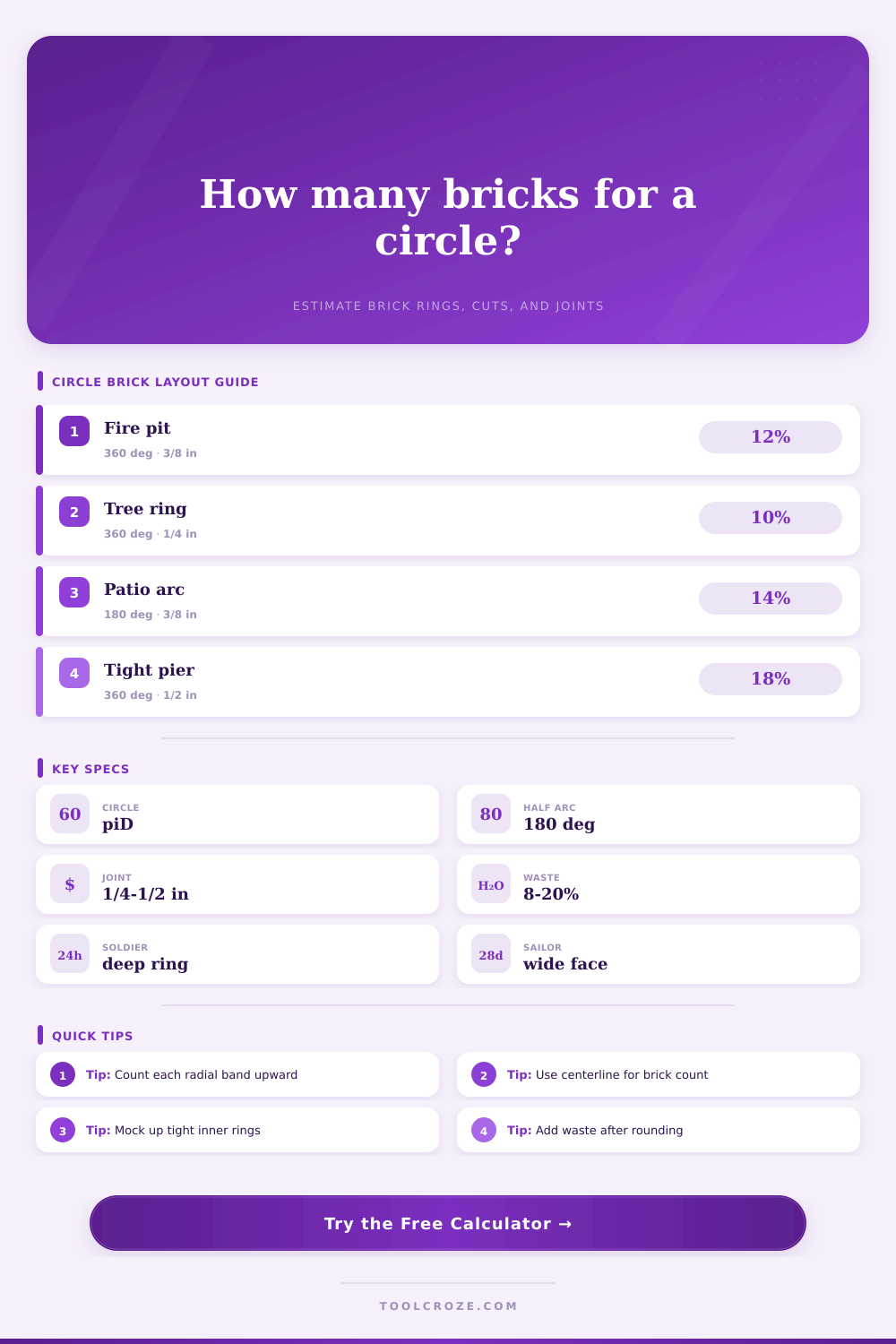
In a circular project, there’s always some waste. Some of the cuts angle off too far and aren’t suitable for another application. To calculate, they include a buffer (percentage) depending on how complicated the rings are. Generally speaking, twelve percent is plenty for a large, continuous circle. But for something more moddern like a custom arc or a very narrow column wrap, it will increases up to eighteen or even twenty percent. Better to come away with an additional brick or two than trekking back down to supplier once the mortar has been mixed.
First, pour one full band of the inner ring of the bed mockup on a flat surface, then dry lay it without mortar to ensure the joints look uniform. Is radius too tight for this brick size? Will the gaps pinch shut or flare out? Poor compaction and uneven ground can’t be calculated by the calculator; they’re physical problems that require a level base. Check your local codes if building around heat sources as some areas has fire-rated assembly requirements. Standard clay brick is not rated for direct flame exposure unless properly insulated.
Geometry and Patience are required to build a circular brick feature. The math is strict, but you could of made minor changes on how you do it if you know the form. Use right diameter base. Orient it so the radius matches what you want. Allow enough material for a waste factor. If all of those come together then the circle closes nicely. You won’t have to force the bricks into an incompatible form because they will find their naturaly home.