
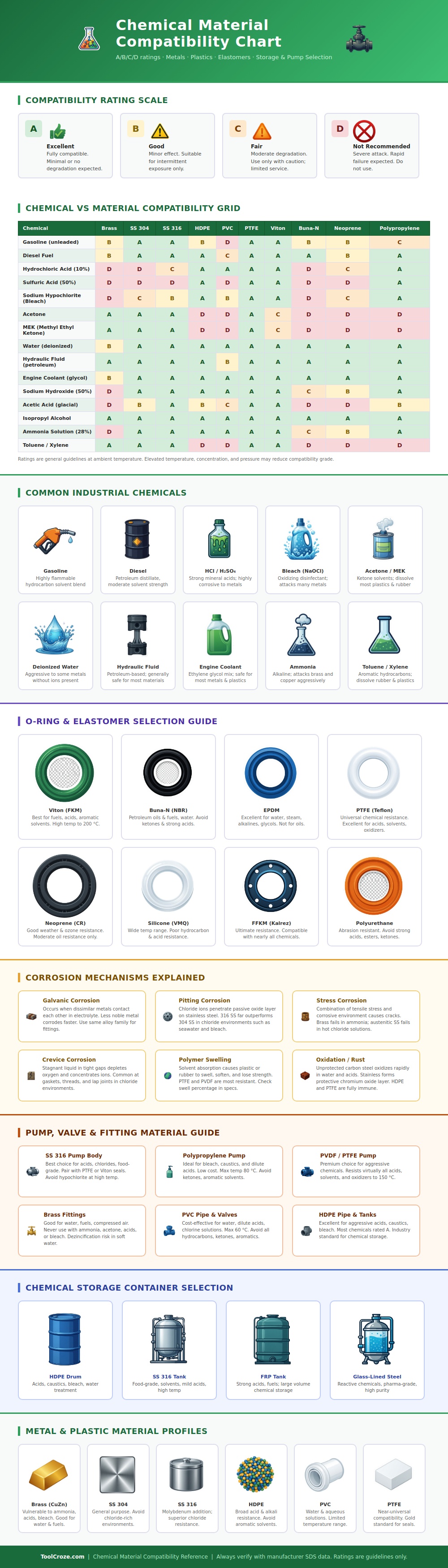
It stays fine until someone places it in a bucket of something that eats away the bottom. Suddenly you has an industrial mess with expensive clean up. Industrial applications are not alone, as this could be your mistake too if you don’t know how chemicals reacts before buying. Knowing what reacts with what help you decide what to use and what won’t.
This is a chart rating the resistance of various materials from A to D to a list of chemicals. A = little or no damage. Use the material with confidence. D= Severely attacked with quick deterioration. Don’t do that! The trouble is most folks overlook B and C ratings, which are dangerous in their own right because they typically indicate limited exposure. What does that mean? If I put a material marked B in contact with solvent it may hold for a while then disintegrate over time. That’s important if you’re comparing purchase price to service life.
Why Chemical Compatibility Matters
Metals is fickle. They can fail in ways that aren’t apparent until it’s too late. For example, stainless steel is not one size fits all. Selecting the wrong grade for your application mean doom. A standard 304 stainless is adequate for most applications, but if you expose it to a lot of chlorides, it’ll be aggressive and pit. And many folks think “stainless is stainless.” That’s great unless you’re using seawater or bleach. Upgrade to 316 stainless because it contain molybdenum, which greatly increases its resistance to these pitting agent.
Another gotcha material is brass. It is great for fuel and water but bad news for acids and ammonia. Dezincification occurs where acids and ammonia eat away at copper in the alloy, leaving a weak porous material behind.
Unlike metal, plastics tend to soften or swell rather than corrode. They are made up of long molecular chain that can be broken by solvents like MEK or acetone. These solvents soak through polymer chains and cause them to break down, making them lose their stiffness and soften into a gooey mass. Polyethylene (HDPE) resists both acids and caustics and is commonly used for chemical containment. Rubber seals also give in rapidly to aromatic hydrocarbons; so does high-density polyethylene.
The truth is that no one plastic resist all substances. It’s a myth to think that there is such a thing as universal plastic. PTFE comes pretty darn close to being gold standard for chemical resistance. Virtually everything from solvents to acids resist attack against PTFE. This usually comes at a price of higher costs and lower mechanical strength.
Any system has its weak links, and frequently that is an elastomer (O-ring) or another seal. The integrity of a system rely on the seal, so even though the body of a pump may be compatible with other parts, it won’t matter if your seal isn’t. Buna-N seals are great for petroleum oils, but fail at resisting ketones. Viton seals resist fuels and aromatics well. As much as matching the housing to the seal material, you need to match the seal material to the chemical. If you get the seal material wrong, a small leak will soon become a full system shutdown overnight.
These ratings are relative as they change based off concentration, pressure and temperature. For example, something may be resistant to a chemical at ambient temperatures but then melt in your hand when it’s warm. So take into consideration how hot or cold things will get. And always check the data sheet from the manufacturer because this makes a difference.
The idea isn’t to select something just because it’ll work for a moment; instead, build a system that lasts. Respect the chemistry of what goes into it. Stop guessing so much. Start designing it to last long term. You should of learned the hard way from that first bucket failure.
