
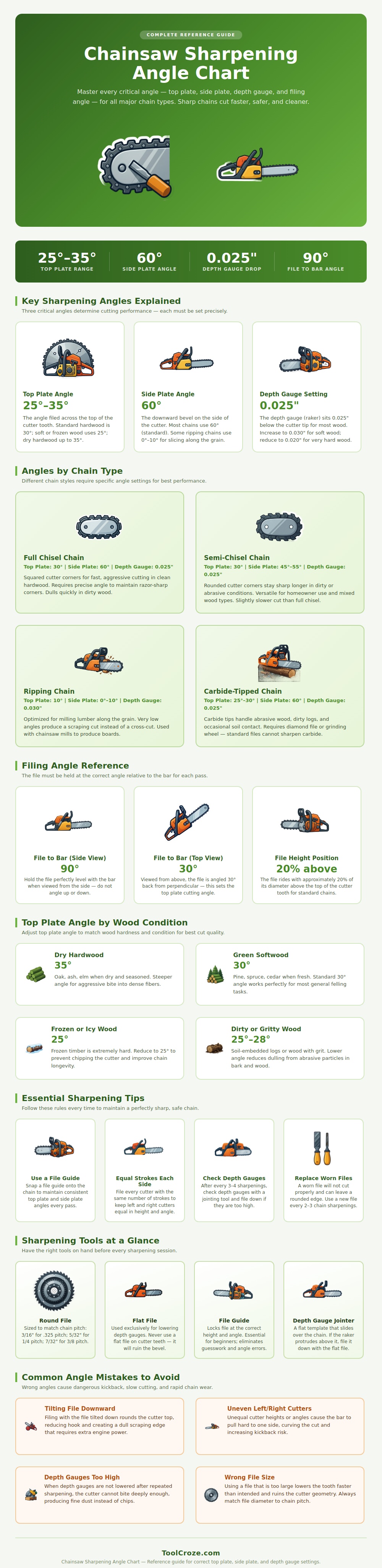
Get your angles wrong with a chainsaw, and it’s going to smoke, not cut well. You’ll assume the chain is dull, or the saw’s weak. But it’s probably just geometry. The little knives on a chain saw scrape off wood, and they needs very specific angles to bite in right. Get the angles right and the thing cuts well. Get them wrong and all you do is make heat and burn fuel.
A key factor for cutting power are the angle of the top plate. Typically with normal hardwoods it’s about thirty degrees. What that does is control how hard the tooth grab the wood fibers. The shallower you make that angle by filing it down to maybe twenty-five degrees, the chain will cut slower but remain sharper for much longer. File it steeper like thirty-five degrees and the tooth will dig deeper and dull quicker from increased resistence. That could of been helpful when cutting something dry like Oak or frozen timber. Most homeowners land right in the middle, where it cuts maple and pine equally well without having to start over.
Why Chainsaw Angles Matter for Better Cutting
While folks is focused on the top plate angle, they completely neglect the importance of side plate angle. This is where beveled surface comes into play when cutting. Once the top plate engages, this bevel dictates whether it cuts cleanly by shaving the wood off or chipping at it. Regular chains has a 60 degree bevel. Ripping chains reduce it to near zero degrees. They do not chip. Instead, they rip/slice. So if you get sloppy, cross-contaminate or let one slide, you’ll get a ratty cut. Rather than nice shavings, the chain will fail to knock chips free. Instead, you’ll get all sorts of tiny dust inside the bar groove which in turn will overheat drive mechanism. It is a little thing, but it matters for how long the saw lasts.
The other thing to change is the depth gauge, that little metal nub in front of the cutters. The teeth becomes shorter as you sharpen them. Unless you file them down, the depth gauges stays the same height even as the teeth get shorter. So if they’re sticking up above the cutters too high, then they’ll catch on the wood first instead of the cutter. Then the tooth is rubbing along something without being able to take a bite. For general use, according to the chart, you want to file it off to be roughly twenty-five thousandths of an inch below where the cutter ends. Check it every few sharpens. I find myself forgetting easily and then the saw won’t cut even though teeth might actualy be sharp.
When filing, maintain the level of the file at the level of the bar. If you don’t, the corner of the tooth will be rounded off, which kills the hook. Use a file guide if your hands aren’t steady enough to hold angle freehand. The key is consistency as this helps keep the chain running true. Round files should never be allowed to go flat. A dull file causes a rounded edge, which means friction, and friction leads to heat, and heat destroys the steel as well as your patience. Learn the angles and eliminate the frustration of having to struggle and deal with smoke.
