Chain Link Fence Post Spacing Calculator
Estimate terminal posts, line posts, true bay spacing, fabric length, top rail, tension wire, tie wire, concrete, and hardware from real chain link fence layout inputs.
Full calculation breakdown
| Fence condition | Suggested line spacing | Typical line post | Terminal post note |
|---|---|---|---|
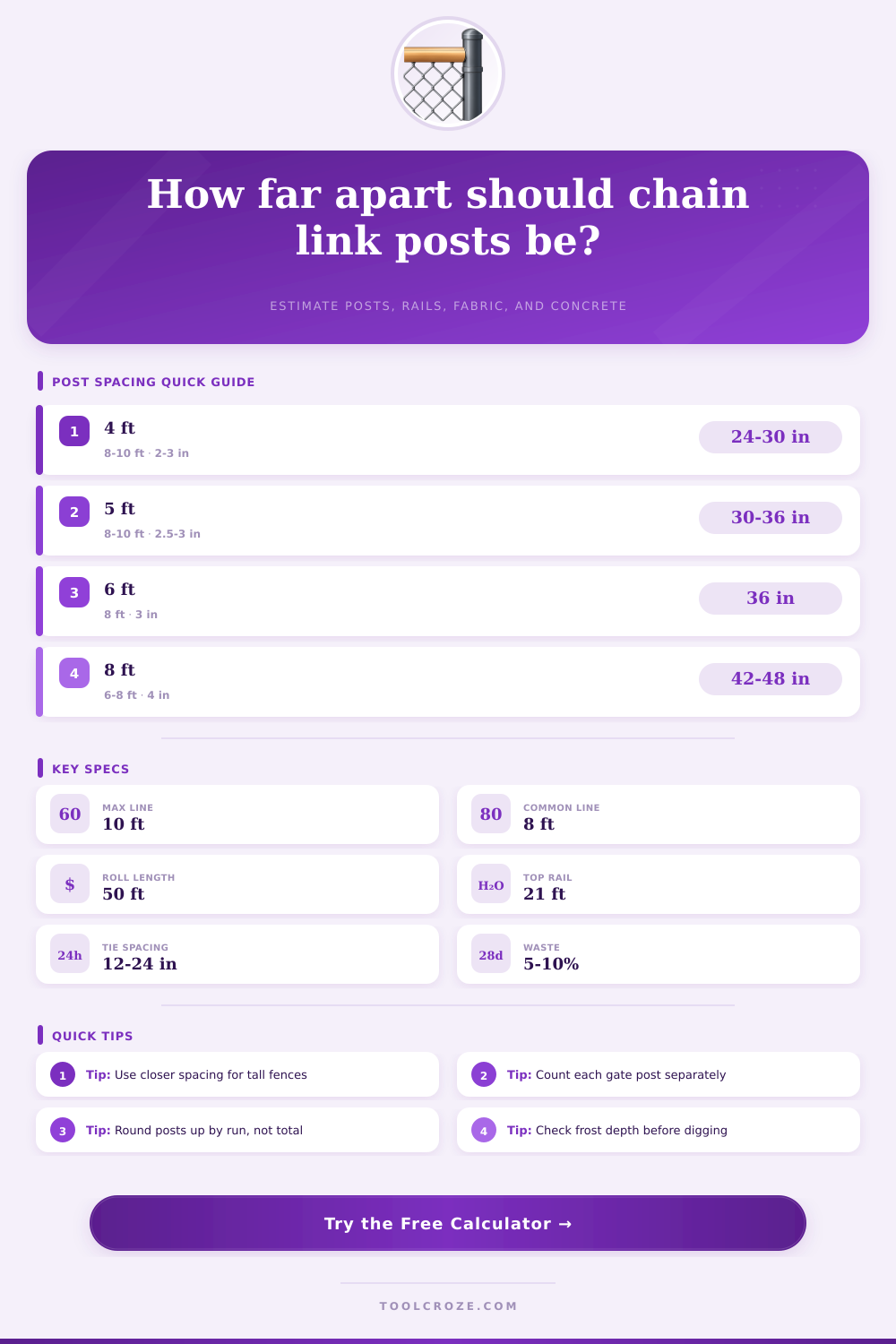
| Residential 4 ft fence | 8 to 10 ft centers | 1-5/8 in to 1-7/8 in OD | Use ends, corners, and gate posts |
| Residential 5 to 6 ft fence | 8 ft preferred, 10 ft maximum | 1-7/8 in to 2-3/8 in OD | Brace all gates and corners |
| Privacy slats or windy area | 6 to 8 ft centers | 2-3/8 in OD often used | Increase terminal diameter |
| Commercial 6 to 8 ft fence | 6 to 8 ft centers | 2-3/8 in OD or heavier | Use pull posts on long runs |
| Feature | Posts counted | Hardware counted | Layout note |
|---|---|---|---|
| End of straight run | 1 terminal post | 1 tension bar, bands, rail end | Count both ends of an open run |
| Outside corner | 1 terminal post | 2 tension pulls may meet | Use a terminal post, not a line post |
| Walk gate opening | 2 gate posts | 2 extra tension bars typical | Subtract clear opening from fabric |
| Double drive gate | 2 heavy gate posts | Hinges and latch not estimated | Use larger holes and posts |
| Fence height | Common hole diameter | Common embed depth | Planning note |
|---|---|---|---|
| 3 to 4 ft residential | 6 to 8 in line holes | 24 to 30 in | Use deeper holes for soft soil |
| 5 to 6 ft residential | 8 to 10 in line holes | 30 to 36 in | Terminal holes often larger |
| 6 to 8 ft commercial | 10 to 12 in line holes | 36 to 48 in | Check engineering and local code |
| Frost or expansive soil | Per local requirement | Below frost depth | Code can override this calculator |
| Item | Common spacing or length | Calculator method | Field adjustment |
|---|---|---|---|
| Chain link fabric | 50 ft rolls common | Net fence length minus gate openings | Add waste for slopes and splices |
| Top rail | 21 ft swedged sections common | Rail pass length divided by rail length | Round up for cuts at terminals |
| Line post ties | About every 12 to 18 in vertically | Based on height and line post count | Use more in windy locations |
| Rail ties | About every 24 in along top rail | Based on rail pass length | Bottom rail adds another pass |
First, know how tension works in terms of geometry. If your chain link fence sags, it’s typically because of improper spacing, not that something went wrong with the material itself. Specify your layout type and enter your perimeter dimensions into the calculator above. It do all the math for you, so you won’t have to guess if your tension bars will be too heavy to span a given straight run.
The other distinction is between terminal and line posts. Terminal posts bears the actual weight of the rail and tension wire; those would be the ends, your corners, gate pillars etc. These are the ones that really matter. A line post is just one that keep the fabric up on a straight run at regular intervals (typically every 8-10 feet if it’s residential height). Treated as such, a corner becomes a leaning mess which slowly leans in toward itself till the whole thing caves under its own weight. This tool automaticly separates out the two types of stock, letting you order enough heavy duty stuff where it’s needed and not too much thin stuff where it isn’t.
Why You Need This Fence Calculator
And then there’s height. Because there’s not much for the wind to use, a four-foot fence can get by with ten feet between line posts. But push it to six or even eight feet and all of a sudden the wind load increases much faster than before. To counter that, you’ve got to have tighter spacing, sometimes coming right down to six or eight feet between, or else the fabric will start bowing out. That’s where the little adjustment in input pays off: instead of having wobbly posts in soft soil, you avoid a huge headache later. The wind load chart on the page explains this very well; as the fence gets taller, the diameter of the posts and the size of their holes should of increase.
Intuition also fails when it comes to concrete volume. Most people end up digging a hole that’s not wide enough or deep enough, since they think just the length of the post is what determine how much material goes into the hole. It’s also important for stability to have a large-enough base for the concrete footing. To factor this in, the calculator figures out how many bags of concrete it’ll take based off the embed depth and hole diameter. The hole diameter has to be bigger for terminal posts than for line posts, because terminal posts must be able to withstand rotational forces.
Don’t forget your local code requirements for frost depths; in California, for example, setting a post two feet down might be fine, but it would be disastrous in Minnesota because of the freeze-thaw cycle, which will pop it right back out again like a cork.
Fabric waste is a silent budget killer. Chain link is available in rolls of a specific length, typically fifty feet. You don’t purchase a single roll and cross your fingers that it’ll be enough for your fifty-two foot run. Nope. You purchase two because you need the small two-foot overlap between them, then some more for the trimming and splicing around the gates, etc. When calculating chain link costs, the calculator factors in the waste factor (i.e., what happens when you have an awkward cut at the end or the fabric stretches slightly during installation).
You can ignore this, but only if you’re prepared for the moment when you realize you’re out of fabric midway through one side of house. You will have to run back to the hardware store while the sun beats down on your back.
The gates add another wrinkle to the geometry. Each one will remove some linear footage of fabric needed, but it will add two hefty terminal posts, plus complex tension hardware. You may end up saving several feet of fabric only to buy double the weight in steel plates and hinges. The tool accounts for those deductions so you don’t overestimate your fabric needs. Also, it’ll remind you that every gate post is a stress point needing greater concrete footing than the remaining line.
Laying out chain link isn’t rocket science, but it requires more precision than raw brawn. Before you dig anything, mark where your posts go. Run a chalk string from corner-to-corner to keep everything nice and straight. Make your holes uniform. Rushing on spacing will make the fabric hang wrong.
Do your geometry homework (let the calculator help you create your materials list) and take your sweet time on the geometry and you’ll be left with a fence that stays standing straight forever; not one that looks like an earthquake did it. Following the math of tension long before driving the first post in the ground is what separates a clean perimeter from an ugly eyesore.