Chain Hoist Capacity Calculator
Estimate required hoist WLL, sling-leg tension, headroom margin, dynamic allowance, and chain grade reserve for shop, plant, and site lifting setups.
Choose a common lift to load realistic starting values, then adjust the rigging details to match the actual job.
Calculation Breakdown
| Angle from horizontal | Leg tension factor | Two-leg share example | Planning note |
|---|---|---|---|
| 90 degrees | 1.00 | 50% of load per leg | Vertical pick, lowest leg tension |
| 75 degrees | 1.04 | 52% of load per leg | Very good rigging geometry |
| 60 degrees | 1.15 | 58% of load per leg | Common minimum target |
| 45 degrees | 1.41 | 71% of load per leg | Review sling WLL carefully |
| 30 degrees | 2.00 | 100% of load per leg | Avoid unless engineered |
| Nameplate capacity | Typical manual hoist use | Approx. headroom range | Planning caution |
|---|---|---|---|
| 1/2 ton | Engines, small pumps, fixtures | 11 to 16 in | Easy to overload with rigging weight |
| 1 ton | HVAC units, small machines | 13 to 18 in | Watch dynamic trolley movement |
| 2 ton | Machine skids, beams, dies | 16 to 24 in | Check beam and trolley rating too |
| 3 ton | Heavy shop lifts, large motors | 20 to 30 in | Hand chain effort rises quickly |
| 5 ton | Molds, generators, vessels | 24 to 38 in | Needs formal lift review in many shops |
| 10 ton | Large machinery and plant work | 34 in and up | Usually engineered and inspected |
| Configuration | Best fit | Capacity effect | Headroom effect | Field check |
|---|---|---|---|---|
| Hook-suspended hoist | Fixed pick points and beam clamps | Nameplate WLL only | Moderate | Top hook seat and latch closure |
| Push trolley hoist | Short travel on clean beams | Limited by lowest rated component | Adds trolley depth | Beam flange width and end stops |
| Geared trolley hoist | Controlled travel under load | Same hoist WLL, smoother movement | Adds gear trolley depth | Hand chain drop and pinch zones |
| Low-headroom trolley | Tight beam-to-load clearance | Must match hoist and trolley rating | Lowest of manual options | Side clearance and load block travel |
| Lift setup | Allowance to include | Why it matters | Calculator input |
|---|---|---|---|
| Beam clamp and hook hoist | Clamp depth, top hook, hoist body | Reduces usable hook height | Hoist body plus hook allowance |
| Trolley mounted hoist | Trolley wheels, side plates, hoist body | Often taller than a hook mount | Available headroom and arrangement |
| Deep load attachment | Spreader, shackles, slings, master link | Consumes clearance before load moves | Add to hoist body allowance |
| High set-down location | Required vertical travel plus final clearance | Can demand more lift than expected | Required lift height |
When you are planning a lift, you have to determine if the equipment can handle the load that you are trying move. The calculator will provide you with an estimate as to whether or not the equipment can handle the lift. To determine this, you will have to provide input for the weight of the load that you are moving, the angle of the sling, the dynamic factors of the lift, and the headroom that will be available for the load as it is being lifted.
These factor will be used to calculate the total forces that will be acting on the lift and whether or not the equipment will be able to handle those forces. However, these calculations wont account for the conditions that may exist on the floor during the lift, so you must also consider these factors yourself. The stamped number on the hoist body indicates the strength of the equipment.
How to Use the Lift Calculator
However, this isnt the complete measurement of the strength of that equipment. The stamped number assumes that the load will be performed vertical and under controlled conditions. In reality, there will often be acceleration of the load with the hand chain, the load may swing slightly as it leaves the ground, or the trolley may require extra force to start to stop.
These factors is accounted for with the dynamic factor for the lift. While the smooth pick of the load may only require the basic weight of the load, the real lift will require a multiplier to account for the movement of the load. Another factor to consider is the angle of the sling that is use to perform the lift.
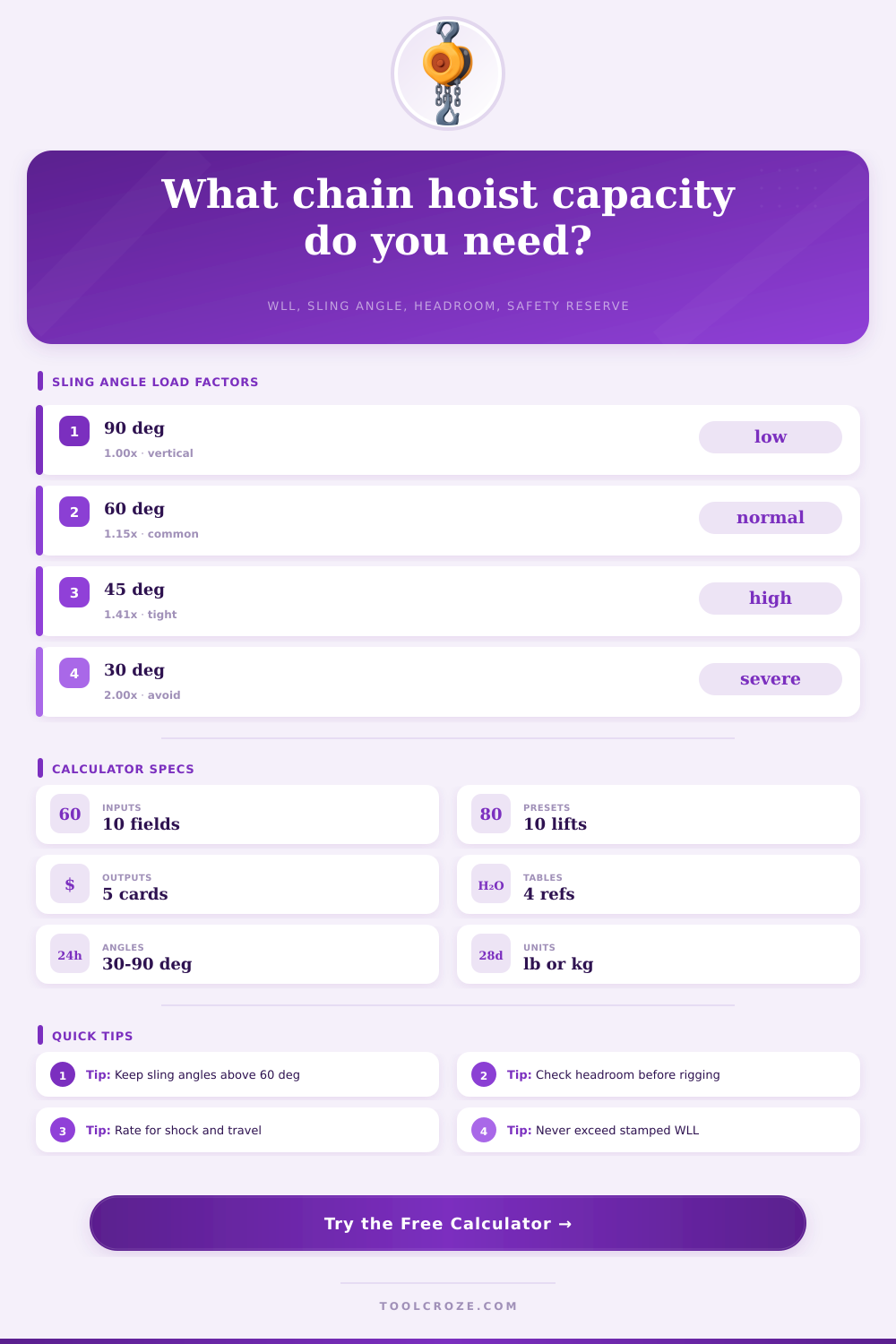
If the angle is flat, the tension of each leg of the sling will be higher. The program will apply a factor to the weight of the load in the calculator prior to dividing that load by the number of leg of the sling. For instance, a sling angle of 45 degrees will create different forces within each leg of the sling different than a sling angle of 60 degrees.
Thus, a shackle that is adequate at a 60 degree angle may reach its limit at a 45 degree angle. The calculator provides a reference table that can help to determine these forces prior to purchasing the lifting hardware. Headroom is another measurement that is often overlooked until the hook cannot clear the load.
Headroom can be calculated by subtracting the depth of the hoist body, the distance that the load must be lifted, and any extra hardware from the headroom that is measured. If the headroom that is calculated result in a negative number, then the problem is not with the hoist as the stamped number indicates. The problem is in the hardware that is between the beam and the load.
While low headroom configurations are provided for situations where headroom is limited, those low headroom configurations will only work if you measure your headroom prior to beginning the lift. Chain grade is another consideration prior to the lift. Chain with a higher grade indicates that there is more strength to the chain.
The higher the grade of chain, the more strength that will be provided to the load, and the higher the grade of chain the more safety that can be provided to handle the lift with potential unknown factor. This number is also provided as an index on the calculator to indicate whether or not the chain that is to be used for the lift is above the grade of the lift that is to be performed. This allows individuals to determine if the lift will be safe with the chains that are to be used.
By running these numbers prior to the lift, you force yourself to consider the various factors regarding the load that is to be lifted. Often, factors like the beam will become the limiting factor for the lift, or the headroom may require certain type of trolley equipment to be used for lifting the load. These discoveries are better when made on paper than in the air.
Additionally, you must read the safety note at the bottom of the calculator. Every component in the lift has a limit. These components include the beam, the trolley, the hoist, and the hook latch.
The component that has the lowest limit will be the limit for the lift. Planning the lift with these numbers will not replace the need for experience performing lifts or for inspecting the components of the lift. However, planning the lift with these factors will make the tradeoffs for lift equipment visible before beginning the lift.
When the numbers line up with the conditions for the lift on the floor, the lift will have less guesswork involved in performing that task. Thus, one of the main outcome of using this calculator will be that the lift can be performed with less guesswork.