💨 CFM to HP Converter
Convert air flow (CFM/L/min) to horsepower for compressors & pneumatic systems
| CFM | Pressure (PSI) | Efficiency 75% | Efficiency 80% | Efficiency 85% | Motor HP (90% motor eff.) |
|---|---|---|---|---|---|
| 2 CFM | 90 PSI | 0.57 HP | 0.54 HP | 0.51 HP | ~0.63 HP |
| 5 CFM | 90 PSI | 1.43 HP | 1.34 HP | 1.26 HP | ~1.59 HP |
| 10 CFM | 90 PSI | 2.86 HP | 2.68 HP | 2.52 HP | ~3.18 HP |
| 15 CFM | 90 PSI | 4.29 HP | 4.02 HP | 3.78 HP | ~4.77 HP |
| 20 CFM | 125 PSI | 6.63 HP | 6.22 HP | 5.85 HP | ~7.37 HP |
| 30 CFM | 125 PSI | 9.95 HP | 9.33 HP | 8.78 HP | ~11.06 HP |
| 50 CFM | 150 PSI | 19.70 HP | 18.47 HP | 17.38 HP | ~21.89 HP |
| 100 CFM | 175 PSI | 46.08 HP | 43.20 HP | 40.65 HP | ~51.20 HP |
| Type | Typical CFM Range | Max Pressure (PSI) | Efficiency Range | HP Range | Best Use |
|---|---|---|---|---|---|
| Reciprocating (Single-Stage) | 1 – 20 CFM | 125 PSI | 65–75% | 0.5–5 HP | Light workshop, home use |
| Reciprocating (Two-Stage) | 5 – 50 CFM | 175 PSI | 70–80% | 2–25 HP | Heavy workshop, auto body |
| Rotary Screw | 20 – 1500 CFM | 200 PSI | 80–88% | 5–500 HP | Industrial, continuous duty |
| Centrifugal | 100 – 10000+ CFM | 150 PSI | 75–85% | 50–5000+ HP | Large industrial plants |
| Scroll Compressor | 1 – 15 CFM | 145 PSI | 85–92% | 1–20 HP | Medical, quiet environments |
| Diaphragm | 0.1 – 5 CFM | 100 PSI | 40–60% | 0.1–2 HP | Lab, low-contamination |
| Application / Tool | CFM Required | Typical PSI | Min. HP Compressor | Duty Cycle | Notes |
|---|---|---|---|---|---|
| Brad Nailer | 0.5 – 1.5 CFM | 70–90 PSI | ~0.5 HP | Intermittent | Very low demand |
| Framing Nailer | 2 – 4 CFM | 100–120 PSI | ~2 HP | Intermittent | Needs 6-gal tank min. |
| Impact Wrench (1/2") | 4 – 6 CFM | 90 PSI | ~3 HP | Intermittent | 80–150 ft-lb torque |
| Impact Wrench (1") | 10 – 20 CFM | 90 PSI | ~7 HP | Intermittent | Heavy duty |
| HVLP Spray Gun | 8 – 12 CFM | 15–50 PSI | ~4 HP | Continuous | Low pressure, high volume |
| Siphon Spray Gun | 12 – 18 CFM | 40–80 PSI | ~6 HP | Continuous | Traditional paint spraying |
| Sand Blaster (siphon) | 8 – 15 CFM | 80–100 PSI | ~5 HP | Continuous | Small cabinet blaster |
| Sand Blaster (pressure pot) | 15 – 50 CFM | 100–150 PSI | ~15 HP | Continuous | Industrial blasting |
| Plasma Cutter (40A) | 25 – 35 CFM | 90–120 PSI | ~12 HP | Continuous | Cutting up to 1/2" steel |
| Plasma Cutter (80A) | 50 – 80 CFM | 120–150 PSI | ~25 HP | Continuous | Heavy industrial cutting |
| Air Drill (3/8") | 3 – 6 CFM | 90 PSI | ~2 HP | Intermittent | Light drilling work |
| Die Grinder | 4 – 6 CFM | 90 PSI | ~2.5 HP | Intermittent | Metal finishing |
| From | To | Multiply By | Example |
|---|---|---|---|
| CFM | L/min | 28.3168 | 10 CFM = 283.2 L/min |
| CFM | m³/h | 1.69901 | 10 CFM = 17.0 m³/h |
| PSI | kPa | 6.89476 | 90 PSI = 620.5 kPa |
| PSI | bar | 0.06895 | 90 PSI = 6.21 bar |
| HP (mechanical) | kW | 0.7457 | 5 HP = 3.73 kW |
| kW | HP | 1.34102 | 5 kW = 6.71 HP |
| HP | Watts | 745.7 | 1 HP = 745.7 W |
| °F | °C | (°F – 32) × 5/9 | 68°F = 20°C |
Whether you want to understand the relation between CFM and HP? It seems really hard in the start. CFM, what is cubic feet in minute points how many air flows through some stuff.
On the other hand, horsepower measures the power of engine. One HP matches 746 watts, and although those two values are linked, the tie is not simple in all cases.
How CFM Relates to Horsepower
Here what most commonly confuses the folks. CFM does not have direct link with horsepower, unless one considers pressure. Pump of 1 HP could give only 2,5 CFM during mode in 100 PSI.
If one takes same 1 HP-engine and use it in normal air pressure, even so, one finds hundreds of CFM. Here the key: pressure changes everything during such calculations.
There are formulas, that go around for convert CFM in ratings of horsepower. One mode multiply the air flow by 1,6, later take that result and multiply by 0,9 for get approximate HP. Other method uses the maximum CFM-flow, multiply by 0,25 and later by 8.
So roll-head with 330 CFM would point around 660 HP-potential, if teh rest of the engine is also good. Is also way multiplying CFM in maximum lift by 0,257, what gives crank horsepower. Notably: those formulas are mainly for fun and do not replace real dyno test.
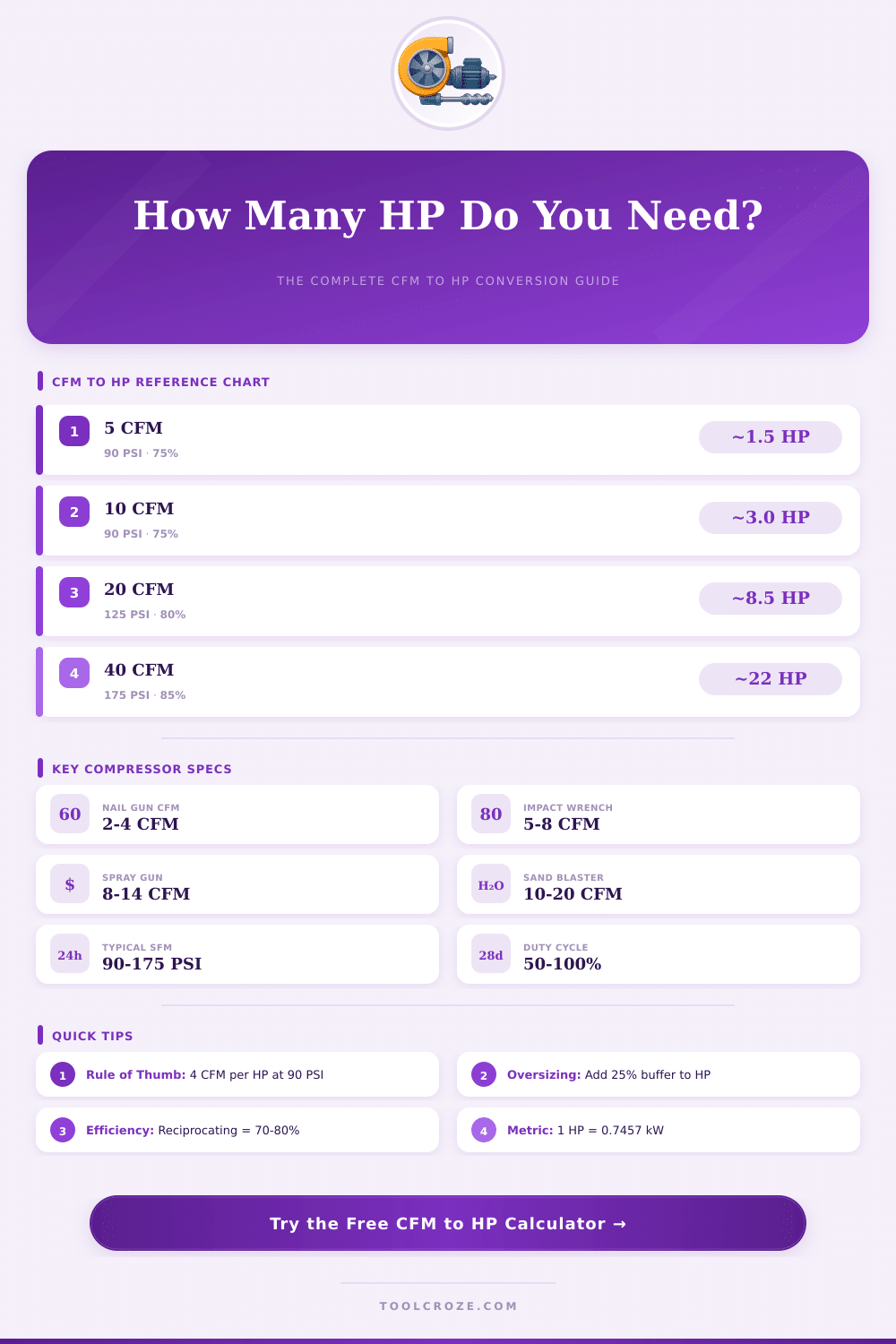
For compressors, the rough number is around 3 until 4 CFM for 1 HP-engine in about 90 PSI. Quincy-compressors indeed reach almost 4,75 CFM each horsepower, what is remarkable. Their unit of 5 HP reaches 23,75 CFM.
Jump to 10 HP and you find between 40 and 50 CFM in 100 PSI. Typical well-rounded air-compressor gives about 5 CFM in 100 PSI for every HP.
The problem with compressors is, that they can not push same amount of air in higher pressures. Two-stage of 5 HP could reach 20 CFM free air, but that drops to 18 CFM in 90 PSI and down too 17 CFM in 175 PSI. It is natural: the motor works more hard against bigger resistance.
With engines, know the horsepower allow to estimate the air flow vice versa. Engine of 1 600 cc, that runs well, must produce around 54 CFM for reach 78 horsepowers. That HP-rating comes of flywheel-measurements.
If you want rear-wheel numbers, you must consider losses in the drivetrain, multiply by that percentage and subtract of the whole. Compression ratio, manifold-design, oil system and ring-sealing all affect the real HP, that one gets from every CFM. Most setups fall in 1,5 until 2 HP each CFM.
Interestingly, some single-carburetor pump-gas builds reached 2,15 until 2,2 HP each CFM.
As general rule, every pound of air in minute matches around 10 HP. The horsepower of the engine and the shift of the motor determines thereal CFM-product, so add only bigger tank itself will not improve your air flow-numbers.