Cedar Tongue and Groove Calculator
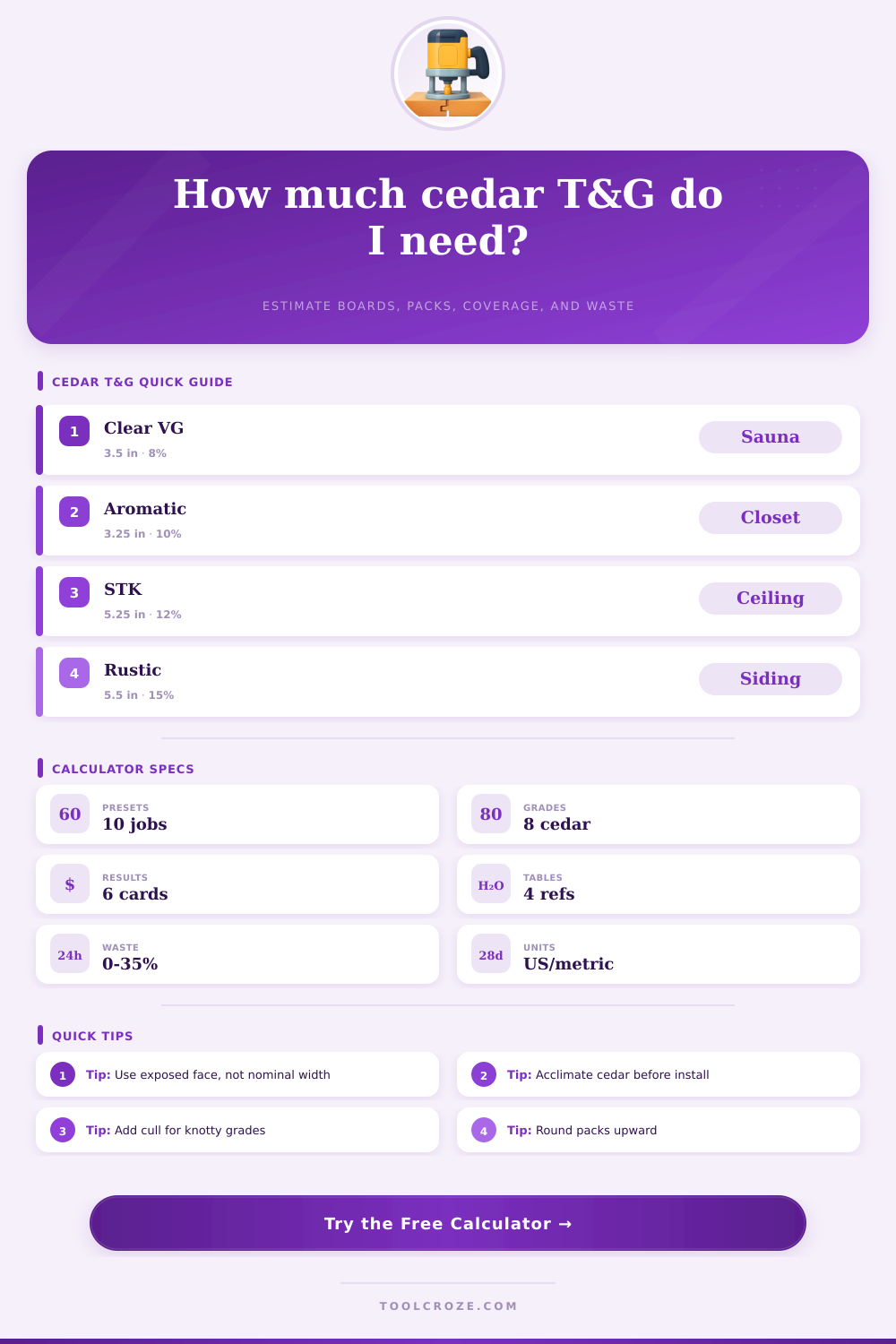
Estimate cedar T&G boards, packs, linear footage, adjusted coverage, waste, and shrinkage allowance from installed exposure instead of nominal board width.
1Cedar project presets
Each preset loads a realistic cedar tongue and groove job with grade, exposure, pack coverage, moisture, and finish-side assumptions.
2Calculator inputs
3Cedar grade/spec grid
| Cedar grade | Typical exposure | Planning cull | Spec note |
|---|---|---|---|
| Clear vertical grain western red cedar | 3.25 to 5.25 in | 6 to 8% | Stable, uniform, premium face work |
| Clear mixed grain western red cedar | 3.25 to 5.5 in | 8 to 10% | Good for visible walls and ceilings |
| Select tight knot western red cedar | 5.25 to 5.5 in | 10 to 13% | Common porch, soffit, and cabin profile |
| Aromatic eastern red cedar | 3.0 to 3.5 in | 9 to 12% | Closets, chests, and small interiors |
| Rustic cedar T&G | 5.25 to 6.75 in | 14 to 18% | More color sorting and knot decisions |
4Exposure and pack reference
| Nominal T&G board | Installed exposure | Coverage at 8 ft | Boards per 100 sq ft |
|---|---|---|---|
| 1x4 cedar T&G | 3.125 to 3.5 in | 2.1 to 2.3 sq ft | 43 to 48 boards |
| 1x5 cedar T&G | 4.25 to 4.5 in | 2.8 to 3.0 sq ft | 34 to 36 boards |
| 1x6 cedar T&G | 5.125 to 5.5 in | 3.4 to 3.7 sq ft | 27 to 30 boards |
| 1x8 cedar T&G | 6.75 to 7.125 in | 4.5 to 4.75 sq ft | 22 to 23 boards |
5Cedar moisture and waste guide
| Condition | Shrinkage allowance | Waste range | Planning note |
|---|---|---|---|
| Dry interior acclimated cedar | 0.5 to 1.5% | 6 to 10% | Best for saunas, closets, and feature walls |
| Normal shop acclimation | 1.5 to 3% | 8 to 12% | Good default for interior ceilings and walls |
| Damp jobsite or exterior covered area | 3 to 5% | 12 to 18% | Allow for cupping, end checks, and movement |
| Mixed-length or reclaimed cedar | 2 to 6% | 15 to 25% | Sort for tongues, color, cracks, and usable length |
6Common cedar T&G project sizes
| Project | Typical area | Common grade | Starting settings |
|---|---|---|---|
| Sauna wall or ceiling | 90 to 180 sq ft | Clear VG cedar | 3.25 in exposure, 8 to 10% waste |
| Closet lining | 70 to 150 sq ft | Aromatic cedar | 3.25 in exposure, face finish only |
| Porch ceiling | 120 to 320 sq ft | STK western red cedar | 5.25 in exposure, seal all sides |
| Cabin or garden room ceiling | 160 to 500 sq ft | Knotty cedar | 5.5 in exposure, 12 to 15% waste |
7Shop tips
Cedar tongue and groove is a type of wood material that can be found in many different environment and for many different uses. Cedar tongue and groove is used for sauna walls, porch ceiling, and closet interiors. When purchasing cedar tongue and groove, people must calculate the correct amount of cedar tongue and groove that are required for the project.
While people can order cedar tongue and groove based off the square footage of the area to be covered, the actual coverage of the cedar tongue and groove is less than the amount of wood that is nominally label on each cedar tongue and groove board. The nominal width of cedar tongue and groove is the labeled width of the boards. However, the installed face width of cedar tongue and groove is the actual width of the board once the tongue is installed into the groove of an adjacent cedar tongue and groove board.
How to Figure Out How Much Cedar Tongue and Groove You Need
The installed face width may be less than the labeled size of the cedar tongue and groove board. For instance, cedar tongue and groove boards may be labeled as being six inch wide. However, the installed face width of the board may only be five and a quarter inches.
Because the installed face width is the actual width of cedar tongue and groove boards once installed, the installed face width is used to calculate the amount of cedar tongue and groove that is needed for a given project. Another factor that affect cedar tongue and groove is moisture. Because cedar is a type of wood that grows in regions with high humidity, cedar tends to move when the moisture in the air changes.
If people install cedar tongue and groove boards into an area that has high humidity relative to the cedar growth regions, the cedar may shrink and create gap between cedar tongue and groove boards. The grade of the cedar tongue and groove can change the amount of cedar tongue and groove that is required for the project. For cedar tongue and groove with clear vertical grain, the boards will have fewer knots in the wood relative to knotty or rustic cedar tongue and groove.
Because there are fewer knot in the wood, the clear vertical cedar tongue and groove will have fewer split in the sawn boards. The fewer splits in cedar tongue and groove with clear vertical grain means that the waste factor will be lower for cedar tongue and groove of this type then cedar tongue and groove of type knotty or rustic cedar. To account for these difference, the calculator allows people to input the cedar tongue and groove grade so that the calculator can provide a waste percentage for the cedar tongue and groove based on that entered grade.
Based on the inputs of the customer for the calculator, the calculator can provide an adjusted square footage value, the total number of cedar tongue and groove boards that are required, and the number of pack of cedar tongue and groove that must be purchased to complete the project. Another factor that affect the amount of cedar tongue and groove that is required for a project is the layout of the cedar tongue and groove. For cedar tongue and groove installed in straight runs with a random stagger, only a small amount of extra cedar tongue and groove is required.
However, if people install cedar tongue and groove into end-matched ceiling, more extra cedar tongue and groove is required because the joints between the cedar tongue and groove boards must fall on the backing for the ceiling. If people install cedar tongue and groove into vertical application, more end cuts are required for installation relative to installations into horizontal applications. Because more end cuts are required for vertical cedar tongue and groove installations, a higher waste percentage is required for cedar tongue and groove to be installed vertically then for cedar tongue and groove to be installed horizontally.
Additionally, if people color sort cedar tongue and groove for installations into a feature wall, more cedar tongue and groove is required because some cedar tongue and groove boards will be set aside during installation to maintain a consistent color pattern. Another factor that influence the amount of cedar tongue and groove that must be purchased is the finish of the cedar tongue and groove. If people seal every surface of the wood, or if the face of the cedar tongue and groove will be visible, extra cedar tongue and groove is required to account for rejects in the cedar tongue and groove products.
The area of the project to be completed minus cedar tongue and groove panels that will be covered by doors or windows is the area to be covered by cedar tongue and groove. By subtracting the area of doors and windows from the total area to be covered with cedar tongue and groove, people can more accurately calculate the amount of cedar tongue and groove that will be required for the project. Such a calculation prevents the purchase of cedar tongue and groove that will not be used in the project because of the presence of window or doors in the area to be covered.
The reference table listed on this page show the typical installations for the different profiles of cedar tongue and groove. Additionally, these table also show the changes in the coverage capacity of cedar tongue and groove according to the length of the cedar tongue and groove boards. These reference tables list the range of shrinkage and waste factors for cedar tongue and groove products.
The ranges account for the different behaviors of cedar in dry areas relative to the behavior of cedar in more humid areas like porch. These tables allow people to decide whether they want to allow for a two percent waste in the cedar tongue and groove installation relative to five percent waste. To calculate the square footage of cedar tongue and groove products that is required for a project, many people will measure a dry sample of cedar tongue and groove after it is installed into a groove.
This type of measurement will produce a more accurately measurement of the area that will be covered by cedar tongue and groove boards than the nominal measurement of cedar tongue and groove products. Furthermore, to allow the cedar tongue and groove to acclimate into the space that will be filled with the cedar tongue and groove products, it is also recommended that the cedar tongue and groove be allowed to acclimate into the same area in the house where cedar tongue and groove will be installed. By allowing the cedar to acclimate, the chances of the cedar shrinking in areas with different humidity from the cedar growth regions can be avoided.
People may find that by only purchasing cedar tongue and groove products for the square footage of the area to be covered by cedar tongue and groove, they will not have enough cedar tongue and groove for the installation job. The calculator allows for the estimation of the total amount of cedar tongue and groove that is required for a project because it calculates for the grade, the layout of the cedar tongue and groove, the finish of the cedar tongue and groove, and the moisture content of the cedar tongue and groove. By using the calculator and allowing for a realistic waste factor for the cedar tongue and groove products, customers will have enough cedar tongue and groove to complete the last row of cedar tongue and groove in their project.