Caulk Yield Calculator
Estimate cartridges, linear yield, total sealant volume, and backer rod allowance from bead width, depth, shape, joint length, tube size, and waste factor.
Choose a common sealing job, then fine tune the dimensions to match the actual joint.
Caulk Yield Results
These tables give quick checks for bead size, package volume, joint depth, and sealant selection.
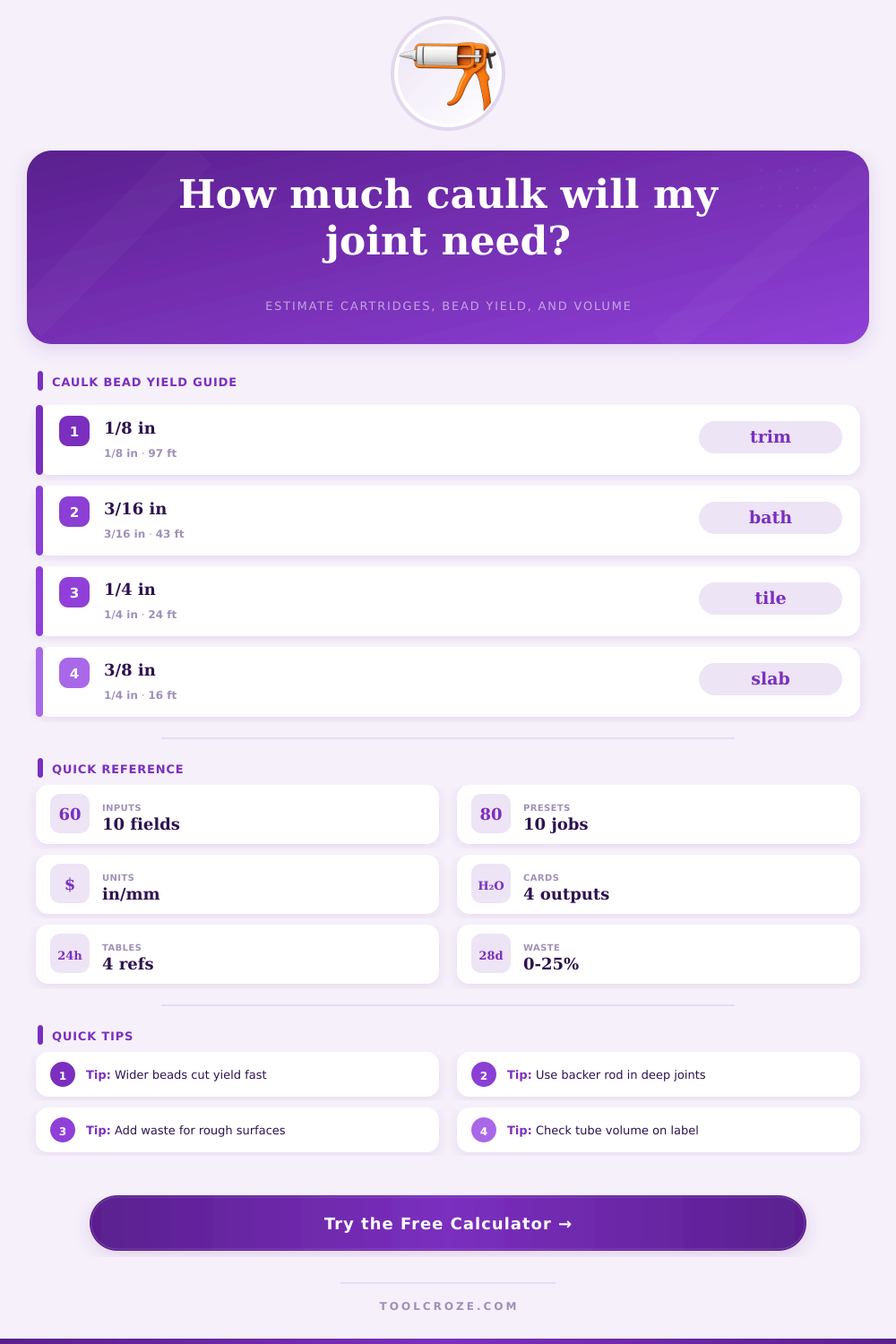
| Bead Size | Profile | 10.1 oz Yield | 300 ml Yield | Typical Use |
|---|---|---|---|---|
| 1/8 in x 1/8 in | Concave | about 97 ft | about 98 ft | Fine trim and paintable gaps |
| 3/16 in x 3/16 in | Concave | about 43 ft | about 43 ft | Bath, backsplash, small tile changes |
| 1/4 in x 1/4 in | Concave | about 24 ft | about 24 ft | Windows, doors, and siding edges |
| 3/8 in x 1/4 in | Concave | about 16 ft | about 16 ft | Exterior trim and masonry transitions |
| 1/2 in x 1/4 in | Slot fill | about 12 ft | about 12 ft | Control joints with backer rod |
| Package Size | Volume in Cubic Inches | Volume in Milliliters | Best Fit |
|---|---|---|---|
| 5.5 fl oz squeeze tube | 9.94 in³ | 163 ml | Short touch-up seams |
| 10.1 fl oz cartridge | 18.23 in³ | 299 ml | General caulk gun work |
| 310 ml cartridge | 18.92 in³ | 310 ml | Common metric cartridge |
| 600 ml sausage | 36.61 in³ | 600 ml | Long professional runs |
| 29 fl oz cartridge | 52.35 in³ | 858 ml | Large concrete or roofing joints |
| Joint Width | Suggested Depth | Backer Rod Diameter | Depth Note |
|---|---|---|---|
| 1/8 in | 1/8 in | Usually none | Small paintable gaps |
| 1/4 in | 1/8 to 1/4 in | 3/8 in | Control depth if gap is deep |
| 3/8 in | 3/16 to 1/4 in | 1/2 in | Use rod for movement joints |
| 1/2 in | 1/4 in | 5/8 in | Do not overfill the cavity |
| 3/4 in | 3/8 in | 1 in | Use sealant made for wide joints |
| Sealant Type | Density Used | Extra Waste | Good Applications |
|---|---|---|---|
| Acrylic latex | 1.45 g/ml | 2 percent | Interior trim and paintable joints |
| Silicone | 1.02 g/ml | 4 percent | Bath, kitchen, glass, and tile |
| Polyurethane | 1.25 g/ml | 6 percent | Exterior concrete, masonry, and metal |
| Hybrid MS polymer | 1.35 g/ml | 5 percent | Exterior trim and multi-material joints |
| Self-leveling concrete | 1.30 g/ml | 8 percent | Horizontal control and expansion joints |
Narrow Trim
1/8 in beads can run nearly four times farther than 1/4 in beads from the same cartridge.
Bath and Tile
3/16 in tooled silicone beads balance coverage, water shedding, and easy cleanup.
Exterior Gaps
1/4 to 3/8 in joints often need a higher waste allowance because surfaces are uneven.
Concrete Joints
Backer rod keeps the sealant shallow, flexible, and much more predictable for yield.
Estimating the amount of sealant that will be needed for a project are a difficult task. Sealant isnt like paint; people often make the mistake of guessing how much sealant they will need by looking at the room that will be sealed. If people guess at the amount of sealant needed, they may find themself out of sealant before the project is complete.
A small increase in the widths of the bead of sealant that will be used will decrease the amount of sealant that can be used for the project. Therefore, people should not guess at the amount of sealant that will be needed for the project. A bead of sealant has three important dimension to consider when calculating how much sealant will be needed for a project.
How to Figure Out How Much Sealant You Need
The dimensions of a bead of sealant include the width, depth, and the profiles of the joint that will be sealed. Many people does not consider the depth of the joint when calculating the amount of sealant needed. A deep joint in a slab of concrete will require more sealant than a thin joint in a bedroom floor.
To calculate how much sealant will be needed for a project, the width, the depth, and the profile of the joint must be considered. The shape that the sealant bead will take up will affect the amount of sealant that will be needed. If the joint that will be sealed requires a square fill of sealant, more sealant will be needed than if a tool create a concave shape in the sealant.
A concave shape in the sealant reduces the amount of sealant needed for the project. The concave shape also allow for the water that comes in contact with the sealant to shed off of the project. For the gaps that are wider than a quarter inch, a backer rod can be used to aid in the sealing process.
A backer rod can be used for the larger gaps because it is not necessary to fill the depth of the gap with sealant. If the entire depth of a gap was filled with sealant, the sealant would form a three sided bond with the material. A three-sided bond prevents the sealant from being able to stretch when the temperature of the material change.
Using a backer rod creates a floor for the sealant so that the sealant only forms a bond with the two side of the joint. Using a backer rod for larger gaps also save money for the project since less sealant will be needed to fill the joint. Another consideration for sealant projects is the amount of waste that may occur during the project.
In most instances, sealant projects will produce some level of waste due to the messy nozzle on the sealant bottles or if people add too much sealant to the joint. Another reason that sealant produces waste is if people use the sealant on a rough surface like masonry. Sealant will sink into the pores in the masonry so that it adhere to the material.
This sinking of the sealant into the pores of the material require the use of more sealant than the theoretical minimum amount for the project. To account for the waste that may happen with the sealant, sealant calculators include a waste percentage that can be added to the total amount of sealant that will be needed for the project. This percentage of waste ensures that the individuals will not run out of sealant before the project is complete.
The size of the cartridges of sealant that will be purchased is another factor that will have an impact on the efficiency of the project. Standard ten-ounce cartridges are the most common size for sealant. However, for projects that require long runs of sealant, larger cartridges of sealant are more efficient.
Using small tube for a large project will require more time to change the cartridge. Furthermore, using small tubes for a large project will result in the waste of sealant at the start of each project. It is best to purchase one large container of sealant rather than several smaller containers of sealant if the project allow for the purchase of such a large container.
To fully understand the efficiency of the sealant that will be purchased, it is important to calculate the linear yield for the cartridge of sealant that will be used. The linear yield of the sealant will provide information about the distance that one tube of sealant will go based off the size of the sealant bead that will be used. If the linear yield of the sealant is less then the distance that was estimated for the project, it is possible that the depth of the joint needs to be considered or that a backer rod will be necessary for the project.
By calculating the linear yield of the sealant, people will know the list of the item that will be purchased at the store. The goal of every sealant project should be to create a watertight joint that can stand the test of time for many year. Given that sealant projects will produce waste, people should of taken a few minutes to calculate how much sealant will be needed for the project before they go to the store to purchase the sealant.
By calculating the amount of sealant needed for a project, people will not run out of the sealant before the project is complete. The correct amount of sealant will allow people to complete one bead of sealant without having an empty cartridge of sealant.