Cast Iron Plate Weight Calculator
Estimate gray iron, ductile iron, CGI, and custom cast iron plate weight from rectangular or round dimensions, thickness, machining stock, cored pockets, ribs, allowances, and quantity.
📌Cast iron plate presets
📏Plate dimensions and casting allowances
Cast iron plate weight results
⚙Cast iron grade grid
📊Cast iron density reference
| Grade or family | Typical density | Common plate use | Planning note |
|---|---|---|---|
| Gray iron Class 20 | 7.15 g/cm³ or 0.258 lb/in³ | Light covers, guards, noncritical pads | Good default for lighter gray castings |
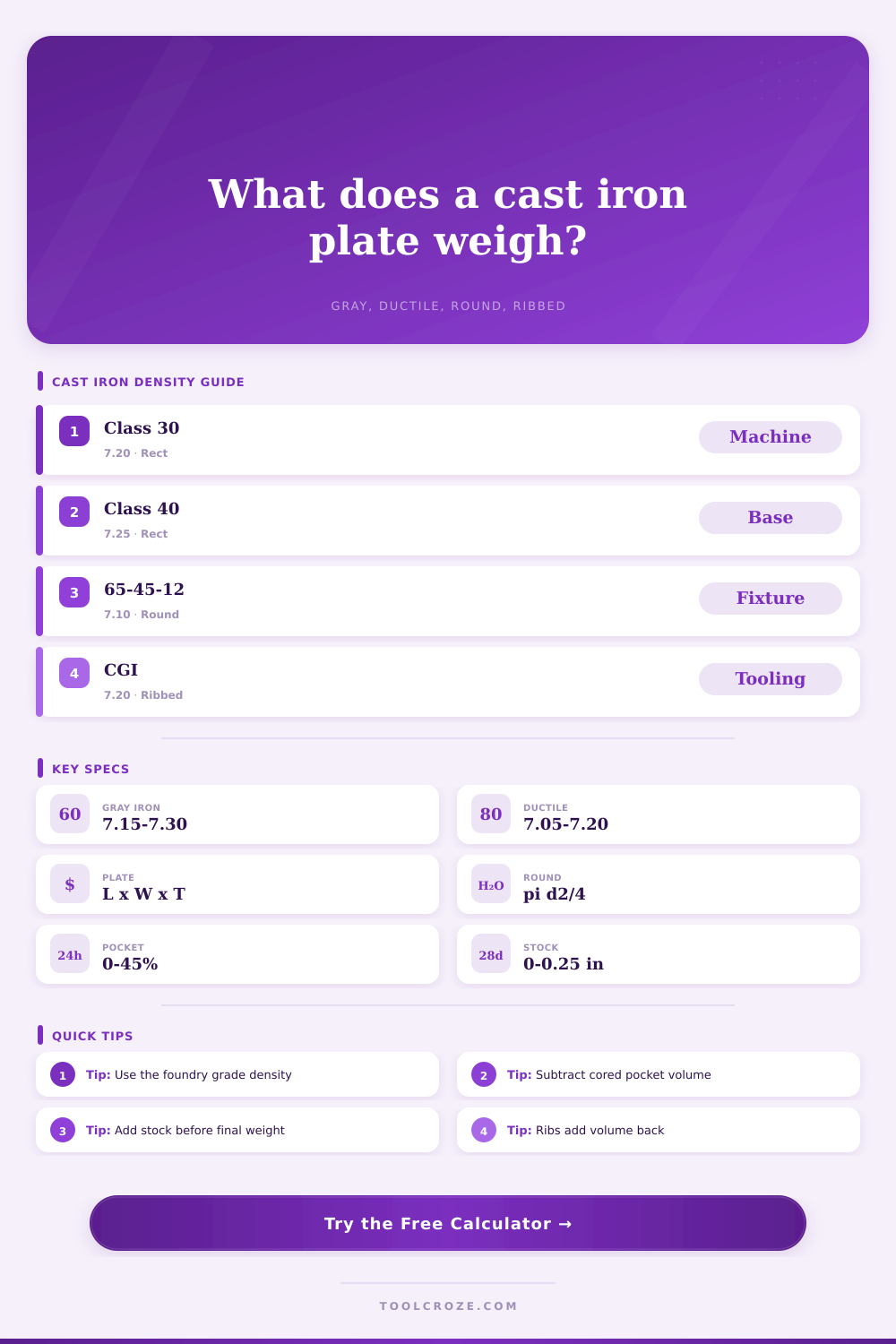
| Gray iron Class 30 | 7.20 g/cm³ or 0.260 lb/in³ | Machine base plates and general tooling | Common estimating density for gray iron plate |
| Gray iron Class 35 | 7.22 g/cm³ or 0.261 lb/in³ | Stiffer plates, frames, tables | Slightly heavier than Class 30 in this calculator |
| Gray iron Class 40 | 7.25 g/cm³ or 0.262 lb/in³ | Thick bases, planer beds, grinder parts | Use for dense gray iron machine castings |
| Ductile iron 65-45-12 | 7.10 g/cm³ or 0.257 lb/in³ | Fixtures, clamp plates, impact parts | Nodular graphite often estimates a little lighter |
| Ductile iron 80-55-06 | 7.12 g/cm³ or 0.257 lb/in³ | Higher strength plate castings | Check chemistry when precision matters |
| Compacted graphite iron | 7.20 g/cm³ or 0.260 lb/in³ | Engine plates, structural castings | Useful midpoint for CGI estimating |
| White iron wear plate | 7.65 g/cm³ or 0.276 lb/in³ | Abrasion liners and wear blocks | Much denser; do not use gray iron default |
🔢Plate geometry formulas
| Plate type | Gross volume formula | Dimensions used | Where stock is added |
|---|---|---|---|
| Rectangular plate | V = L × W × T | Length, width, thickness | Both edges and both faces |
| Round plate or disc | V = π × D² / 4 × T | Diameter and thickness | Diameter and both faces |
| Cored pocket allowance | Net V = gross V × (1 - pocket %) | Pocket percentage estimate | Subtracts internal hollow volume |
| Ribs or bosses | Net V = gross V × (1 + rib %) | Rib percentage estimate | Adds pads, feet, and reinforcing ribs |
| Trim and foundry allowance | Total = net weight × (1 + allowance %) | Fettling or rough-casting percent | Added after pocket and rib adjustment |
🔧Common cast iron plate presets
| Preset | Grade | Finished size | Allowance pattern |
|---|---|---|---|
| Class 30 Base Plate | Gray iron Class 30 | 24 in x 18 in x 1.25 in | 0.125 in stock, 5% trim |
| Class 40 Tooling Plate | Gray iron Class 40 | 36 in x 24 in x 2 in | 0.188 in stock, 8% trim |
| Ductile Fixture Plate | Ductile 65-45-12 | 30 in x 20 in x 1.5 in | 0.125 in stock, 4% pockets |
| Round Machine Table | Gray iron Class 35 | 28 in diameter x 2.5 in | 0.125 in stock, 6% trim |
| Ribbed Lathe Bed Plate | Gray iron Class 40 | 60 in x 18 in x 3 in | 12% pockets, 18% ribs |
| Cored Pump Cover | Gray iron Class 30 | 22 in diameter x 1.25 in | 28% pockets, 6% bosses |
| Thin Gray Wear Plate | Gray iron Class 20 | 18 in x 12 in x 0.5 in | 0.063 in stock, 3% trim |
| Metric Heavy Platen | Gray iron Class 40 | 900 mm x 600 mm x 75 mm | 5 mm stock, 10% trim |
| Ductile Round Disc | Ductile 80-55-06 | 500 mm diameter x 45 mm | 4 mm stock, 5% trim |
| Metric Pocketed Plate | Compacted graphite iron | 700 mm x 450 mm x 60 mm | 22% pockets, 9% ribs |
✅Pockets, ribs, and stock guide
| Adjustment | Typical range | What it represents | Weight effect |
|---|---|---|---|
| Machining stock | 0.063 to 0.250 in | Extra material on faces and edges | Raises gross casting volume |
| Light cored pockets | 5% to 15% | Shallow relief or underside cleanup pockets | Subtracts moderate volume |
| Deep cored cavities | 20% to 45% | Pump covers, hollow plates, boxed castings | Subtracts major volume |
| Ribs and bosses | 5% to 25% | Stiffening ribs, feet, pads, thick mounting bosses | Adds volume back after pockets |
| Foundry trim allowance | 3% to 15% | Flash, scale, riser cleanup, rough yield variation | Adds planning margin to net weight |
💡Cast iron plate tips
There’s this thing that happens, though, where someone realizes that a part they need to move is just plain too heavy for them to pick up by themselves. And it’s always at some moment of high drama: A loading dock Tuesday, and the forklift are parked three bays away. The castings look rock-solid on paper, but they don’t take into account that foundries adds a bunch of stock as part of their machining process. Or all the reinforcing ribs and cored out pockets they put in that add or subtract weight respectively. Will the part fit on hand truck? Or does it has to be picked up with a crane? If you get the weight wrong, you’ve got a logistics issue and a potential safety concern.
This is where the engineering drawing meets the reality of the shop floor, and it’s why I like having a calculator available that goes further than multiplying length times width times thickness. This one take into account the details of how something will be made. First, you choose what type of iron is used: Grade 30 gray iron (common for machine bases) has a density of approximately 7.20 grams per cubic centimeter. A little bit lower in ductile iron as the graphite exists as nodules, often around 7.10. That small change in density realy adds up fast when dealing with a big disc. The converter know how to do it, but knowing the grade will help you catch mistakes earlier.
Why Calculating Cast Iron Weight Is Important
The weight of thickness is one thing. The other side of the coin is that you specify stock and it’s machined down from there. You put in your final size, but out pops a casting bigger than what went in. That’s what the calc does: subtracts off those additional sizes while adding them to the volume first. It copies the thought processes of the foundry, which pours more metal so there’s enough for the milling cutter to grab onto. Don’t account for that stock and your guess will be wrong. Plan for a plate that two people can carry? Forget the iron layer on each side; you need three.
Ribs and Pockets make an enormous difference in the weight. They don’t need to be solid blocks, which is very heavy and very stiff. To reduce material cost and weight, engineers hollow out the center with cored pockets but add ribs back in to maintain stiffness. They call them cored pockets, where they take off 10-40% of the gross volume. But they also adds ribs underneath to retain stiffness in the plate. So you set this based off a percentage of the gross volume with the tool. This provides a range that reflects the actual casting. It is a ballpark figure, but it is much better then nothing.
You also need to estimate allowances. Before any machining occurs, there’s weight added from foundry trim, flash, and cleaning up risers on the raw casting. Depending upon how rough they were, a rough tooling plate may require a 10 or 15 percent buffer. Or maybe they were clean enough to only require a 3 percent. Add this margin so you aren’t surprised by a casting being heavier than expected.
This isn’t only a mathematical exercise. This is accounting for physically handling the part. Presets get you started fast and the reference tables that come with the calculator are good to check your input against industry standards. Keep in mind when selecting a material like a wear plate, say white iron, that the density will shoot up quite a bit. Using the default of gray iron here would underestimate the weight by a significant amount. If you’re ballparking a typical machine table, the presets can save time.
Control comes down to weight. Weight is about being prepared when the casting is ready to be cast. Knowing how much weight it will take to lift the plate by one inch on the hook of the crane. The tool runs the numbers, but you have to understand what those numbers mean. But you have to know what they are saying about the job in front of you on the shop floor. You see the crane with its hook on the plate. Visualize the weight pulling on the hook as it lifts. That’s the difference between a good estimate and a dangerous guess.
Look at the drawing, see the grade, the stock, the pockets and then let the calculator back up what your brain already knows. A couple of pounds can make all the difference between knowing and guessing. And in cast iron that couple of pounds is the diffrence between a broken axle and a nice smooth move.