Cabinet Material Calculator | Sheet Planner
Estimate cabinet carcass sheets, backs, face frames, and waste so you can plan a cleaner cut list before the first panel is broken down.
🛠Preset Cabinet Builds
⚙Calculator Inputs
📊Results
Calculation breakdown
🧰Material / Spec Grid
📑Reference Tables
| Cabinet type | Depth | Default shelves | Notes |
|---|---|---|---|
| Base | 23 1/4 in | 1 | Toe kick base |
| Wall | 12 in | 1 | Upper box |
| Tall | 24 in | 4 | Full height |
| Pantry | 24 in | 5 | Large storage |
| Sheet size | Area | Common use | Buy note |
|---|---|---|---|
| 4 x 8 ft | 32 sq ft | Base boxes | Most shops |
| 4 x 10 ft | 40 sq ft | Tall carcases | Fewer seams |
| 1220 x 2440 | 2.98 m2 | Metric builds | Cabinet core |
| 1250 x 2500 | 3.13 m2 | Deep panels | Extra margin |
| Part | Formula | Allowance | Note |
|---|---|---|---|
| Sides | 2 x H x D | Plus waste | Main structure |
| Top and bottom | 2 x (W - 2T) x D | Kerf reserve | Cabinet core |
| Shelves | S x (W - 2T) x D | Edge trim | Fixed shelves |
| Back | W x H | Fit tolerance | Panel or HDF |
| Allowance | Waste | Extra area | Use |
|---|---|---|---|
| Light | 6% | Small jobs | Simple cuts |
| Normal | 10% | General use | Most cabinets |
| Heavy | 15% | Mixed grain | Pantry jobs |
| Custom | 20% | Complex sets | Corner builds |
💡Practical Tips
⚠Safety Note
Calculating the amounts of material needed for kitchen cabinets require careful planning. Before you can begin constructing the cabinets, you have to determine the exact number of sheet of plywood that are needed for the carcass as well as the exact amount of hardwood required for the face frames of the cabinets. If you buy too much or too little material, you will encounter problems in the construction of the cabinets.
If you buy too little material, you will have to stop constructing the cabinets in order to go purchase more material. However, if you buy too much material, you will waste money on purchasing extra inventory that you wont use to construct the cabinets. To calculate the amount of material that is needed for the carcass of the cabinets, you have to measure the carcass.
How to Calculate Materials for Kitchen Cabinets
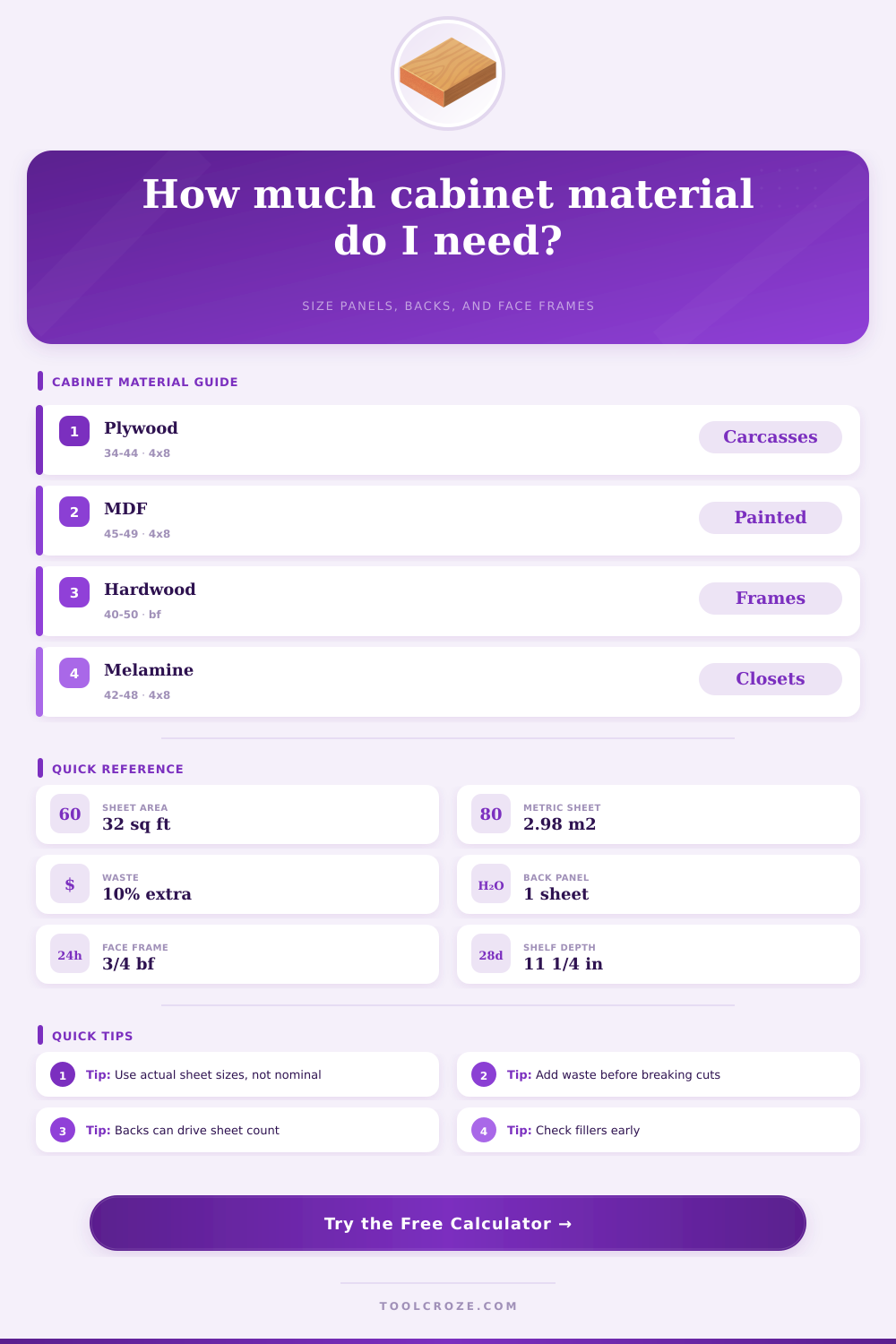
The carcass consist of the sides, the top, the bottom, and the fixed shelf of the cabinet. Because the sides of the cabinet require the most material, you will have to account for the height and depth of the cabinet. The top and the bottom of the cabinet will require less material than the sides of the cabinet because they will fit within the sides.
However, when you calculate the amount of material that is required for the top and bottom of the cabinet, you must account for the thickness of the material. Without accounting for the thickness, you will have incorrect measurement for the top and bottom of the cabinet. The shelves also require the use of material for the carcass of the cabinet.
In addition to calculating the amount of material required for the carcass of the cabinets, you must also calculate the amount of material required for the backs of the cabinets. The back of the cabinets is a large panel that cover the back of the carcass of the cabinets. To calculate how much material is required for the back of the cabinets, you have to multiply the width of the cabinet by the height of the cabinet.
Because many cabinets are either tall or wide, the backs of the cabinets may require an entire sheet of material for the back of the cabinet. Many people select thin material for the backs of the cabinets because it is much lighter and easy to fit into the rabbet of the carcass of the cabinets. However, thin material may warp if the humidity of the room where the cabinets are to be used is high.
It is important for people to plan for the backs of the cabinets as a separate piece of material from the carcass of the cabinet. Another important factor to consider when calculating the amount of material that is needed to build the kitchen cabinets is the amount of waste that will occur during the cutting of the wood. The waste that occurs during the cutting of the wood includes the saw kerf.
The saw kerf is the amount of wood that the saw blade saws away when the cabinet wood is cut, usually around sixteenth of an inch of wood. Other types of waste include the defects in the wood, the grain of the wood, and the amount of wood that is lost when the sheets of wood are squared up to form a perfect square piece of wood. To account for the waste, an additional percentage of wood can be purchased.
Twelve or fifteen percent of wood can be purchased to allow for waste on simple cabinet layouts. For more complex cabinet layouts with many angle, more wood can be purchased to allow for waste during the cutting of the wood. If not enough wood is purchased to allow for waste, there will not be enough wood to construct the cabinets.
If you are constructing traditional cabinets, you will also have to purchase wood for the face frames of the cabinets. The face frames are made of hardwood and consist of stiles and rails. The stiles are the tall pieces of wood that go the full height of the cabinets, while the rails are the pieces of wood that span the width of the cabinet opening.
The face frames are sold in board feet rather than sheets of wood. If you are constructing frameless cabinets, you will not have to purchase face frames for the cabinets. Instead, you will have to purchase edge banding for the edge of the plywood.
The type of material from which the cabinets are to be constructed will also impact the amount of material that is required to create the cabinets. For example, Baltic birch is a very stiff type of plywood and is often used to create the boxes for the cabinets drawers. Medium-density fiberboard, or MDF, is often used in the construction of cabinets because it is smooth and accepts paint well.
However, MDF can sag if it is supporting heavy load. Particleboard is an inexpensive type of wood that is often used in the construction of parts of the cabinets that will not be seen. Melamine is often used for the interior of closets because it does not need to be edged with edge banding.
The type of material for the cabinets can be determined based on the weight of the material, the humidity of the environment in which the cabinets will be used, and the type of finish that will be used on the cabinets. Another way of calculating and determining the amount of material needed to construct cabinets is the use of preset builds for the type of cabinets. For example, wall cabinets are often constructed to be relatively shallow in comparison to base cabinets, so they will use less material.
Pantry towers are constructed to be tall cabinets, so they will require more vertical material than a standard cabinet. Sink bases are constructed to have a void in the cabinets for the plumbing for the sink, and corner kitchen cabinets are constructed to allow for a diagonal layout of the cabinets. By using these preset builds for the cabinets, if you use the actual dimensions of your kitchen cabinets, the math will tell you how many sheets of plywood you need to buy as well as how much hardwood you need to buy for the face frames of the cabinets.
You also have to consider other factor in the construction and building of the cabinets. One such factor is the grain of the wood. The grain of the wood grows in certain directions, and you may want the grain to go vertically along the sides of the cabinet.
Also, you must take into consideration the toe kick clearances of the cabinets. These clearances will reduce the height of the side panels of the cabinets. Additionally, the amount of filler strips that you will need to construct the cabinets must be tallied.
Filler strips are made of narrow piece of wood. These can be cut from the offcuts of the wood that is sawn from the plywood sheets. Always build a single mock-up box of the cabinet before you purchase any materials.
This will ensure that your dimensions for the cabinets are correct. If the dimensions of your mock-up box are incorrect, then your list of the amount of material that you need will also be incorrect. A successful project will occur when you have an accurate cut list for your cabinets and the panels will fit together without force.
You will know that your calculations are complete and correct when you see how many sheets of plywood are required for the cabinet backs as well as the carcasses of the cabinets. By planning for six percent waste for simple kitchen cabinet jobs and twenty percent waste for custom cabinets, you will have an accurate understanding of the amount of material that you will need to stack. Accurate material breakdown is the most important part of starting a kitchen cabinet project.