Cabinet Dimension Calculator
Plan cabinet box sizes, opening widths, front blanks, and cut parts for base, wall, tall, pantry, and utility cabinets.
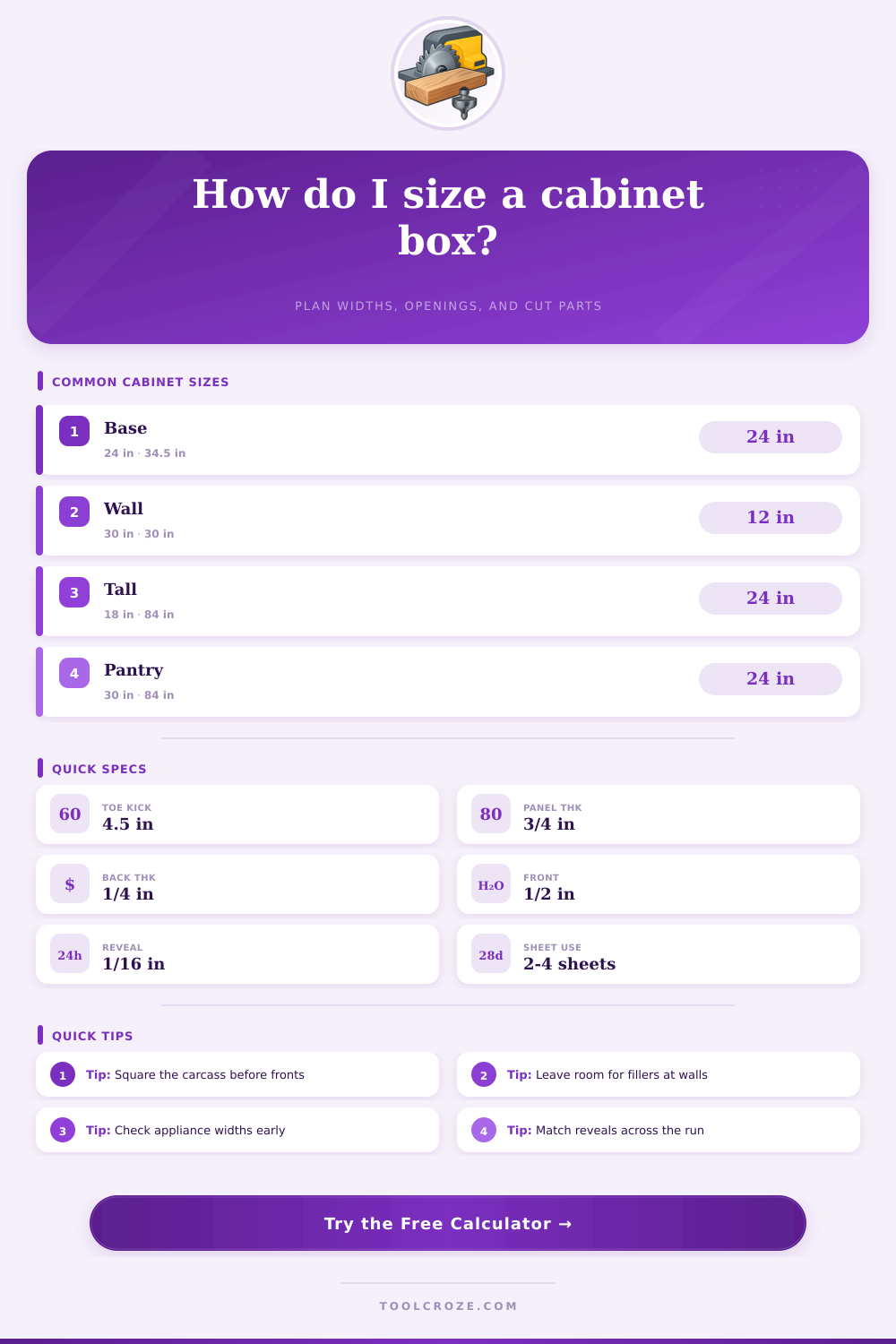
| Type | Width | Height | Depth |
|---|---|---|---|
| Base | 24 to 36 in | 34 1/2 in | 24 in |
| Wall | 12 to 36 in | 30 in | 12 in |
| Tall | 18 to 36 in | 84 in | 24 in |
| Pantry | 18 to 36 in | 84 in | 24 in |
| Material | Side | Back | Shelf |
|---|---|---|---|
| Cabinet ply | 3/4 in | 1/4 in | 3/4 in |
| Birch ply | 3/4 in | 1/4 in | 3/4 in |
| MDF | 3/4 in | 1/4 in | 3/4 in |
| Melamine | 3/4 in | 1/4 in | 3/4 in |
| Hardwood | 3/4 in | 1/4 in | 3/4 in |
| Style | Front | Back | Best for |
|---|---|---|---|
| Frameless | Overlay | Overlay | Modern runs |
| Face frame | Inset | Overlay | Classic builds |
| Base | Overlay | Overlay | Toe kick box |
| Pantry | Inset | Inset | Tall storage |
Cabinet sizing involve precise mathematical calculations. Cabinet sizing determine how the cabinets will fit within a kitchen. Many people finds that kitchen walls are not straight.
Additionally, kitchen appliances do not matches the measurements listed in specification sheets. Cabinet builders must measure all space within the kitchen accurately. If the measurements is off, the cabinets may be too large or too small for the kitchen.
How to Size and Install Kitchen Cabinets
The carcass is the main box within the cabinet. The carcass determine the internal space of the cabinets. The side panel of the carcass determine the height and depth of the cabinet.
However, the thickness of the side panels will reduce the amount of internal space the cabinet can contain. Three-quarters inch plywood and melamine is used for the side panels of the carcass because they are thick enough to support the shelves without sag. There are two type of carcasses: frameless and face frame.
With the face frame design, the side panels of the carcass add a border around the front of the cabinet. The face frame take up space for the cabinet, reducing the width of the cabinet opening. Every cabinet must have a specific depth.
The depth of a cabinet can vary depending on whether it is a base, wall, or floor cabinet. Base cabinets typically measures 24 inches in depth. This depth allow for the placement of appliances with standard depths.
However, wall cabinets are typically 12 inches deep so they will not crowd the countertop area of the kitchen. If the depth of the wall or floor cabinet is too deep, it will crowd the countertop. If the base cabinet is too shallow, items that are too large will not fit within the base cabinet.
Floor cabinets has a toe kick. The toe kick is a 4.5-inch-high by 3-inch deep recessed area on the floor floor cabinets. The toe kick allow people to place there feet on the floor while standing at the counter.
The toe kick should of be accounted for when determining the total height of the cabinet. The depth of the cabinet opening must be measured with precision. If the builder will split the opening of the cabinet into two doors, they must account for the thickness of the dividers.
For overlay doors, the doors will wrap around the carcass by a certain amount. For inset doors, the doors will be flush with the carcass. The inset doors must be able to perfectly fit into the carcass.
Builders will adjust the carcass so that the reveal of the doors will be even with one another. The materials used to make the carcass will impact how the cabinets will react with the environment. For example, birch plywood will change size with changes in humidity in the environment.
Due to this unique property of the birch plywood, it is often used in garages. MDF will stay flat and will not warp in the cabinets. However, if moisture is not controlled, the MDF will absorb that moisture.
Cabinet backs are typically made of quarter-inch material so that the cabinets will be lightweight. Additionally, the backs of the cabinets can be inset into the carcass so that there are no rough edge along the back of the cabinets. Depending on the number of cabinets to be made, the amount of sheet goods are calculated.
One sheet of sheet goods is 4 inches by 8 inches, or 32 square feet. This area may not be enough to cover the tall pantry cabinets. To prepare for the installation process, the builder should account for common installation problems.
For instance, if the wall is not level, fillers will be used. Fillers are used to even out the gaps between the wall and the cabinets. When measuring appliances, the depth of the appliances without the handles is measured.
This is because the handles adds to the depth of the appliance. If the cabinet is tall, such as a pantry, the builder will secure the cabinets to the wall with wall anchors. This is due to the fact that tall cabinets will be heavy when they are filled with the items.
Corner cabinets are typically difficult to use. The diagonals of the cabinets are not even. To even out the corner cabinets, cardboard mockups can be used to even out the corner cabinet prior to installation.
When installing the cabinets, follow the installation process in order. Base cabinets should be installed first. Shims will be used to even out the base cabinets.
The wall cabinets will then be hung from the top rails. The wall cabinets should be evenly plumb so that the cabinets will not sag. The functionality of the cabinets should be considered during installation.
For instance, a pantry cabinet will be more useful with shelves that can be easily pull out. Finally, all measurements and load requirements should be accounted for one last time prior to installation of the cabinets to ensure that the cabinets will remain stable and continue to fulfill their function throughout the life of the kitchen.