⚡ Brushless Motor Torque Calculator
Calculate BLDC motor torque, speed, power, and efficiency from KV rating, Kt constant, or power and RPM
✔ Calculation Results
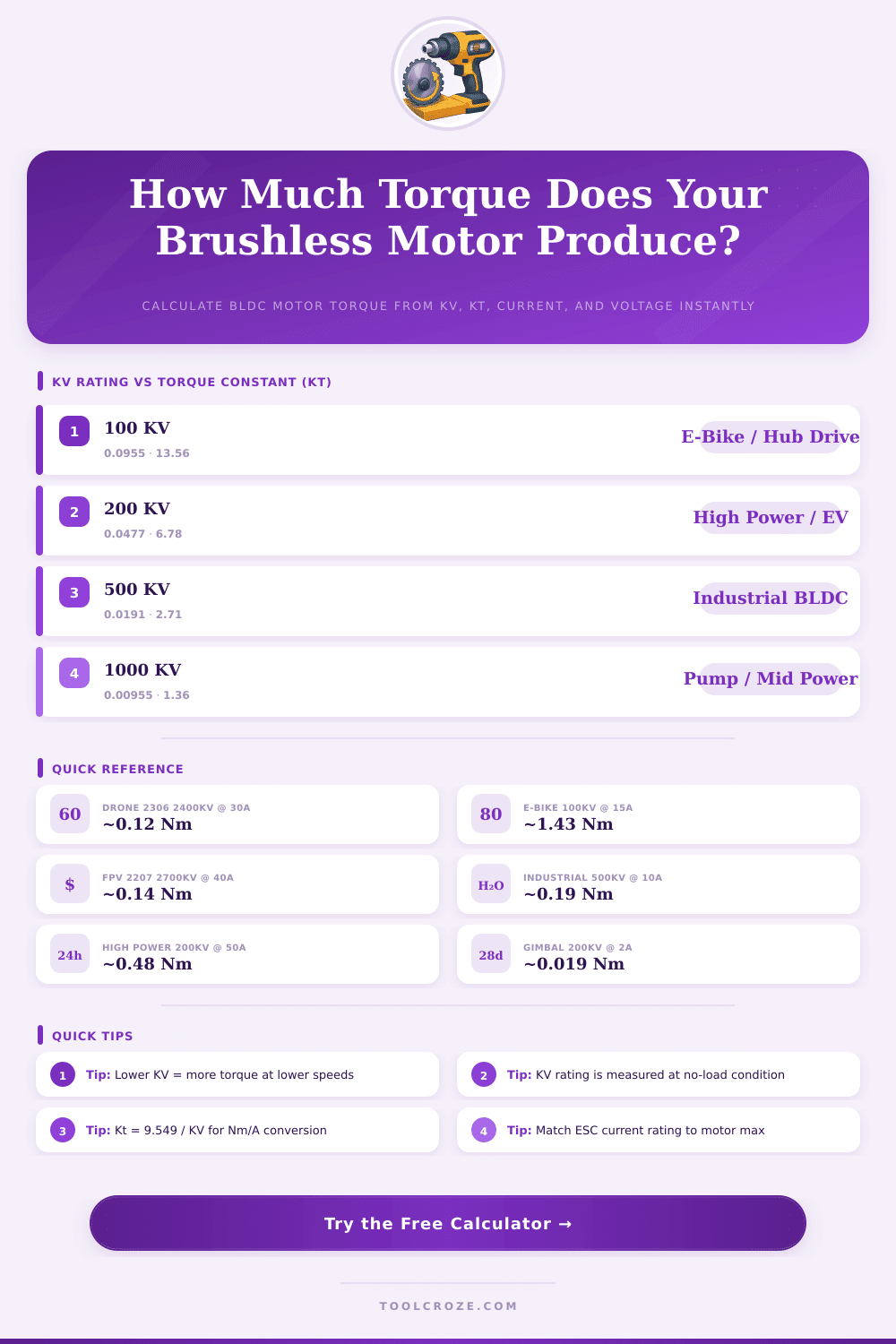
| KV Rating (RPM/V) | Kt (Nm/A) | Kt (oz-in/A) | Typical Application |
|---|---|---|---|
| 100 KV | 0.0955 | 13.56 | E-Bike Hub Motor |
| 200 KV | 0.0477 | 6.78 | High Power / EV Drive |
| 500 KV | 0.0191 | 2.71 | Industrial BLDC |
| 1000 KV | 0.00955 | 1.36 | Pump / Mid-Power |
| 1500 KV | 0.00637 | 0.90 | Mid-Size Drone |
| 2000 KV | 0.00477 | 0.68 | 5" FPV Drone |
| 2400 KV | 0.00398 | 0.57 | Racing Drone 2306 |
| 2700 KV | 0.00354 | 0.50 | FPV Racing 2207 |
| 3600 KV | 0.00265 | 0.38 | RC Car / Racing |
| 5000 KV | 0.00191 | 0.27 | Micro Racing / Fast RC |
| Application | Typical KV Range | Voltage Range | Use Case |
|---|---|---|---|
| E-Bike / Hub Drive | 50 – 150 KV | 24V – 72V | Direct drive, high torque |
| Industrial BLDC | 200 – 800 KV | 12V – 48V | Pumps, conveyors, CNC |
| Gimbal Motor | 100 – 300 KV | 6V – 16V | Stabilization, low speed |
| RC Plane / Heli | 800 – 2000 KV | 11.1V – 22.2V | High efficiency cruise |
| FPV Drone 5" | 1700 – 2800 KV | 14.8V – 22.2V | High thrust, racing |
| RC Car | 2500 – 5000 KV | 7.4V – 14.8V | Speed, high RPM |
| Pump / Fan | 500 – 1500 KV | 12V – 24V | Continuous duty |
| % of Max Load | Typical Efficiency | Heat Generation | Notes |
|---|---|---|---|
| 10% | 65 – 75% | Low | Iron losses dominate |
| 25% | 78 – 86% | Low | Moderate operation |
| 50% | 85 – 93% | Moderate | Near peak efficiency |
| 75% | 88 – 95% | Moderate | Peak efficiency zone |
| 90% | 82 – 91% | High | Copper losses rise |
| 100% | 70 – 85% | Very High | Stall / overcurrent risk |
brushless motor show everywhere now, in electric cars, strong devices, drones for fun. Many people want to understand how exactly the torque works in such machines. Here the key spot: in a brushless motor the torque depends on the electricity.
Bigger flow of electricity forces stronger torque. Really it is just this simple.
How Torque Works in Brushless Motors
Some equations explain the torque of the engine. The most basic formula is T = Kt × I, where Kt shows the constant of torque and I the electricity that flows through it. There are also more difficult equations that include voltage number, back force and turns per minute.
Everything happens by means of sudden increase of electricity when the torque drops. At the state of zero speed, that is the stop, the back force vanishes, the electricity becomes voltage shared by resistance, and the torque reaches its highest value.
Here it becomes really cool. The electricity controls the torque, but the voltage determines the turns per minute. So, if one changes the voltage, also the electricity changes, so that the torque does not stay the same through various speeds.
Many folks get confused becuase of that, when they try to choose the right engine.
So, here comes the link between Kt and Kv, which does cause a lot of mix. Some use the equation Kt = 1 / Kv. Others prefer Kt = 30 / (π × Kv).
In the world of electric cars there are lots of myths about the tie between Kv and torque. One can swap different stators in the same winding of engine, and low Kv means more strong magnetic field at the stator.
brushless motor types, even though one marks them as DC, actually work as three-phase AC engines. They use frequency ranging to turn the DC into AC energy. That system gives them efficiency and strong torque without losses in the rotor.
Controlling them requires more attention then brushed versions, on the other hand. Brushed engine? One only touches it to the battery, and it starts.
For brushless motor types one requires more complex control to work.
The field of strong tools shows, that brushless motor types bring real benefits. Old brushed drills reach around 450 foot-pounds of torque, while new brushless types reach 750, sometimes even above 1000 foot-pounds. That difference can cause real headache.
Folks commonly end up with too strong shooting of screws with brushless tools, because they lack fast drop of resistance, which brakes the process.
In the range of electric cars, one can break the gearbox almost instantly by means of switching to brushless motor types, thanks to that sudden burst of torque. Such engines remove big heavy parts and low gear chains without any effort. Sometimes one adapts to that, but it only worsens the situation, making even more torque and problems with traction instead of fixing them.
The mechanical energy is only torque multiplied by turnsper minute, so when some of them reach zero, one has no energy output at all.