⚡ Brushless Motor Efficiency Calculator
Calculate BLDC motor efficiency, heat dissipation, ESC losses & estimated flight/run time
📊 Power Loss Breakdown
| Loss Component | Power (W) | BTU/hr | % of Input |
|---|
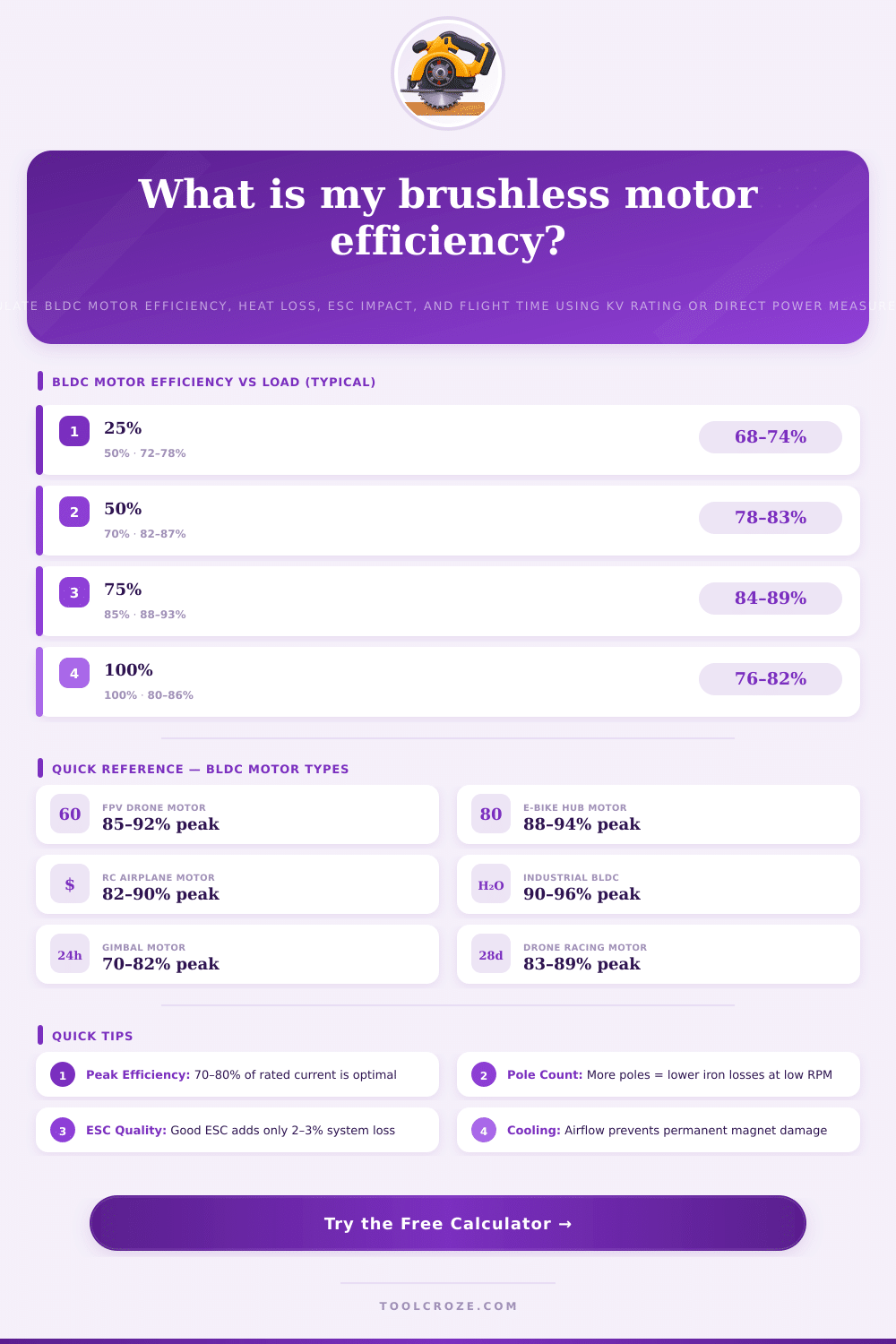
| Load / Speed % | Approx RPM % | Typical Motor Eff % | Notes |
|---|---|---|---|
| 25% Load | ~50% RPM | 72 – 78% | Low speed, high slip losses |
| 50% Load | ~70% RPM | 82 – 87% | Good mid-range operation |
| 75% Load | ~85% RPM | 88 – 93% | Near peak efficiency zone |
| 100% Load | ~100% RPM | 80 – 86% | Copper losses dominant |
| ESC Quality | Typical Efficiency | Added System Loss | Application |
|---|---|---|---|
| Budget ESC | 88 – 91% | 9 – 12% | Hobby / entry-level |
| Mid-Range ESC | 92 – 95% | 5 – 8% | FPV / RC aircraft |
| High-End ESC | 96 – 98% | 2 – 4% | Racing / industrial |
| Vector Drive ESC | 98 – 99% | 1 – 2% | EV / servo systems |
| Loss Type | Typical % of P_in | Main Cause | Reduction Method |
|---|---|---|---|
| Copper (I²R) | 4 – 9% | Winding resistance | Lower R, reduce current |
| Iron / Core | 2 – 5% | Eddy currents, hysteresis | Laminated cores, fewer poles |
| Mechanical | 1 – 3% | Bearing friction, windage | Quality bearings, alignment |
| ESC Switching | 2 – 8% | MOSFET switching losses | Higher quality ESC, cooling |
When talking about efficiency, brushless motor engines clearly stand out between the others. The basic differences are easy: one removed the brushes and the commutator entirely. In the place of that, electronic controllers control the flow of current during permanent magnets (that stay magnetized without electrical flows) do the main work.
That change in construction is the reason that they convert electrical energy in mechanical work much better.
Why Brushless Motors Are More Efficient
Here where the numbers become attractive. Brushes engines usually reach only around 75 until 80 percent of efficiency. Brushless motor engines, vice versa, can arrive in 85 until 90 percent.
Practically talking, that wants to say, that almost 90 percent of the enclosed electrical energy in brushless motor engine turns in useful activity, with only maybe 10 percent lost as heat. When the conditions are ideal; operating in the best spot, some brushless motor engines even surpass 96 percent of efficiency, almost entirely turning the electricity in practical force.
The main cause of that loss in efficiency comes from friction. In brushes engines, the brushes permanently rub against the rotor, what pushes energy by means of friction and create heat. That noise and heat you hear and feel?
It simply shows energy, that wastes away of the place, where it had to go. Brushless motor engines almost entirely escape that misfortune, so much more of energy indeed help in the real work, instead of simply disappear.
Is other good spot, that one should mention: brushless motor engines do not suffer of voltage-loss because of brush-contact. If you give the same amount of electrical energy to both kinds, the brushless motor variant converts more from it in mechanical move. That becomes genuinely important for devices on batteries, think about wireless tools or drones.
Brushless motor tools strain the duration of the battery on one round, or gives more force from more little, compact design. Some little brushless motor tools surpass their brushes versions by means of big difference, while taking much less of place.
Even so, efficiency is not permanent cause. Engine operates best, when its speed under burden match to the spot, where counter force matches the applied voltage. Every burden slows the engine, what depresses the counter force and expand the flow of current.
Here the main spot, efficiency genuinely sinks until nothing in two different cases: when the engine is entirely stopped, and when any burden exists. Both cases kill the output, because one requires speed and torque to involve.
Different uses operate otherwise also. Heat pumps reach the highest efficiency in one particular pace, later it drops, when causes slow down. Train engines operate vice versa, slowing brushless motor permanent magnet engine, one keeps the efficiency relatively high, neither a lot.
Except the gains in efficiency brushless motor engines live much more long, because any brushes exhaust the time. They work more quietly and create fewer electromagnetic problems. The thinsg?
Higher initial price and need of special controllers. Even little improvements in motor efficiency accrues threw whole systems, what shows, that well set those machines matter more thanfolks commonly reckon.