Brick Mortar Calculator
Estimate brick count, wet mortar volume, dry sand, cement, lime, premix bags, and joint allowance for veneer, garden walls, piers, chimneys, and repair panels.
⚙Project Presets
📏Wall And Joint Inputs
Brick Mortar Takeoff
🧪Mortar Material Spec Grid
📚Brick Size Reference
| Brick name | Nominal size | Actual size | Common joint | Approx. face bricks |
|---|---|---|---|---|
| Modular brick | 4 x 8 x 2-2/3 in | 7.625 x 2.25 x 3.625 in | 3/8 in | 6.8 per sq ft |
| Queen brick | 3 x 8 x 2-3/4 in | 7.625 x 2.75 x 2.75 in | 3/8 in | 5.8 per sq ft |
| Utility brick | 4 x 12 x 4 in | 11.625 x 3.625 x 3.625 in | 3/8 in | 3.0 per sq ft |
| Norman brick | 4 x 12 x 2-2/3 in | 11.625 x 2.25 x 3.625 in | 3/8 in | 4.6 per sq ft |
⚒Mortar Mix Ratio Reference
| Mortar type | Portland cement | Hydrated lime | Masonry sand | Typical use |
|---|---|---|---|---|
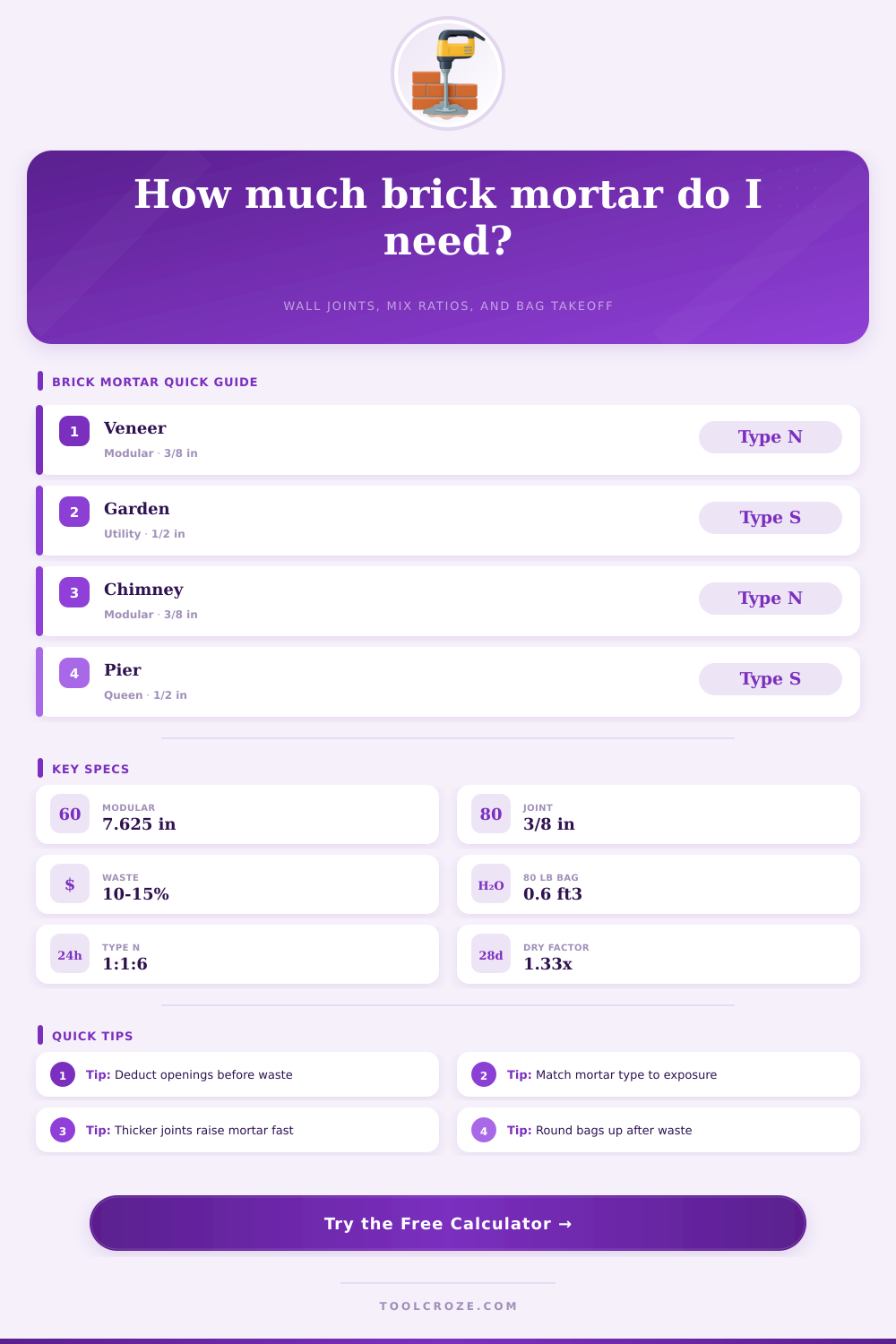
| Type N | 1 part | 1 part | 6 parts | Exterior veneer, chimneys, non-load walls |
| Type S | 1 part | 1/2 part | 4-1/2 parts | Below grade, garden walls, retaining exposure |
| Type M | 1 part | 1/4 part | 3 parts | Heavy structural masonry and hard stone |
| Type O | 1 part | 2 parts | 9 parts | Soft historic interior brickwork |
📊Joint And Waste Reference
| Condition | Typical allowance | Mortar impact | Brick impact | Use in calculator |
|---|---|---|---|---|
| Straight veneer panel | 5% to 10% | Low | Low cuts | Normal site work |
| Returns, corners, piers | 10% to 15% | Medium | More closures | Cuts and returns |
| Irregular salvage brick | 15% to 20% | High | Sorting loss | Repair or irregular |
| Raked joints | Profile factor | Slightly lower | No change | Raked profile |
🏗Common Brickwork Preset Reference
| Project | Wall size | Brick and joint | Mortar type | Field factor |
|---|---|---|---|---|
| Veneer accent wall | 18 ft x 8 ft | Modular, 3/8 in joint | Type N | 10% waste |
| Low garden wall | 24 ft x 3 ft | Utility, 1/2 in joint | Type S | 15% waste |
| Chimney face repair | 8 ft x 12 ft | Modular, 3/8 in joint | Type N | 20% waste |
| Double wythe screen | 30 ft x 4 ft | Modular, 1/2 in joint | Type S | 15% waste |
💡Mortar Takeoff Notes
The mortar holds the bricks together. You tend to think of it as just filler, something you don’t really have to worry about too much except at delivery time when there’s nothing in the back of the truck! Mortar is one of those structural ingredients… Not filler, and behave like a sponge by absorbing moisture and expanding a little bit during curing. Therefore getting the mortar mix correct can extend life of the wall.
The mistake here is not knowing what size job you are doing. The calculator do all that math for you after you enter your dimensions, preventing this frequent mistake. The trickiest part of estimation is knowing what you’re estimating. Wall area part is clear enough. But then there’s the thickness of the joints, which throw estimates off kilter. Three-eighths inches (a common size) doesn’t sound like much on paper. But times that by however many courses and headers and you start adding things up. Double that joint width to a half-inch if you want some rustic look. You will suddenly have much more binder and less clay. This means you will have more volume to deal with when you make your mix. This tool calculates that geometry, leaving you free to avoid the multiplication mistakes humans often makes.
How to Calculate Mortar for Your Wall
Also, remember: Sand settles differently in a pail than it does in a bag. It break the wet volume into its dry parts for you. Picking the right kind of mortar is just as important to a strong structure. Type N is the workhorse for most above-grade exterior veneers. It’s strong enough but still flexible enough to allow for thermal expansion and contraction. If you’re in a climate that goes from freeze to thaw repeatedly, you will want something that is more flexibel than that: Brick doesn’t want to crack! In locations where the wall is exposed to any soil moisture, like a garden wall, Type S are stronger (with better bond strength) and also more resistant to water. Trapped moisture that expands behind your brick can cause the face of it to pop off, which is known as spalling. The ratio tables on that page make clear what material goes where, depending on exposure.
Until your project comes to a grinding halt because you ran out of material, waste is something that rarely gets addressed. If your layout has lots of cuts and returns, and little straight walls, then your overage will be higher. Add another 10 percent or 15 percent to your take off for spillage, breakage, and misfit pieces and it’s best to have a few extra bags in the corner rather than running back to hardware store the next day when you run short. These adjustments are built into the calculator to give you a realistic cost upfront, saving you from making a commitment.
The amount of material you need depends on your pattern. Fewer cuts make running bond the most efficient choice. However, both Flemish and soldier bonds requires more precision and tend to create more waste since headers must be cut to fit narrow gaps. For vintage renovations, note what type of mortar was used originally (because historic homes frequently employed lime-laden mixtures that let the brick “breathe”). Moddern Portland cement can trap moisture and speed up the decay of delicate historic brick. When renovating, use the lime-based options on the calculator to match the original so the old material isn’t ruined by the new.
The quality of the sand used makes a difference to the overall strength of the finished project. Dirty sand will weaken the bond between blocks and introduce weak points in the joint, so it’s important to use masonry sand that’s well sized and clean. The biggest advantage of using pre-blended bags is their consistency (the manufacturer determines both cement and aggregate size), which removes the guesswork from on-site mixing of three distinct ingredients. Although pre-mix runs at a premium, it’s worth the money for smaller repair jobs; with larger jobs, purchasing sand in bulk along with separate bags of lime and cement saves money, assuming that you have the storage space for these materials and a mixer capable of properly blending them.
Always account for openings before adding waste. Because doors and windows decrease the amount of actual brickwork that will need covering, they in turn reduce the amount of materials required. By taking accurate measurements of these reductions, you won’t end up buying more than necessary. The results of this tool provide you with a clear starting point from which you can budget… Literally pulling off the shelf exactly how many 94 pound bags of cement and 50 pound bags of lime you’ll need.
Building walls out of bricks is both an engineering task and a creative one, and your eye will guide how they go up; the math happens in your hands as you hold a tool. Respect the waste factor. Get the mortar right. Pick the right mix for where you live. That is what makes the difference between a pile of red rectangles and a wall that will last for decades. Because then when you step back to look at it and admire the work, you don’t think about the crumbling joints, you think about the pattern of the brick.