Brass Metal Weight Calculator
Estimate brass stock weight by alloy and shape for round rod, flat bar, tube, sheet, and hex stock with quantity and machining allowance.
⚒Brass stock presets
📏Stock dimensions
Brass stock weight results
⚙Alloy and shape grid
📊Brass density reference
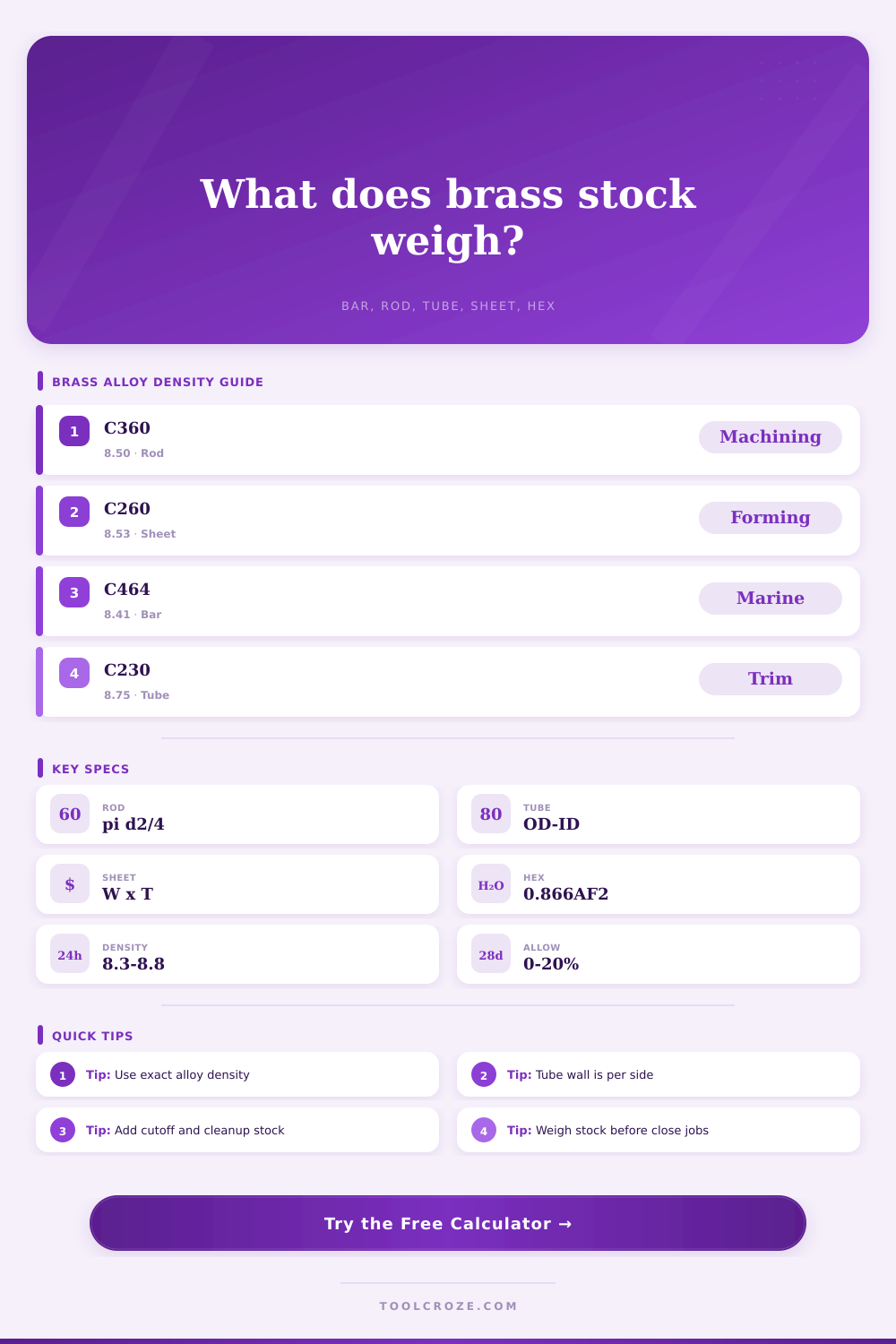
| Alloy | Common name | Density g/cm³ | Typical stock |
|---|---|---|---|
| C360 | Free machining brass | 8.50 | Round rod, hex, bar |
| C260 | Cartridge brass | 8.53 | Sheet, strip, formed parts |
| C464 | Naval brass | 8.41 | Rod, flat bar, plate |
| C230 | Red brass | 8.75 | Tube, sheet, ornamental stock |
| C385 | Architectural brass | 8.47 | Extrusions, plate, trim |
| C377 | Forging brass | 8.44 | Billets, forged blanks |
| C272 | Yellow brass | 8.44 | Sheet, strip, light bar |
| C353 | Leaded brass | 8.48 | Bushing stock, tube, rod |
🔢Shape formulas
| Shape | Area formula | Dimensions used | Best stock examples |
|---|---|---|---|
| Round rod | A = πd²/4 | Diameter, length | Turning blanks, pins, bushings |
| Round tube | A = π(OD² - ID²)/4 | OD, wall, length | Spacers, sleeves, decorative tube |
| Flat bar | A = width × thickness | Width, thickness, length | Bus bars, brackets, trim |
| Sheet or plate | V = width × thickness × length | Width, thickness, sheet length | Plates, shims, panels |
| Hex bar | A = 0.866025 × AF² | Across flats, length | Nuts, valve parts, fittings |
🔧Common brass stock presets
| Preset | Alloy | Shape and size | Allowance |
|---|---|---|---|
| C360 1 in Rod | C360 | 1 in diameter x 3 ft | 5% cleanup |
| C260 Shim Sheet | C260 | 12 in x 0.032 in x 2 ft | 3% trim |
| C464 Flat Bar | C464 | 2 in x 0.25 in x 6 ft | 8% saw trim |
| C230 Round Tube | C230 | 1.5 in OD x 0.065 in wall | 5% cleanup |
| C360 Hex Valve | C360 | 0.75 in AF x 1.5 ft | 10% turned blanks |
| Metric Tube Batch | C353 | 25 mm OD x 2 mm wall x 1.2 m | 8% facing |
✅Machining allowance guide
| Allowance | Use case | What it covers | Weight effect |
|---|---|---|---|
| 0% | Finished stock | Known net dimensions | No added material |
| 3% | Simple saw trim | Cutoff and small cleanup | Light added stock |
| 5% | General machine blanks | Facing, burr cleanup, kerf variation | Common default |
| 8% | Turned brass parts | Chuck allowance and faced ends | Moderate added stock |
| 10% to 20% | Rough or uncertain yield | Extra grip, trial cuts, rejected ends | Conservative planning |
💡Shop calculation tips
There’s something about standing down an aisle at a metal supply house that gets your heart pumping with anxiety. You’ve got a sketch in your pocket and a rough estimate of how much brass you’ll need. You know the type of alloy you want, and you know dimensions of parts. But do you know if that pile of hex bar is five pounds, or fifty? Because if it’s the latter, cost to ship adds up fast, and capacity of the crane used to load it are limited.
That is what this page is for. After selecting the stock shape and entering dimensions, the calculator does all the work for you. You won’t have to do complicated geometry calculations in your head while the store clerk wait.
How to Calculate Brass Weight
There are different types of brass Not all brass is created equal. There is more than just one type of brass. In fact, there’s a whole family of them made from combinations of zinc and copper that vary in their properties based off the mix.
For example, C360 free machining brass contain some lead which aids in clean chip separation. That helps when you’re turning the material but it also increases density to about 8.50 grams per cubic centimeter. C260 cartridge brass are harder and has a density near 8.53. That may sound small, but it matters. If you are buying a hundred feet of heavy rod, that half-percent swing change the total weight enough to affect your freight quote.
This table helps with that. Rather than guessing at an average number, you’ll have the correct density for whichever alloy you select from list.
But that’s not the case with shape of the stock. A round rod is simple. To find cross-sectional area, square the diameter and multiply by Pi/4. A tube is a bit more complex as you has to consider the void in the center. You provide outside diameter and wall thickness. It figures out inside for you. It does this by subtracting 2X the wall thickness from the OD. That is where people leaves material off. The wall thickness occurs on each side so they double subtract when they shouldn’t. They’ll end up way overestimating weight.
Plate and sheet work are easier to say, harder to actualy do. It’s area versus profile. Width times thickness equals area. Length times area equals volume. Mass is what you get when you multiply volume by density.
A different constant apply if you use hexagonal bar stock. To find the area, multiply by approximately.866, which is a standard geometric constant used because six sides are symmetrical. You don’t need to derive this one; just memorize which dimension to use for your measurements.
This is the saw kerf. This is something most machinists will overlook. When you make a cut on a piece of brass, you’re turning some of that material into chips and dust. So if you’re cutting ten blanks, that’s two end cuts and nine cuts between them.
When using the calculator, you can enter a kerf width (typically about one-sixteenth of an inch for a band saw). Then it will adds that amount to your overall length and calculate accordingly. It matters when you order custom cut stock to a specific net length.
The other thing that separates the pros from the amateurs is machining allowance. Most of the time, your part isn’t perfect. You need extra material for turning, facing, and boring to get the part finished. Simple trim allows three percent. Rough blanks that are going to take significant cuts calls for ten percent. Dial it in with the tool and add the percentage to the final weight so you don’t order too little. Why? Scrap metal is less expensive than rush fees on getting stuff ordered late.
At the bottom, you’ll get a breakdown of what it’s doing. It provides the volume, cross sectional area, weight of each one, and total weight for the bunch. Run through it again yourself to make sure you’re on track. Did the weight per foot seem off? Double check your units. The calculator defaults to metric or imperial but that doesn’t mean you chose those units.
Metal is heavy, conducts well and looks good. Metal is also costly by weight. Waste happens, but knowing exactly how much you’re buying prevents it. Making a one off part like a custom valve or even a piece of decor is all the same math. Mass = volume X density. Use the calculator at the top to do the math for you, then go make something.
Remember though, your saw eats up some metal in the process. You should of factored that into the calculation. Measure twice, cut once. When you get it right, the weight matches the sketch.