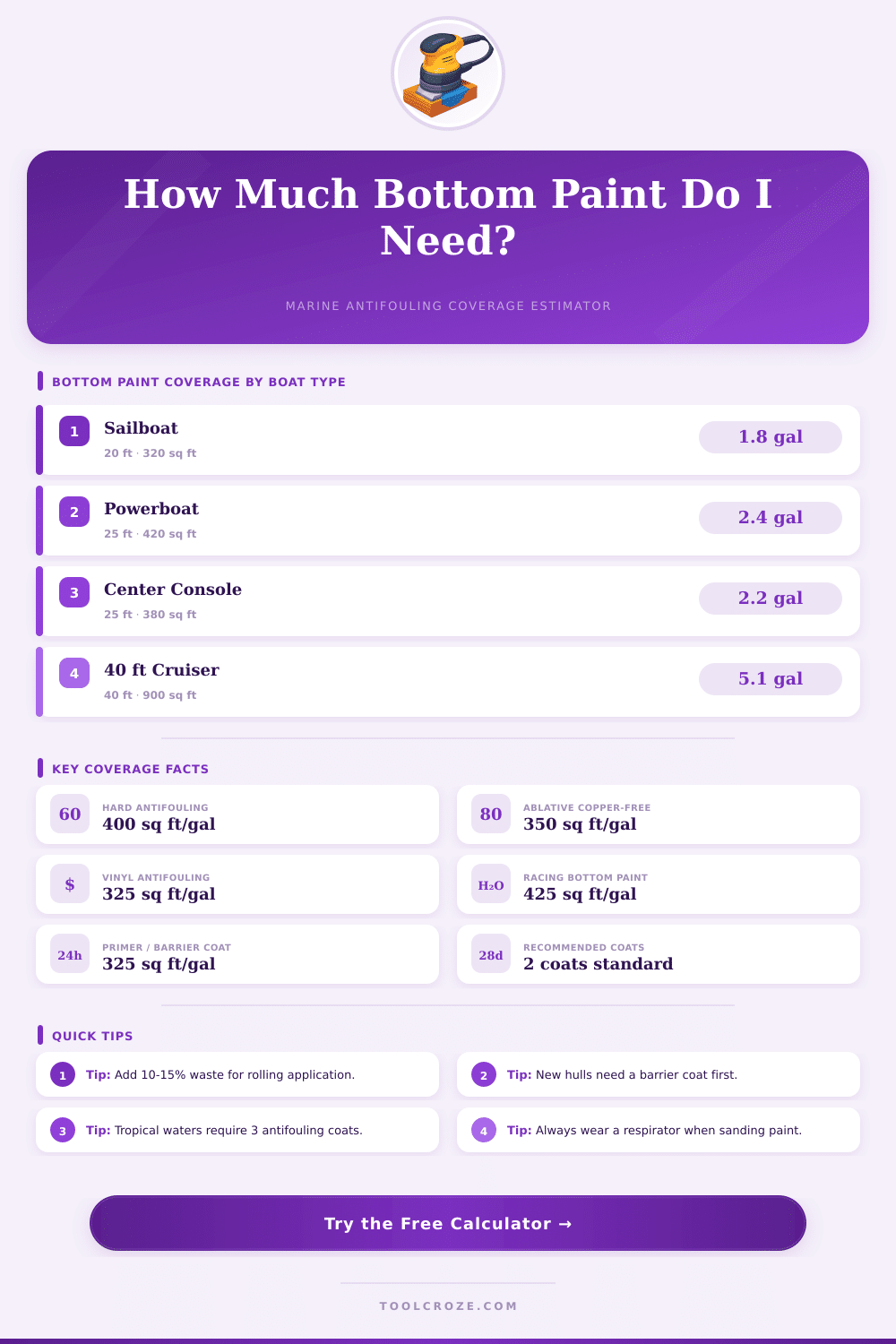
⛵ Bottom Paint Coverage Calculator
Calculate exactly how much antifouling bottom paint you need for your boat hull.
| Boat Type | LOA | Typical Beam | Est. Wetted Area (sq ft) |
|---|---|---|---|
| Small runabout | 15 ft | 6–7 ft | 160–220 |
| Sailboat | 20 ft | 7–8 ft | 280–350 |
| Center console | 22 ft | 8–9 ft | 300–380 |
| Sailboat | 25 ft | 8–9 ft | 370–450 |
| Powerboat | 25 ft | 9–10 ft | 350–430 |
| Cruising sailboat | 30 ft | 10–11 ft | 500–620 |
| Sportfisher | 30 ft | 10–11 ft | 470–580 |
| Cruiser | 40 ft | 13–14 ft | 800–1,000 |
| Sailing catamaran | 38 ft | 20–22 ft | 700–900 |
| Paint Type | Coverage | Copper Content | Antifouling Life | Best Use |
|---|---|---|---|---|
| Hard antifouling | 400 sq ft/gal | High (40–67%) | 1–2 seasons | Trailered / raced boats |
| Modified hard | 350–400 sq ft/gal | Medium–High | 1–2 seasons | General use |
| Ablative copper-free | 350 sq ft/gal | None (biocides) | 1 season | Freshwater / eco-conscious |
| Vinyl antifouling | 300–350 sq ft/gal | Medium | 1 season | Budget / DIY |
| Primer / barrier coat | 300–350 sq ft/gal | None | N/A (primer) | New hulls, blister repair |
| Racing bottom paint | 400–450 sq ft/gal | Very high (65%+) | 1 season | Performance racing |
| Hull Condition | Barrier Coats Needed | Antifouling Coats | Notes |
|---|---|---|---|
| New / gelcoat | 2–4 epoxy barrier coats | 2 | Sand barrier coat before antifouling |
| Previously painted (good) | None | 2 | Light sand, wash, apply direct |
| Previously painted (strip) | 1–2 after stripping | 2 | Strip old paint, inspect gel coat |
| Osmotic blisters | 4–6 epoxy barrier system | 2–3 | Dry hull fully (months) before barrier coats |
| Region / Fouling Level | Recommended Coats | Reapplication | Notes |
|---|---|---|---|
| Tropical / high fouling | 3 coats | Every season | Warm water accelerates barnacle growth |
| Temperate saltwater | 2 coats | Every 1–2 seasons | Standard recommendation |
| Freshwater | 1–2 coats | Every 2 seasons | Lower fouling; copper-free options preferred |
| Great Lakes / cold water | 1 coat | Every 2–3 seasons | Minimal biological growth |
Most people measure the amount of paint by square feet per coat, this is the usual standard for guessing how much you will need for any task. One coat usually covers around 350 to 400 square feet, but really, this is only a rough number. In the real world the values often range a lot, because it depends on different factors that play a role.
Your choice of the final paint really affects the results. The directions on the cans of paint show the coverage amounts, so check them before you open the tin and start to paint. Paint for ceilings normally falls in the range of 350 to 400 square feet per coat.
How Much Paint You Need Per Coat
About the primer? It is more lightweight, so you can expect only around 225 to 275 square feet per coat, depending or not. Those numbers adjust when you consider how well prepared or primed already are your walls.
The texture of the surface and its gaps create a big difference. Rough or holey walls absorb the paint more quickly than smooth. In perfect conditions of work you maybe will reach the numbers on the labels, but reality rarely helps.
Also the mode of putting it on matters, a spray can extend the coverage compared to brush or roller, but latex paint usually reaches around 400 square feet per coat in most cases.
Flat finishes have stronger thickness of pigment, so they cover bigger area. Semi-gloss, deep colours and some whites with almost no pigment? They are more costly.
Here the quality matters, good mid-range paint in a light shade will conceal more effectively than the cheap version in the same colour. Combinations of paint and primer can help save money and extra coats while keeping good coverage.
Two coats are what moast people suggest for smooth, full coverage that really shows the depth of the colour in the paint. If you do a big change of colour over an old coat, three coats maybe are needed. Coloured primer mixed in half of the strength of your top colour gives good base.
Black shades usually require three coats to look well, while brighter tones sometimes work with one thick coat if the existing walls already are primed.
Spray paint follows totally other rules. An average can of spray paint can cover around 12 to 16 square feet per coat. For high build or enamel sprays?
They apply thicker coats, so the coverage drops to around 8 to 12 square feet because of that heavy coat.
Adding a bit of white can help against staining and extend the coverage, but your end colour might shift a bit from the originally chosen. Most paint brands offer online calculators that remove the guesswork, simply enter the sizes of your rooms and the type of surface, andthey will give a pretty reliable guess.