🔩 Bolt Joint Calculator
Estimate target preload, installation torque, bolt stress, stiffness ratio, and separation margin for machine joints, base plates, flanges, and structural bolted connections.
📌 Presets
⚙ Joint Setup
🎯 Results
🧱 Material and Spec Comparison
Anchors and light steelwork
General machinery joints
Frames and brackets
Heavy machine service
📊 Reference Tables
| Bolt Spec | Proof Strength | Yield Strength | Recommended Preload |
|---|---|---|---|
| ASTM A307 | 36 ksi | 60 ksi | 55-60% |
| SAE J429 Grade 5 | 85 ksi | 92 ksi | 70-75% |
| SAE J429 Grade 8 | 120 ksi | 130 ksi | 75-80% |
| ISO 8.8 | 600 MPa | 640 MPa | 70-75% |
| ISO 10.9 | 830 MPa | 940 MPa | 75% |
| A2-70 Stainless | 450 MPa | 600 MPa | 60-70% |
| Friction State | Mu | Approx K | Use Case |
|---|---|---|---|
| Lubricated alloy | 0.10 | 0.218 | Controlled assembly |
| Zinc/oiled | 0.12 | 0.230 | Common shop install |
| Plain carbon steel | 0.15 | 0.247 | Dry machine joints |
| Dry plated | 0.18 | 0.264 | Maintenance work |
| Dry stainless | 0.20 | 0.276 | Corrosion service |
| Member Material | Modulus E | Compression Factor | Joint Behavior |
|---|---|---|---|
| Carbon steel | 29 Msi / 200 GPa | 1.00 | Stiff, stable clamp |
| Cast iron | 16 Msi / 110 GPa | 0.90 | Moderate stiffness |
| Aluminum 6061-T6 | 10 Msi / 69 GPa | 0.65 | Higher embedment risk |
| Stainless plate | 28 Msi / 193 GPa | 0.95 | Good clamp retention |
| G10 / FR4 | 2.6 Msi / 18 GPa | 0.35 | Low member stiffness |
| Preset Joint | Bolt | Clamp Stack | Typical Duty |
|---|---|---|---|
| Servo mount bracket | M8 8.8 | 18 mm | Vibration machine |
| Base plate anchor | 1/2 in Gr 5 | 1.5 in | Frame column |
| Pump flange | M16 10.9 | 32 mm | Pulsating pressure |
| Hydraulic manifold | M6 12.9 | 20 mm | High clamp retention |
💡 Tips
Bolted joint are used to hold machine parts together. Additionally, people use bolted joints to manage the forces within a machine. If the bolt become loose within the machine, it can lead to misalignment within the machine or fatigue crack within the machine’s components, both of which can lead to catastrophic failure of the machine.
To prevent catastrophic failure of the machine, the person designing the machine must calculate the correct amount of preload that should be apply to the bolt. Preload is the tension that is applied to the bolt when the bolt is tightened. The preload creates a clamp force within the joint that compress the joint’s members.
How Bolts Hold Parts Together Safely
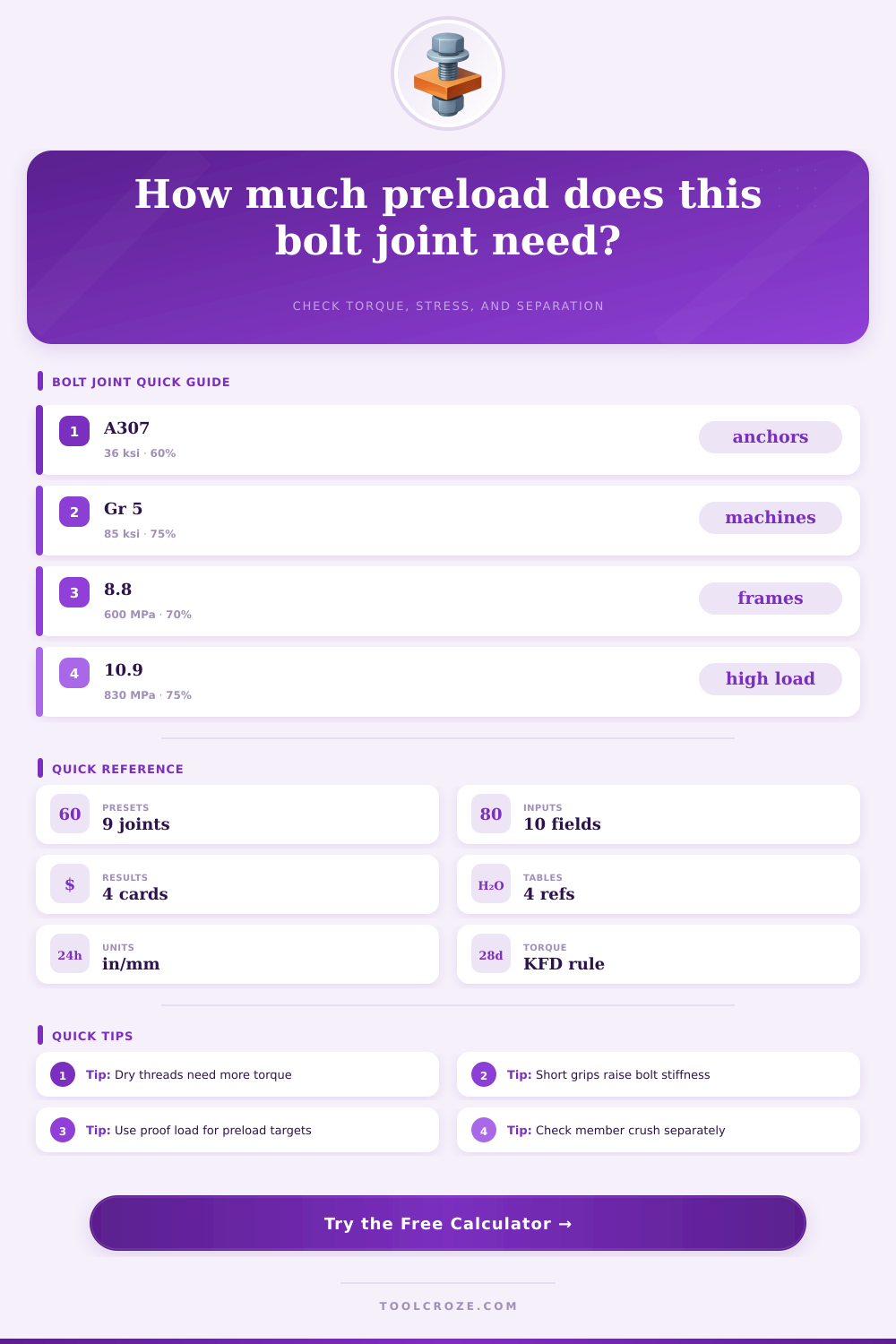
If the preload is too low, the joint will open up when load are applied to the joint. If the preload is too high, the bolt will begin to yield due to the preload being higher than the strength of the bolt. Engineers often choose a preload between 60 and 80 percent of the proof load of the bolt; this range allow the bolt to remain within its elastic range while ensuring that the bolt maintains it’s grip on the joint’s members.
Proof load is the tension that a bolt can withstand before it begins to deform. Proof load is dependent upon the tensile stress area of the bolt; the tensile stress area is the narrowest portion of the bolt, specifically the portion of the bolt that contains the thread. The diameter of the bolt and the thread pitch are also important parameters in calculating the tensile stress area.
If the threads are fine, the tensile stress area will be larger for a bolt of a specific diameter. Thus, finer threads allow for more preload to be applied to the bolt without risking the bolt’s integrity. Coarse threads allow for faster assembly of the bolt and joint, but the coarse threads will have a smaller tensile stress area, and thus allow less preload to be applied to the bolt.
The material of the joint members can impact the operation of the bolted joint. If the joint members are made of steel, they will be relatively stiff materials. The joint members will share the external load with the bolt by compressing.
If the joint members are made of aluminum, they will be less stiff than steel. Thus, the aluminum joint members will experience more compression than the steel joint members. This additional force apply to the joint members will increase the load that must be shared by the bolt.
Grip length is the portion of the bolt that is under tension. If the grip length is shorter, the bolt will be stiffer. A stiffer bolt will share the joint load with the joint members similar to how the joint members share the load with each other.
The method that is used to achieve the preload of the bolt is called torque. The torque that is applied to the bolt is dependent upon the friction between the bolt and the joint members. The relationship between torque and preload is calculated using a nut factor.
The nut factor is different for dry threads as compared to lubricated threads. For example, lubricated threads may have a nut factor of 0.22, but dry stainless steel threads may have a nut factor of 0.28. Because the nut factor changes with lubrication of the threads, a change in lubrication will change the torque by 20%.
If the wrong torque is applied to the bolt based on the wrong nut factor, the preload will be incorrect. Additionally, another consideration is the effect of temperature on the joint. If the temperature of the bolt and the joint members are different, the bolt may expand or contract with the change in temperature, which may change the preload within the joint over time.
Another consideration of bolted joints is the stiffness ratio of the bolt to the joint members. If the joint members are stiffer than the bolt, the external loads will not put much stress on the bolt. However, if the joint members are thin or flexible, the bolt will experience most of the load that is applied to the joint.
This can lead to fatigue of the bolt. One method of counteracting this effect is to use plate washers within the joint. Finally, one last consideration is the utilization of the bolt.
The utilization of the bolt should of been kept under 85% of the proof load of the bolt. Utilization under 85% of the proof load provides a safety margin for the bolt against fatigue and loss of preload. Human factors in the creation of bolted joints involve consideration of the load that will be placed upon the bolt.
For instance, one consideration is whether the bolt will be subjected to dynamic loads. Dynamic loads include loads that are cyclic, vibrations, or impacts. Loads that are dynamic may lead to fatigue failure of the bolt.
Factors that contribute to fatigue in bolts include stress concentrations at threads, bolt holes, and other feature that are different than the remaining portion of the bolt. Fatigue can also be created by the repeated tightening and loosening of the bolt. Fatigue can also be created if the bolt is subjected to vibration.
Thus, factors that can help to counteract fatigue within bolts include smoothing out the threads and other feature that contribute to fatigue, minimizing the number of times the bolt is tightened and loosened, or minimizing the vibration that is placed upon the bolt. Youll see that many moddern engineering problems stem from these small details. Most enginners dont realize how alot of small errors can sum up to a problem.
When you are designing, its important to think about how the furnitures will be held together too.