Body Filler Mix Ratio Calculator
Calculate filler, cream hardener, spread thickness, waste allowance, batch size, and temperature-adjusted working time for small to medium panel repairs.
▣Repair presets
Choose a real panel repair starting point, then adjust the filler type, thickness, temperature, and batch plan to match the work in front of you.
⚙Mix inputs
▦Current material specification
☰Reference tables
| Filler material | Density | Normal hardener | Typical use |
|---|---|---|---|
| Standard polyester filler | 1.25 g/cc | 2.0% | General panel dents |
| Lightweight filler | 0.92 g/cc | 2.0% | Skims and broad lows |
| Premium low-shrink filler | 1.05 g/cc | 1.8% | Contour finishing |
| Short-strand reinforced filler | 1.35 g/cc | 2.2% | Weld seams and edges |
| Finishing glaze putty | 1.10 g/cc | 2.0% | Pinholes and final skim |
| Flexible bumper filler | 1.15 g/cc | 1.8% | Plastic cover skim |
| Shop temperature | Hardener target | Pot life effect | Batch advice |
|---|---|---|---|
| 45–55°F | 2.5–3.0% | Slow cure | Keep batches normal |
| 56–70°F | 2.0–2.5% | Moderate | Mix by repair stage |
| 71–85°F | 1.5–2.0% | Fast | Use smaller batches |
| 86–100°F | 1.0–1.5% | Very fast | Split every coat |
| Repair preset | Area | Thickness | Batch count |
|---|---|---|---|
| Door ding skim | 28 sq in | 0.045 in | 1 |
| Quarter panel low wave | 120 sq in | 0.050 in | 3 |
| Rocker edge shaping | 84 sq in | 0.110 in | 4 |
| Hood hail cluster | 65 sq in | 0.025 in | 2 |
| Welded patch leveling | 56 sq in | 0.125 in | 3 |
| Sail panel contour | 150 sq in | 0.060 in | 4 |
| Average layer | Best material | Waste allowance | Check before sanding |
|---|---|---|---|
| 0.015–0.030 in | Finishing glaze | 8–12% | Pinholes filled |
| 0.031–0.080 in | Lightweight filler | 10–15% | Feather edge visible |
| 0.081–0.125 in | Standard filler | 12–18% | No soft center |
| 0.126–0.250 in | Reinforced filler | 15–25% | Built in layers |
✓Practical mix notes
Mixing body filler requires an correct ratio of hardener to body filler. You need to add the right amount of hardener to the body filler to ensure it will remain in a workable state for the process of spread the body filler on the metal panel. If the body filler contain too much hardener, it will harden before you can spread it on the panel.
If the body filler has too little hardener, the centers of the body filler will remain soft for many hours. The body filler will not work good if you dont calculate the ratio of body filler to hardener correctly; this will result in wasted time sanding or redoing the body filler repair. The calculator will mathematically show you how much body filler you need based off the area of the panels you are repairing and the thickness of the body filler.
How to Mix Body Filler and Hardener
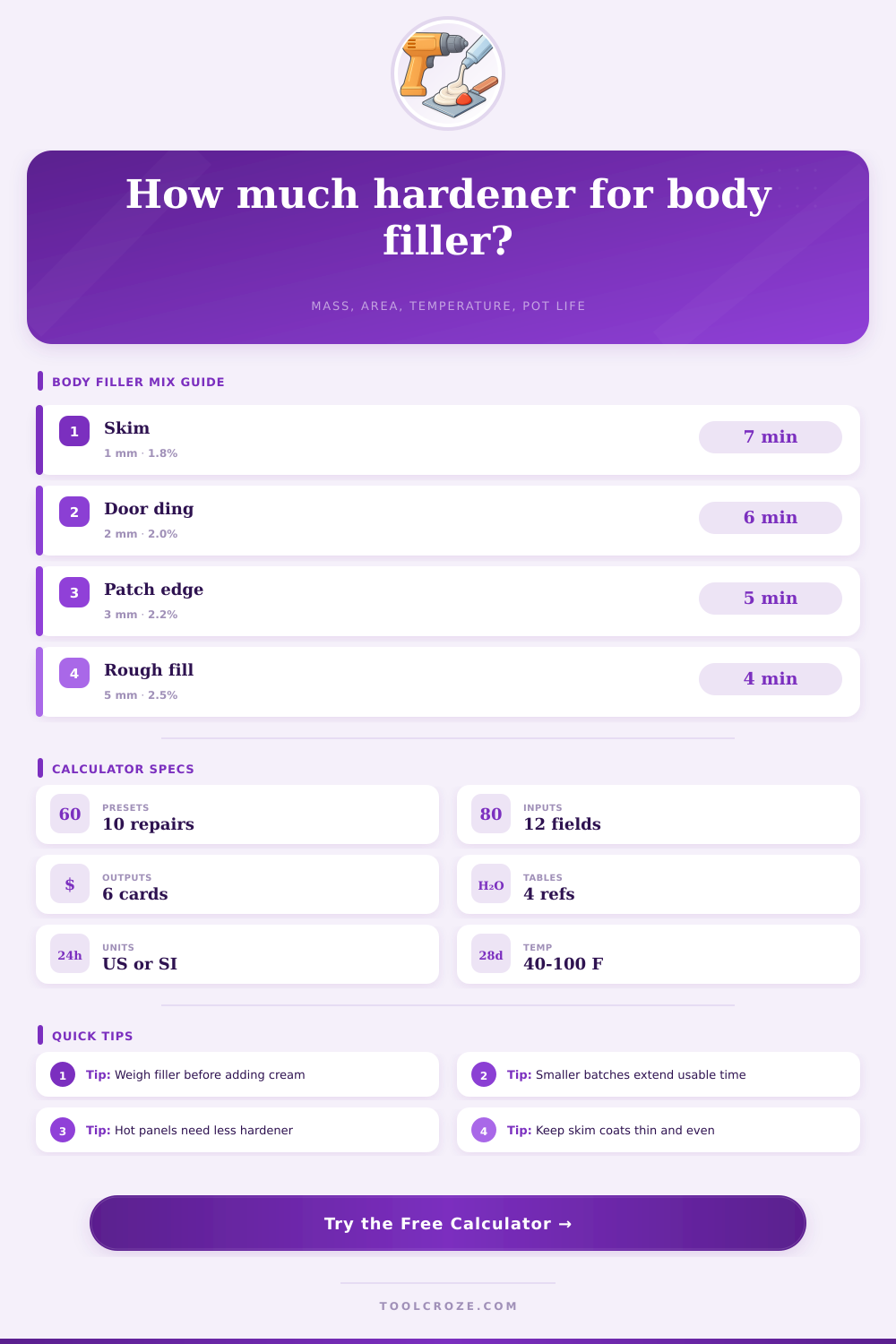
The calculator also take into account the temperature of the shop and the type of body filler you are using. The area of the panel and the thickness of the body filler will allow you to calculate the total volume of body filler you will need. The temperature in the shop will impact the chemical reaction of the body filler.
The type of body filler you use will change the density of the body filler and the percentage of hardener it contain. Many auto body shop will use a single percentage of hardener for every job. However, there may be problems with using a single percentage of hardener.
The temperature of the panel will cause body filler to harden at a more faster rate. Additionally, the bigger the area of the panel you need to repair, the longer it takes to spread the body filler. The calculator will adjust the number of minute you have to work with the body filler based on the temperature of the panel and the percentage of hardener.
This will show you if you should mix the body filler into several batch instead of one large batch of body filler. You should also include the waste allowance in the calculation of how much body filler to mix. The body filler that gets stuck to the mixing board and the spreader will be lost.
Additionally, some of the body filler will get feathered away when sanding the panel. The waste allowance will account for this lost body filler. If you leave the waste allowance at zero, the calculation will not show you the actual amount of body filler you need for the job.
The reference tables below the fields for entering the job information are essential to see how long body filler will remain workable. You dont need to memorize these tables, but they will show you if the percentage of hardener you plan to use is the right percentage for the job based on the temperature in the shop. For instance, if the tables show the workable life of the body filler at the shops temperature is four minutes, you can avoid mixing a batch of body filler that will harden too quick for your repair.
The temperature in the shop will change the amount of hardener you must add to the body filler. Body filler work best in an environment with a specific temperature. In cold conditions, the chemical reaction of the body filler will occur at a slow rate.
Thus, you will have to add a higher percentage of hardener to the body filler so that it will cure in a workable amount of time. In hot conditions, the chemical reaction of the body filler will happen at a faster rate. Hence, you will have to add less hardener to the body filler then you would at room temperature.
The calculator will account for the temperature of the shop, and it will also calculate the number of minutes you will have to work with the body filler once mixed. The number of batches of body filler you will mix is another factor in the body filler repair process. Mixing the body filler into one large batch can cause problems.
The first half of the batch will harden while you are still spreading the second half of the batch. The calculator will divide the total amount of body filler by the number of batches you will make. The calculator will also check to see if the time it takes to spread the body filler is shorter than the number of minutes you have to work with the body filler.
If the time to spread the body filler is shorter than the number of minutes you can work with the body filler, the calculator will flag this for you to decide whether to make more batches of body filler or to change the percentage of hardener in the body filler. The conditions for body filler in the auto body shop might not be as listed on the body filler container. For example, the panel may be cooler in the shade than the temperature of the shops air.
Additionally, the depth of the dent may be deeper in one part of the panel than the average depth of the dent measured on the panel. Finally, the brand of body filler you use on one job may not be the same as the brand for the next job. You can use the body filler calculator to work out the numbers for the job before you start mixing the body filler.
Using the calculator will save you time instead of guessing the ratio of body filler and hardener and fixing the problem once you start the job on the auto body shop vehicle. Use the body filler calculator to check your plan before you start the job. Enter the values for the job you are working on.
Look at the number of minutes you have to work with the body filler and the batch size suggestion. After you have entered and reviewed the job information, you can decide if mixing the body filler as you plan will work good for the job. Using the body filler calculator before you begin mixing the body filler can save you time and money sanding body filler that will not have hardened enough for a good repair.