Board Foot Weight Calculator
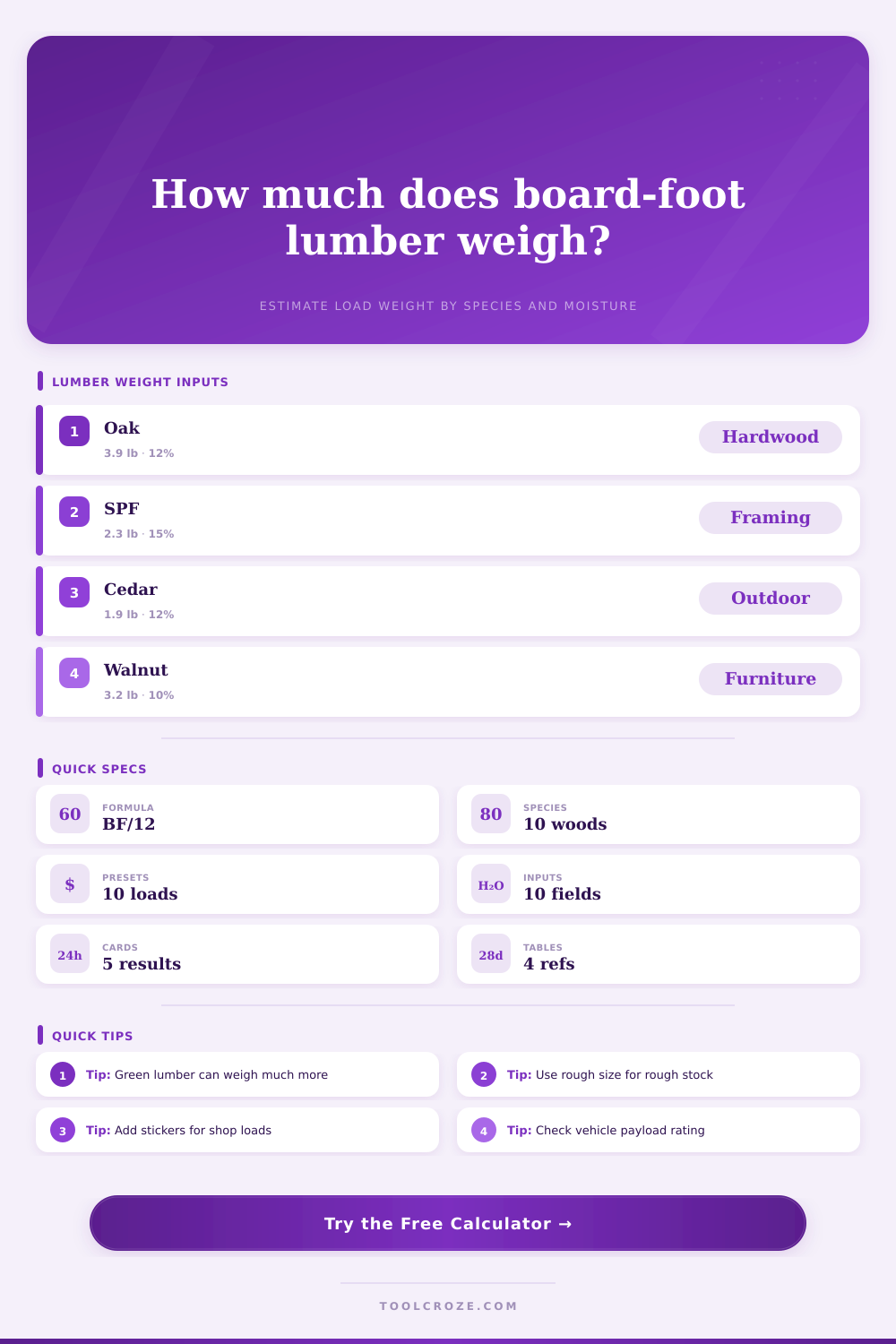
Estimate lumber load weight from board feet, piece dimensions, species density, moisture content, surfacing allowance, and handling extras.
| Species | Oven-dry density | Dry lb/BF | Typical use |
|---|---|---|---|
| Spruce-Pine-Fir | 26 lb/ft³ | 2.17 | Framing, studs, light rafters |
| Douglas fir-larch | 33 lb/ft³ | 2.75 | Beams, joists, structural stock |
| Southern yellow pine | 35 lb/ft³ | 2.92 | Deck framing, treated lumber |
| Western red cedar | 23 lb/ft³ | 1.92 | Decking, fencing, outdoor boards |
| White oak | 47 lb/ft³ | 3.92 | Heavy hardwood, slabs, joinery |
| Black cherry | 35 lb/ft³ | 2.92 | Tables, cabinets, millwork |
| Black walnut | 38 lb/ft³ | 3.17 | Furniture, casework, table stock |
| Moisture condition | MC input | Weight multiplier | Common situation |
|---|---|---|---|
| Oven dry reference | 0% | 1.00x | Density tables and lab basis |
| Indoor acclimated hardwood | 6-9% | 1.06-1.09x | Furniture shops and heated spaces |
| Air-dried shop stock | 12-15% | 1.12-1.15x | Covered lumber racks |
| Construction lumber | 15-19% | 1.15-1.19x | Kiln dried framing and deck orders |
| Fresh or green lumber | 30-80% | 1.30-1.80x | Sawmill slabs and wet timbers |
| Stock condition | Calculator factor | What it means | When to use |
|---|---|---|---|
| Nominal BF measured | 1.00x | Use the tally as entered | Invoice or rack tally already in BF |
| Rough sawn | 1.08x | Adds volume for oversize rough boards | Unplaned hardwood and mill stock |
| Surfaced S4S | 0.94x | Allows for material removed by planing | Finished boards sold by nominal size |
| Heavy rough slabs | 1.14x | Adds extra thickness and edge irregularity | Live-edge stacks and slab pallets |
| Planed thin stock | 0.88x | Reduces tally for thinner finished stock | Resawn or heavily milled boards |
| Load type | Typical tally | Likely moisture | Weight note |
|---|---|---|---|
| 2x4 SPF wall bundle | 110-160 BF | 15-19% | Often manageable on a pickup if payload allows |
| Cedar deck boards | 80-140 BF | 12-18% | Light species but wet boards add quickly |
| White oak slab stack | 90-180 BF | 20-45% | Dense hardwood can exceed shop carts |
| Douglas fir beams | 180-350 BF | 15-25% | Check trailer tongue and axle ratings |
| Walnut furniture pack | 40-100 BF | 7-12% | Piece count helps estimate handling weight |
| Spec choice | Weight effect | Accuracy effect | Best practice |
|---|---|---|---|
| Known board-foot tally | Direct volume input | Best when the tally is reliable | Use mill or invoice BF for mixed widths |
| Piece dimensions | Builds BF from size and count | Best for uniform boards | Measure actual length and thickness |
| Species density | Main driver of dry weight | Varies by growth region | Select the closest species group |
| Moisture percentage | Adds water weight | Largest uncertainty for green wood | Use a moisture meter when loading heavy stock |
| Surfacing factor | Adjusts effective volume | Improves rough versus S4S estimates | Choose the condition of the boards in hand |
You pick up a stack of white oak at the lumber yard; you grab it, lift it and boy, does it feel heavy! The heaviness isn’t imaginary; it’s physics. The oak is dense; it holds lots of water even when not soaking wet, so all that surrounding moisture add weight to the pile.
We count board feet as if they were money: this many board feet are good, those many board feet cost more then these. But a board foot of oak is much heavier than a board foot of balsa wood. Mass doesn’t correlate with volume. This is why we blow out tires, hurt our back, and wreck our shop floors.
Why Wood Weighs More Than You Think
After plugging in moisture and species into the calculator, it calculates all of the math for you, no need to convert and no need to worry about coefficients. It fills the gap. You plug in the number of board feet, choose the wood type, and it translates that into the cost per pound for that volume. It’s just a translating layer but one that most DIYers miss until they’re trying to lift the truck bed.
The variable is species. And that’s where the reference table spells it out for you. Lighter lumber is spruce-pine-fir (SPF) framing lumber. This stuff is built to move easy and stack high. Load up your truck with some studs and it will feel like you haven’t lifted anything at all.
Compare that to hard maple or black walnut. Those are hardwoods. They are tighter and have less air space in their cell structure. Less air space means more wood per cubic foot of lumber. And more wood equals more weight. Treat ’em all alike and you’ll be wrong. It ain’t no subtle difference either. It’s the difference between a maxed-out suspension vs. It is a casual haul.
There’s another multiplier to consider: moisture content. Wood absorbs moisture. It draws in water from the air, until reaching an equilibrium with its surroundings. A slab of green lumber straight off the sawmill can contain just as much water (in pounds) as there is actualy fiber in the wood. This is why it feels like a slab of concrete when wet.
And then it slowly dries out. All that water evaporates. Its weight decrease. The calculator updates accordingly. It uses the oven-dry density of your material and credits you for all the water you’re lugging around.
Buy some kiln dried stock for your furnitures? Lower weight. Pick up a truckload of green timber for your deck? You’re hauling water. And that water adds up quickly. You pay for it, lift it, ship it, only to have it dissapears into thin air later. It’s a tax on impatience.
So what happens when you get to surfacing? The math of volume changes. The large rough sawn boards contains more real wood. They contain more than just bark and windfall. They contain more than their nominal size would indicate. Four-sided planed boards have now been reduced in size. And the calculator takes that into account.
It either adds to, or subtracts from the number of board feet depending off the condition of the wood. This happens because the weight is calculated accurately. And if you don’t take that into account, you’re calculating the weight of a non-existent board. It is a ghost board.
The handling strategy depends on how many pieces there are. If it’s two big beams then fine. If it’s a hundred little strips…yuck! So how do you know what each lift will be like? How much does the average piece weigh? With that number, make a decision as to whether you should of used a winch, a helper or a cart.
Don’t rely on your arms to tell you about density. They lie. Wood’s density varies widely by geography and growth ring. A pine piece grown fast may actualy weigh less than one grown slow. The calculator provides a good average based on typical species information. It is not perfect, but it is much better than guessing.
Know Your Vehicle Payload: Be sure to know how much you are allowed to put in your truck on its own four tires. That’s payload, and it’s different than towing capacity. You will be surprised at just how fast you can max out a half ton truck with a pile of hardwoods when you include passengers, tools, etc. Don’t make this mistake.
Many folks purchase a truck based off towing capacity and overlook payload. This leads to dangerous driving conditions and drooping leaf springs. Know your limitations. Measure your load. Then check the math.
The catch? It is mostly about understanding exactly what we’re measuring. Wood doesn’t equal wood. Wood equals wood plus water plus volume error. If you want to know the truth about the load, look at the final weight number. That is what is actualy sitting on the rack. Respect that number. Lift with your legs, not your ego. Plan around that number.
The wood will always weigh more than you think it does.