Board Foot to Square Feet Calculator
Convert lumber volume into surface area, estimate coverage by thickness, and reverse the math for buying, planning, or quoting a layout.
Full breakdown
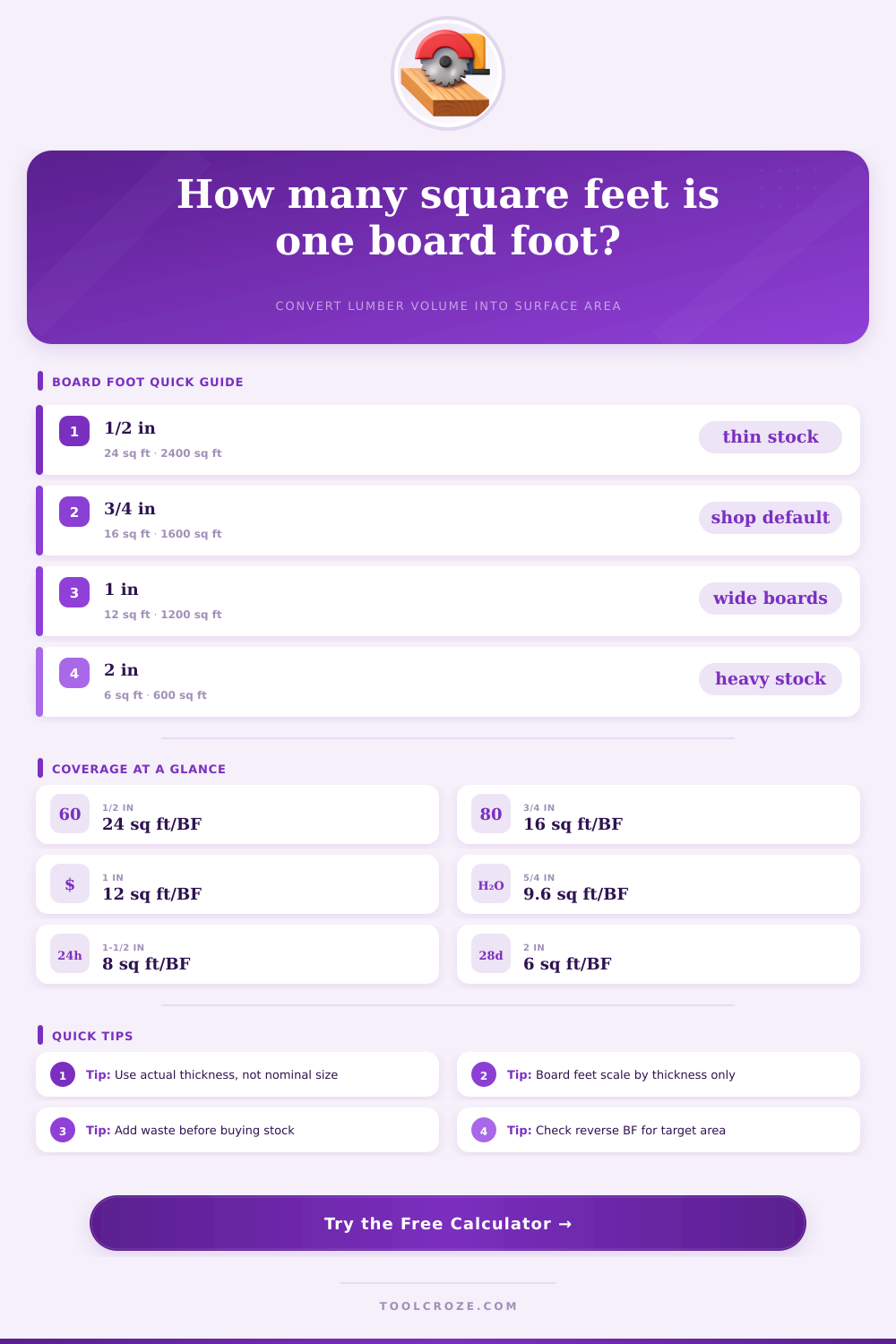
| Thickness | Sq ft/BF | BF per 100 sq ft | Use |
|---|
| Width | Linear ft/BF | 100 BF at 3/4 in | Note |
|---|
| Formula | Meaning | Use | Example |
|---|
| Stock | Thickness | 1 BF covers | Example use |
|---|
A board foot are a unit of measure for the volume of wood. A board foot isnt the same as a square foot of wood; a square foot measure the surface area of wood, while a board foot measure the volume of wood. The volume of wood that is purchased will tell you how much wood you has purchased; the surface area will tell you how much area that the wood will cover in your project.
One board foot is a piece of wood that is 12 inches in length, 12 inches in width, and 1 inch in thickness, which are equal to 144 cubic inches in volume. The thickness of the wood have a direct impact on the amount of surface area that one board foot can cover. The relationship between thickness and the area of wood that can be covered by one board foot is an inverse relationship; as the thickness of the wood increase, the area that can be covered by one board foot of wood will decrease.
Board Feet and How to Find the Area They Cover
For instance, one board foot of wood that is 0.5 inch in thickness will cover 24 square feet of area. However, one board foot of wood that is 1 inch in thickness will only cover 12 square feet of area. One board foot of wood that is 2 inches in thickness will only cover 6 square feet of area.
The thicker that the boards are, the more less area that they will cover by one board foot. It is also important to understand the difference between the nominal size and the actual size of the boards. Wood is often sold according to its nominal size; however, the actual size of the wood will be more smaller than the nominal size.
For instance, if the wood is labeled as a 1×12 board, the actual thickness of the wood may only be 0.75 inches. Thus, instead of using the nominal thickness of 1 inch in calculations regarding the area that the wood will cover, you should use the actual thickness of 0.75 inches. If the calculations use the incorrect thickness, the calculations will be incorrect regarding the amount of wood that will be required for a project.
In addition to calculating the amount of wood that will be required for a project based off the thickness of the wood, it is also important to account for the amount of wood that may be wasted in the project. Waste results from the cutting of the boards to the required sizes for a project, as well as from the natural defect in the wood. People typically allow for 10% to 15% for waste; however, 20% may be required if the project is more intricate or if exotic wood is to be used.
If waste is not account for in the determination of the total amount of wood that will be needed for a project, it is possible that the wood will run out before the project is complete. The formula that can be used to calculate the amount of square footage that will be covered by the wood that is measured in board feet is: the number of board feet multiplied by 12 will provide the total square inches that will be covered by the wood. That total can then be divide by the thickness of the wood in inches to calculate the total square footage that will be covered.
For instance, if there are 48 board feet of wood, and the thickness of the wood is 0.75 inches, 48 multiplied by 12 is 576. 576 divided by 0.75 is 768 square inches. 768 divided by 144 (the number of square inches in 1 square foot) is 5.33 square feet. Thus, 48 board feet of 0.75 inch thick wood will cover 5.33 square feet.
Alternatively, the thickness of the wood can be used to calculate how many square feet will be covered by one board foot of that type of wood; that number can then be multiplied by the number of board feet of that type of wood that you will purchase. The thickness of the wood impact the project in relation to both the budget that must be allotted for the wood purchase and the utility of the boards. If the budget for the project is limited, it is possible to use thinner boards to cover the area of the project; the smaller thickness will allow more area to be covered by the same amount of wood (board feet).
However, the thinner the boards, the more fragile the wood may be. Thicker wood will be more durable, but will cover less area per board foot of wood; thus, the budget will have to be higher if thicker wood is select. In summary, the measurements of volume will determine how much wood will be purchased, while the measurements of surface area will determine how much area the wood will cover.
The actual thickness of the boards must be use in any calculations of the woods coverage of the project area. Any waste of the wood must also be account for in calculating the total amount of wood that will be required for a project. Through understanding the relationship between the various measurements of wood, both in relation to board feet, thickness, and square feet, it is possible to ensure that the amount of wood needed for any project will be purchased.