Board Foot Log Calculator
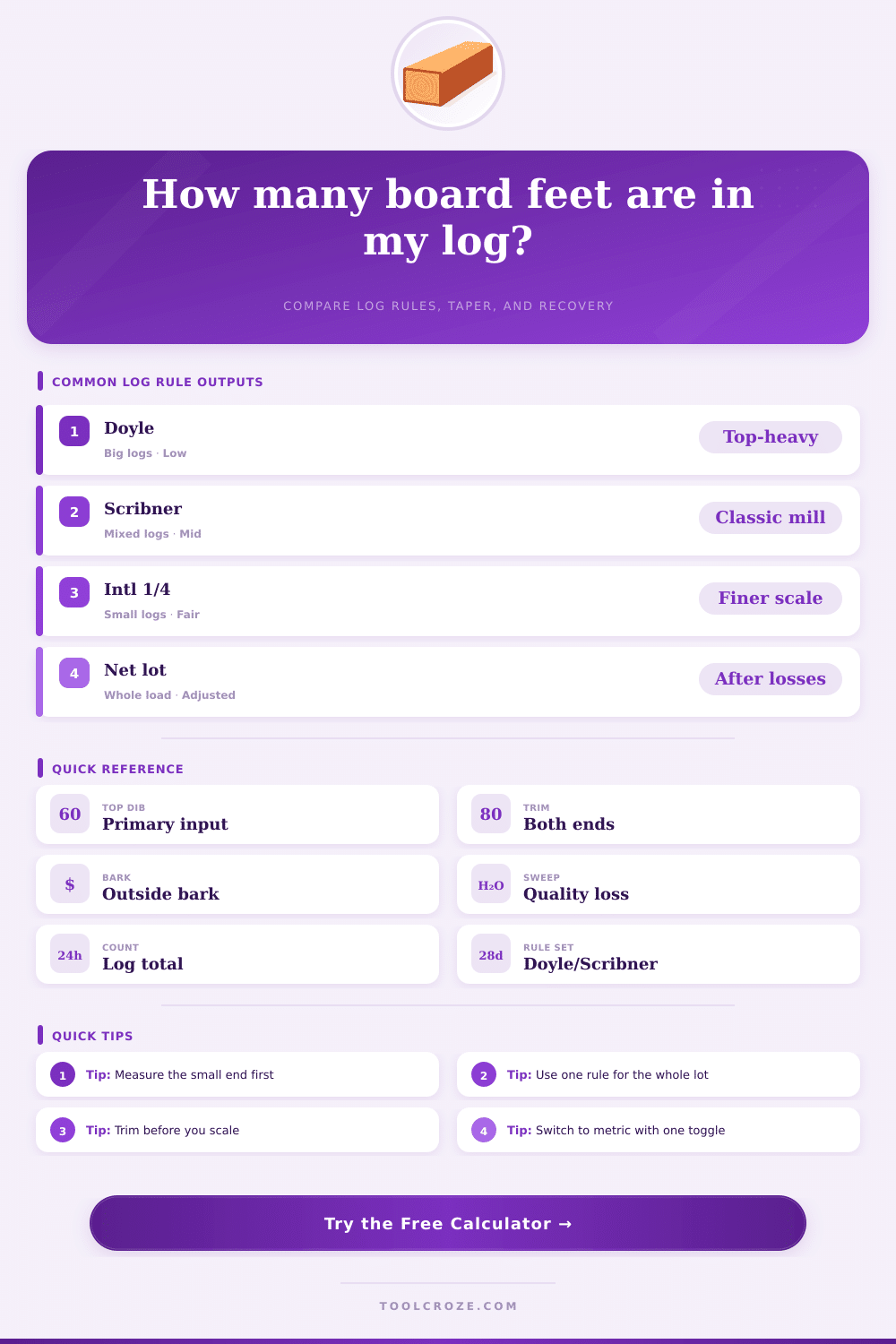
Estimate log board feet with Doyle, Scribner, or International 1/4-inch scaling, then apply trim, bark, sweep, and recovery factors to your lot.
📍Preset log scenarios
🔧Log inputs
📊Results
Full breakdown
🧱Species and log specs
📈Log rule comparison
| Rule | Formula shape | Bias | Best fit |
|---|---|---|---|
| Doyle | ((D - 4)^2 x L) / 16 | Low on small logs | Rough sawlog check |
| Scribner | (0.79D^2 - 2D - 4) x L/16 | Middle ground | Common mill estimate |
| Intl 1/4 | (0.22D^2 - 0.71D - 1) x L/8 | Closer on smaller logs | Finer scale option |
| Net lot | Gross x loss factors | Recovery only | Use after trim |
📈Common log sizes
| Log size | Doyle | Scribner | Intl 1/4 |
|---|---|---|---|
| 10 in x 8 ft | 18 BF | 28 BF | 14 BF |
| 14 in x 16 ft | 100 BF | 123 BF | 64 BF |
| 16 in x 16 ft | 144 BF | 166 BF | 88 BF |
| 20 in x 20 ft | 256 BF | 316 BF | 180 BF |
📈Loss and recovery guide
| Condition | Sweep loss | Defect loss | Mill note |
|---|---|---|---|
| Straight, clear | 0-3% | 0-4% | Use as baseline |
| Mild sweep | 4-7% | 5-8% | Farm or yard logs |
| Visible knots | 8-12% | 8-15% | Utility stems |
| Crooked / short | 13-20% | 15-30% | Stay conservative |
📈Metric to imperial guide
| Metric input | Imperial equivalent | Use | Note |
|---|---|---|---|
| 250 mm | 9.8 in | Top DIB | Round to tenths |
| 350 mm | 13.8 in | Butt DIB | Compare spread |
| 5.0 m | 16.4 ft | Log length | Trim first |
| 25 mm | 1.0 in | Bark thickness | Only if DOB |
💡Tips and safety
A board foot is a unit for lumber. It equals one square foot of wood that is one inch thick. A slice of wood exactly 1 foot long, 1 foot wide, and 1 inch thick is a board-foot.
Because it is about volume, the shape does not matter. For example, a piece 6 inches wide, 24 inches long and 1 inch thick is one board foot. It is the most used measure for volume of trees and logs for lumber and veneer
What is a Board Foot and How to Measure It
Log board feet show how many usable lumber you can get from a log. You count it by multiplying the diameter and length of the log by a scaling factor. The board-foot volume of a tree or log shows how many board-feet of lumber you can cut from it.
Log rules try to estimate the number of board-feet in a log, but it is harder than you thnik, because the width of the kerf varies by saw.
To estimate board-feet of logs, you measure the average diameter of the small part in inches. Later you measure the length of the log in feet. Lay the marker of the scale on the spot where those two values meet, and here you find the board-foot amount for those logs.
A board foot log rule calculator estimates the yield of board-feet from any logs using Doyle or Scribner rules, or the International log rule with 1/4 inch or 1/8 inch kerf. In them you enter diameter and length, compare results between different rules and even move them to a CSV file.
For board-feet of some bit of lumber you multiply length, width and thickness. Everything in inches, and divide by 144 cubic inches. For instance, a board of 18 inches by 5 inches by 13/16 inches gives around 0.5 board feet.
One way to estimate board-feet of a standing tree is to keep good notes about yield of many logs of the same diameter and straightness.
Buying or selling logs, precise rating of board-feet matters. Use a tape measure for basic dimensions. Always check the volume with an expert sawyer, mill or forestry professional before buying logs, pricing lumber or deciding about production.
Occasionally logs scale in the mill less than you expect, and the buyer must clearly explain the reason. Boards usually have less than four inches of thickness, while thick bits are called beams. Some portable mill operators go to the logs and mill them to particular specifications for around 0.50 dollars perboard foot.