
The steel within make all the difference: Why does one cost twenty bucks, while another is eighty and yet another clocks in at two-hundred? The steel inside explain why some last longer without an edge roll, others withstand being dropped onto concrete, and still others won’t turn orange if left in your sink.
There are no right answers. Blade steel is all about tradeoffs. No single alloy will give you everything. Instead, it’s about understanding what the various steels offer and how they balance four key properties against each other. When you put a knife to use, every sharp edge are a compromise between holding its edge and regaining it as it blunts.
How to Choose the Right Steel for You
Budget steels is forgiving, which is why most people begin here. 8Cr13MoV and 420HC are popular entry level steels. While they won’t retain a hair-shaving sharpness for extended periods of hard use, it’s super easy to re-sharpen. A couple swipes on your ceramic rod while waiting for dinner and you’ve got the burr gone. Don’t underestimate how nice that is when you’re first learning to maintain knives.
Higher-end steels like 1095 high carbon steel offer amazing edge holding power, toughness, and more, but they also needs respect. If you soak it in the sink and don’t immediately dry it off, you’d better say hello to some corrosion. Bushcraft folks embrace this because they often expect their blade to be used for chipping and prying at stuff. Casual users aren’t bothered by that as much, so they would rather avoid the risk of blade corrosion then have a really good knife.
The middle range is where most are hitting sweet spot. A strong balance between edge holding properties and corrosion resistance comes from steels such as 440C and VG-10. VG-10, in particular, gets used a lot in Japanese kitchen knives. It holds an edge well, and keeps that edge longer than softer steels.
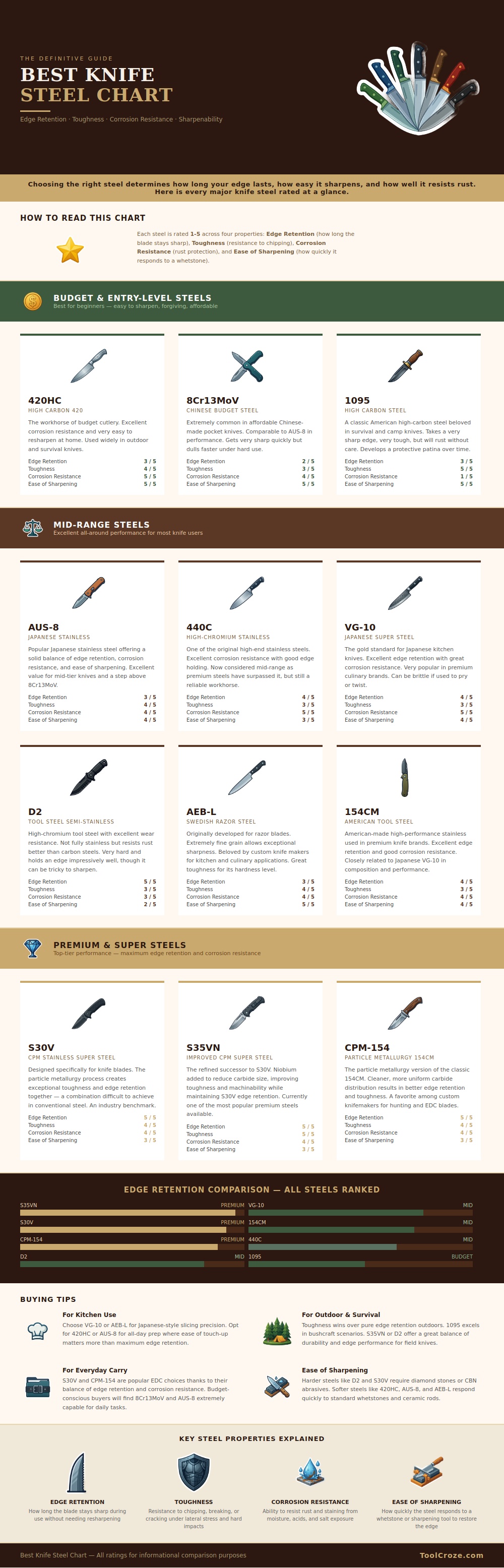
Is it indestructible? No. Twist the knife trying to pop a can open, and yes, it may chip. That’s the mistake people make regarding hard steel. Sure, hardness equals wear resistance. But it can also mean low toughness. You’ll see the opposite relationship shown on the chart. High scores in edge retention tend to drops down on the toughness side.
Powder metallurgy can do that with premium super steels such as S30V and S35VN. Powder metallurgy lets steel makers load up their metal with more chromium and carbon without making it brittle. You get a stainless steel blade that performs nearly as well as high-carbon blades for resisting wear but retains moisture much better.
S35VN takes this a step further by refining its carbide structure. This increases toughness while retaining that famous edge retention. It’s very pricey to machine out, thus a luxurius knife. But in tough conditions where you don’t have time to stop and sharpen hourly, they delivers consistently.
Ultimately, selecting your steel is as simple as asking yourself: What am I going to use it for? Do you need an everyman kitchen knife to get through daily prep tasks with a minimum of fuss and maximum rust-free durability? A middle-of-the-road stainless is your guy. It is easy to care for and good enough for 90% of us at home. Are you planning an apocalypse scenario where strength trumps sharpness? In this case you’ll be whacking things like knots in wood and bone, so you want something that won’t chip and break if it’s used for more than slicing cheese.
The infograph lists each priority next to one another, making it easy to see that there isn’t simply “the” best steel, but rather the best steel for the task at hand. Last, reflect on how willing you are to maintain it. Premium powders take longer to sharpen, but will stay sharp for a very long time. Easier steels will respond well to just rubbing them against something. If you don’t care about top-of-the-line performance as much as low-effort upkeep, go with softer, easy-to-sharpen steels. But if you’re willing to spend more money initially, and care about not having to re-sharpen often, go with harder (denser) steels like D2 that should of need aggressive abrasives/diamond stones to get them back up to snuff.
Basically, make sure you choose a steel based off your life style, so that you have a good blade that stays sharp and doesn’t turn into a delicate ornament you fear breaking all the time. Knowing what the steel emphasizes makes choosing an alloy intuitive. It is no longer about finding the best.
