Bend Radius Sheet Metal Calculator
Calculate inside bend radius, bend allowance, bend deduction, flat blank length, V-die opening, springback, relief size, and press brake tonnage.
📌Shop presets
⚙Bend setup
Calculation breakdown
📊Material and tooling grid
📐Reference tables
| Material | Typical inside radius | K-factor range | Notes |
|---|---|---|---|
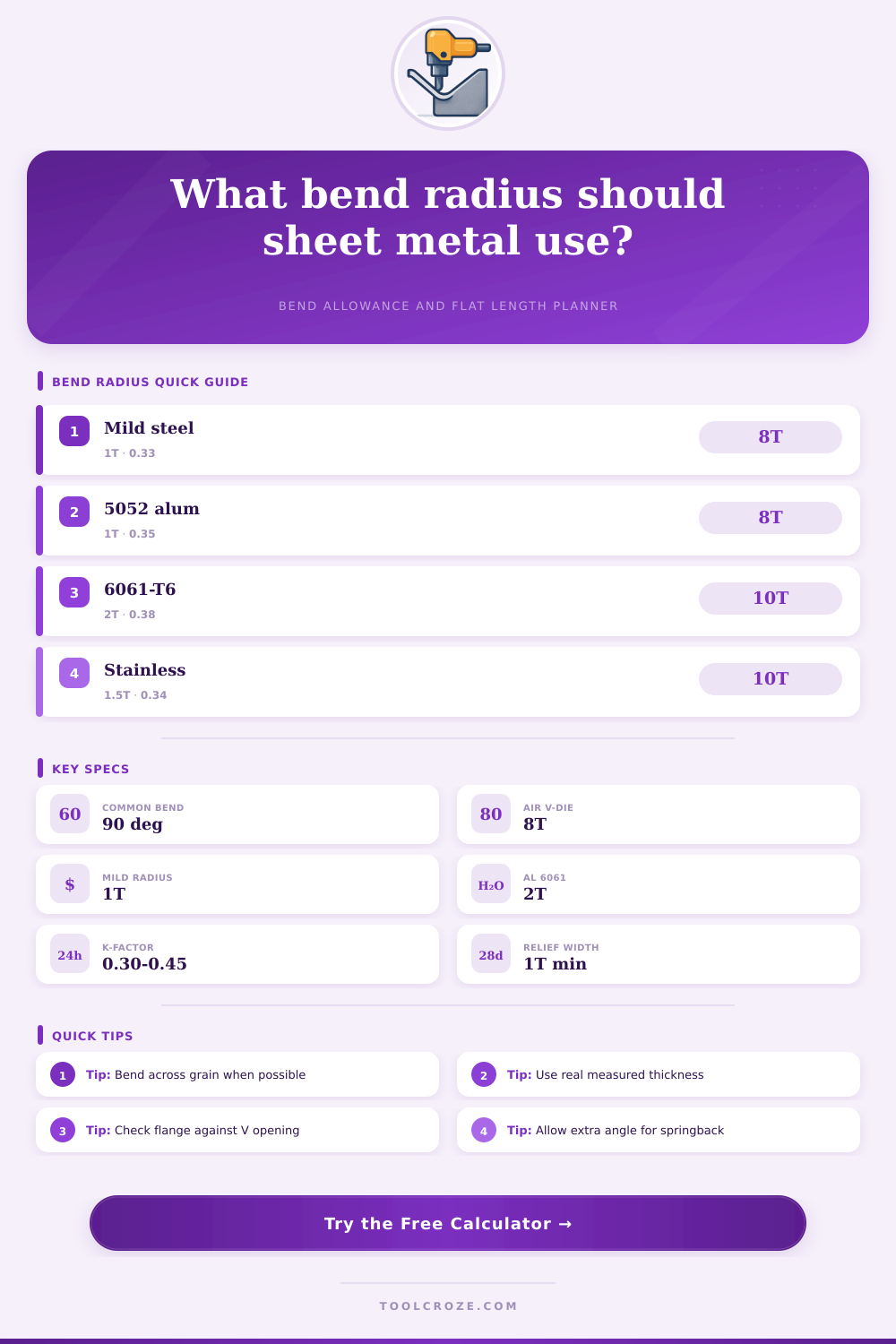
| Mild steel, cold rolled | 0.8T to 1.0T | 0.30 to 0.36 | Good baseline for air bending and bottom bending. |
| 304 stainless steel | 1.5T to 2.0T | 0.32 to 0.40 | Higher springback and higher press load than mild steel. |
| Aluminum 5052-H32 | 1.0T to 1.5T | 0.33 to 0.42 | Common sheet grade for tight formed brackets and boxes. |
| Aluminum 6061-T6 | 2.0T to 4.0T | 0.36 to 0.45 | Use generous radius; tight bends can crack. |
| Copper and cartridge brass | 0.5T to 1.0T | 0.32 to 0.40 | Ductile, but finish marks and grain direction still matter. |
| Titanium grade 2 | 2.0T to 3.0T | 0.36 to 0.44 | Plan for strong springback and conservative tooling. |
| Thickness range | Air-bend V opening | Minimum flange guide | Use case |
|---|---|---|---|
| 0.020 to 0.040 in | 6T to 8T | V/2 + R | Small covers, light clips, duct transitions. |
| 0.050 to 0.125 in | 8T to 10T | V/2 + R + T | Brackets, panels, enclosures, trays. |
| 0.188 to 0.250 in | 10T to 12T | 0.55V + R + T | Base plates, machine guards, heavy supports. |
| Large radius forming | 12T or more | Confirm with tooling | Rolled guards, sweep bends, radius covers. |
| Bend setup | Formula used | When it matters | Shop check |
|---|---|---|---|
| Bend allowance | Angle rad × (R + K × T) | Flat pattern arc length through the neutral axis. | Test coupon if finish dimensions are critical. |
| Outside setback | tan(angle / 2) × (R + T) | Used to connect outside leg dimensions to the bend zone. | Verify the virtual sharp on acute and open bends. |
| Bend deduction | 2 × setback - allowance | Subtract from outside legs for flat blank layout. | Use the same convention across drawings and CAM. |
| Press tonnage | 575 × T² / V, adjusted by tensile ratio | Air-bending load estimate for a 60 ksi mild steel baseline. | Never exceed press, tooling, or die ratings. |
| Preset scenario | Material | Typical thickness | Reasonable starting radius |
|---|---|---|---|
| Light enclosure flange | 5052 aluminum | 0.063 in | 0.063 to 0.094 in |
| Shop angle bracket | Mild steel | 0.075 to 0.125 in | 1T inside radius |
| Food-safe cover panel | 304 stainless | 0.060 to 0.075 in | 1.5T inside radius |
| 6061 structural tab | 6061-T6 aluminum | 0.090 to 0.188 in | 2T to 4T inside radius |
💡Calculation tips
A simple flat pattern of a sheet metal part isn’t just two straight lines meeting at an angle. It’s a mathematical puzzle in which one side compresses the metal while the other stretches it outward. In between is some kind of unchanging neutral axis that no one ever sees. Get this centerline wrong and your flange might be too short, or your bracket could be too snug. That’s the complicated mathematics the calculator above will do for you to calculate both deduction and bend allowance, sparing you trigonometry each time you require an exact blank length.
Most of the drama in bending happens because materials has memory. It tries to return to its original shape if you have forced a sheet into an angle. Titanium and stainless steel are particulary prone to this and tend to need several degrees overbent before they’ll settle down into a ninety degree final bend. The tool accounts for this springback but real world conditions is always more variable then one can account for with any given coefficient.
Why You Need to Test Your Sheet Metal First
Grain direction is really significant here. Bending across the grain usually results in tighter radii without as much cracking. This is because the way sheet was rolled causes the crystal structure to resist splitting in different ways. That stuff is small but when you’re pushing a material to the edge it starts to be pretty important.
How hard it is depends on the inside radius. For instance, the tighter the radius, the more difficult it will be to do and the more likely it is to crack (particularly with harder metals such as 6061 aluminum). You can see this clearly in the reference table on the page. It indicates that mild steel bend better into tighter radii compared to stainless, which require more space to bend without breaking. In other words, if you go with a smaller radius than what is right for the thickness, then you’re not using physics to work in your favor; you’re fighting against it. Using the calculator, you can confirm whether or not the radius you’ve selected makes sense based off both thickness and ductility of your material. It’ll alert you before you set foot near the press brake.
The other number to pay attention to is tonnage. No, not that kind; I mean on your press brake. You only gets so many tons out of a press brake before they bend the tool instead of sheet metal. It takes much less tonnage to air bend than it does to coin or even bottom bend. In coining or bottom bending, the entire sheet must be forced into die walls, whereas in air bending, it is supported by the V-die over a greater arc. Your tool will estimate how many tons it thinks you need according to material strength and the width of your V-opening. Always add a margin to this value in the tank. This safety buffer protects your tooling and prevents surprise overload trips.
This brings us to flange length. Many newer fabricators gets caught up here. If you use a bend radius and V-die opening that is too large for the flange length, you get an awkward punch angle. This can cause either die interference or inconsistent angles. To avoid this, the minimum flanges in the results section will keep you out of trouble by giving you plenty of material for the tools to do their job properly. You can’t form a clean angle from a piece of metal not wide enough for your tools.
To conclude. There is nothing like a test coupon. Get a real piece of sheet metal from your actual lot, run it through on your own tooling and check the flat length and springback before ordering any quantity. Sheet metal changes with grain flow, heat treatment and even temperature in your own shop. Take these numbers as the beginning and not the end of your calculations. Once you figure out how the material, thickness, and radius work together, the math turns into intuition. Then you are engineering instead of guessing.